90% Of People Fail This Simple Math Trap Are You Smarter than him?
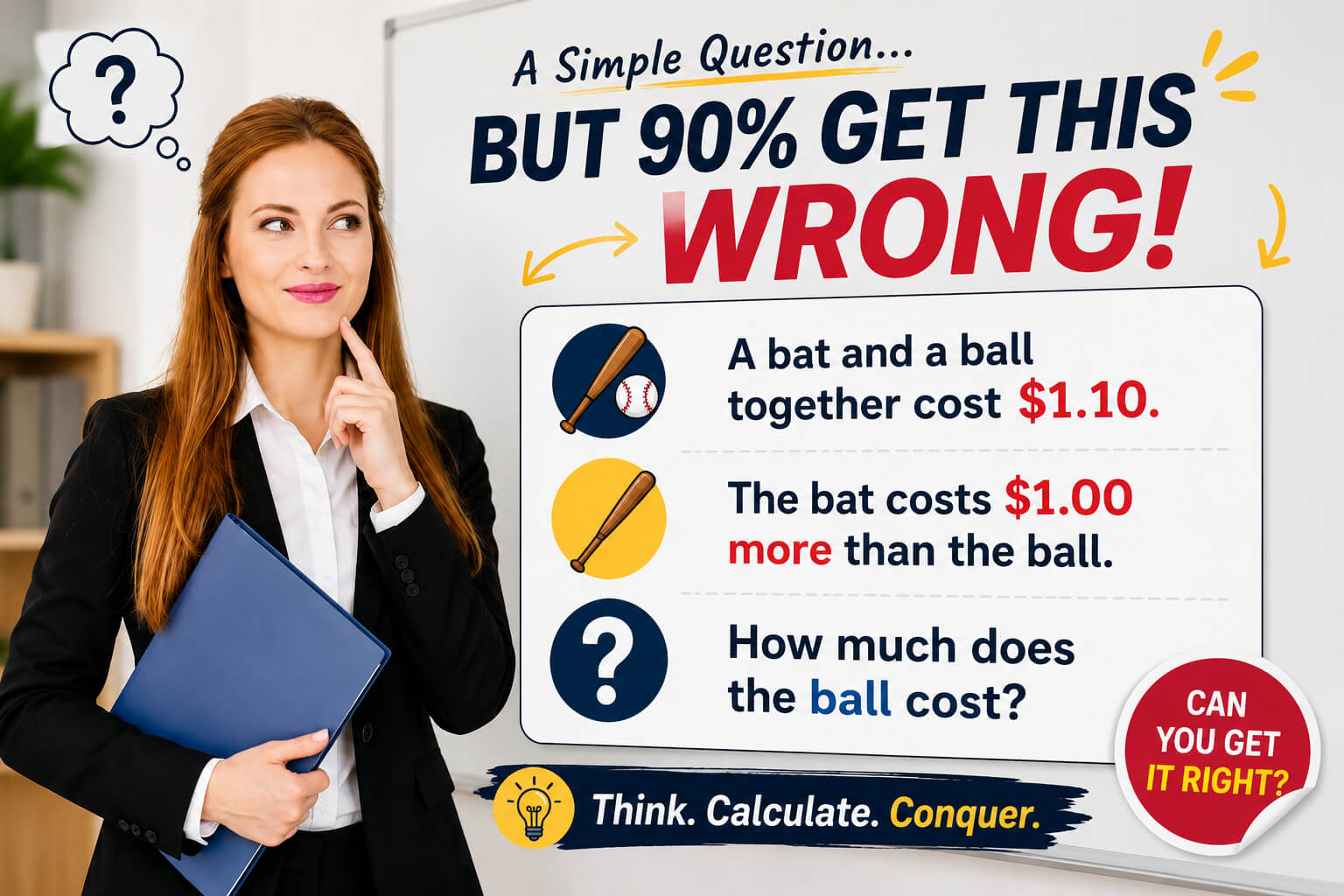
Stop getting tricked by easy-looking problems! This ultimate resource challenges your brain with 24 viral math puzzles that fool 90% of adults. Master tricky algebra formulas, bypass core order-of-operations traps, and eliminate fractions instantly using smart mental shortcuts. Do not skip a single page solve every single question step-by-step to test your raw logical reasoning and claim your genius score!
- 1. The Bat and Ball Riddle
- 2. Solve \(\frac{x}{2} + \frac{x}{5} = 9\)
- 3. Solve \(y^3 + y^3 + y^3 = 81\)
- 4. Solve \(a^2 = 25, ab = 50\)
- 5. Solve \(3a^2 = 75, ab = 90\)
- 6. Solve \(4x^2 = 64\)
- 7. Solve \(2x^2 + 5x - 3 = 0\)
- 8. Solve \(\frac{x}{3} + \frac{x}{6} = 4\)
- 9. Solve \(2a^2 = 50, ab = 30\)
- 10. Solve \(x^2 - 7x + 12 = 0\)
- 11. Solve \(x + y = 1, x - y = 0\)
- 12. Solve \(5x^2 + 10x - 15 = 0\)
- 13. Double Me & Add 10
- 14. Solve \(a+b=50, a-b=50\)
- 15. Solve \(6 + 6 \times 6 \times 0\)
- 16. Radical Equation System
- 17. Solve \(9 \div 3 \times (2+1)\)
- 18. Solve \(65\%\) of \(580\)
- 19. Solve \(2x + 1 = 5 - 6x\)
- 20. Solve \(5 \times 8 - 9 + 7\)
- 21. Solve \(5 \times 5 - 5 + 5 \div 5\)
- 22. Solve \(\frac{x+8}{x} = 2\)
- 23. Solve \(2^{23} + 2^{23}\)
- 24. Main Rational Equation
Finding tricky math questions and answers that actually explain things like a friend can be tough. Most algebra textbooks use dry, robotic terms that make simple topics feel like mountain-climbing. This guide changes that. We will cover various math quizzes, test your cognitive biases, and teach you how to solve rational equations step by step using everyday logic and textbook-grade illustrations.
Our focus is on helping you understand the real mechanics behind the numbers. Instead of just showing one static method, we provide multiple pathways—including direct algebraic equations, mental visual block tools, and logical deduction hacks—to help you build true math fluency.
1. The Famous Bat and Ball Riddle
The bat costs $1.00 more than the ball.
How much does the ball cost?
Method 1 – Strict Algebra (Systematic Way)
Let us write this down as equations. This is the ultimate method to find the viral bat and ball riddle solution.
Equation 1 (Total Cost): \[x + y = 1.10\]Equation 2 (Price Difference): \[y = x + 1.00\]
Method 2 – The Logic Shift Hack
Why does almost everyone say 10 cents ($0.10) initially? This is because our brain uses fast mental shortcuts. We automatically split $1.10 into $1.00 and 10 cents. But think about it: if the ball is 10 cents, and the bat is $1.00 more, the bat costs $1.10, making the total $1.20! That fails our rule. By forcing our logical thinking, we see that:
- If ball = \(5\) cents ($0.05)
- And bat = \(1\) dollar more = $1.05
- Total = $1.05 + $0.05 = $1.10! It matches perfectly.
2. Solve \(\frac{x}{2} + \frac{x}{5} = 9\)
Method 1 – Multiply by the LCM (Clearing Denominators)
Method 2 – Converting to a Common Denominator
3. Solve \(y^3 + y^3 + y^3 = 81\)
Find \(y = ?\)
Method 1 – Combine Like Terms
Method 2 – Factoring Out the Common Factor
4. Solve \(a^2 = 25\) and \(ab = 50\)
\[ab = 50\]
Find \(b^2 = ?\)
Method 1 – Square Root and Divide
From the first equation, we get \(a = \pm 5\). Put this into the second equation: If \(a = 5\), then \(5b = 50 \implies b = 10\). If \(a = -5\), then \(-5b = 50 \implies b = -10\). Squaring either value gives \[b^2 = (\pm 10)^2 = 100\]
Method 2 – Direct Square Division
Square the equation \(ab = 50\) to get \(a^2 b^2 = 2500\). Divide this expression by the first equation (\(a^2 = 25\)): \[\frac{a^2 b^2}{a^2} = \frac{2500}{25} \implies b^2 = 100\]
5. Solve \(3a^2 = 75\) and \(ab = 90\)
\[ab = 90\]
Find \(b^2 = ?\)
Method 1 – Step-by-Step Substitution
If \(a = 5\), then \(5b = 90 \implies b = 18\).
If \(a = -5\), then \(-5b = 90 \implies b = -18\).
Method 2 – The Square Product Shortcut
6. Solve \(4x^2 = 64\)
Method 1 – Division First
Divide both sides of the equation by \(4\): \[x^2 = 16\] Take the square root of both sides to get: \[x = \pm 4\]
Method 2 – Difference of Squares
Bring all terms to one side: \(4x^2 - 64 = 0\). Factor out the common \(4\): \[4(x^2 - 16) = 0 \implies 4(x - 4)(x + 4) = 0\] This gives us the solutions \[x = 4 \quad \text{or} \quad x = -4\]
7. Solve \(2x^2 + 5x - 3 = 0\)
Method 1 – Factorization by Splitting the Middle Term
Method 2 – The Quadratic Formula
8. Solve \(\frac{x}{3} + \frac{x}{6} = 4\)
Method 1 – Clear Denominators (Multiply by LCM)
The LCM of the denominators \(3\) and \(6\) is \(6\). Multiply the entire equation by \(6\): \[6 \cdot \left(\frac{x}{3}\right) + 6 \cdot \left(\frac{x}{6}\right) = 6 \cdot 4\] This simplifies to: \[2x + x = 24 \implies 3x = 24 \implies x = 8\]
Method 2 – Create Equal Denominators
Convert the first term to have a denominator of \(6\): \[\frac{2x}{6} + \frac{x}{6} = 4 \implies \frac{3x}{6} = 4\] Simplify the fraction: \[\frac{x}{2} = 4 \implies x = 8\]
9. Solve \(2a^2 = 50\) and \(ab = 30\)
\[ab = 30\]
Find \(b^2 = ?\)
Method 1 – Solve Separately
Divide the first equation by \(2\): \(a^2 = 25 \implies a = \pm 5\). Put this into the product equation: If \(a = 5\), then \(5b = 30 \implies b = 6\). If \(a = -5\), then \(-5b = 30 \implies b = -6\). Squaring gives us \[b^2 = (\pm 6)^2 = 36\]
Method 2 – Algebra Formula
Square the product equation to get \(a^2 b^2 = 900\). We know \(a^2 = 25\) from simplifying the first equation. Divide by \(25\): \[b^2 = \frac{900}{25} = 36\]
10. Solve \(x^2 - 7x + 12 = 0\)
Method 1 – Factorization
Find two numbers that multiply to \(12\) and add up to \(-7\). These numbers are \(-3\) and \(-4\). Rewrite as a factored product: \[(x - 3)(x - 4) = 0\] This directly tells us that \[x = 3 \quad \text{or} \quad x = 4\]
Method 2 – Using the Quadratic Formula
Identify parameters: \(a=1, b=-7, c=12\). Put them into the formula: \[x = \frac{-(-7) \pm \sqrt{(-7)^2 - 4(1)(12)}}{2(1)} \implies x = \frac{7 \pm \sqrt{49 - 48}}{2}\] Simplify further: \[x = \frac{7 \pm 1}{2} \implies x = 4 \quad \text{or} \quad x = 3\]
11. Solve \(x + y = 1\) and \(x - y = 0\)
\[x - y = 0\]
Find \(x \times y = ?\)
Method 1 – Elimination
12. Solve \(5x^2 + 10x - 15 = 0\)
Method 1 – Simplify First
Divide the entire equation by \(5\) to simplify the coefficients: \[x^2 + 2x - 3 = 0\] Find two numbers that multiply to \(-3\) and add up to \(2\). These are \(3\) and \(-1\): \[(x + 3)(x - 1) = 0 \implies x = -3 \quad \text{or} \quad x = 1\]
Method 2 – Standard Quadratic Formula
Using \(a=5, b=10, c=-15\): \[x = \frac{-10 \pm \sqrt{100 - 4(5)(-15)}}{10} \implies x = \frac{-10 \pm \sqrt{400}}{10}\] This simplifies to: \[x = \frac{-10 \pm 20}{10} \implies x = 1 \quad \text{or} \quad x = -3\]
13. Double Me and Add 10
Method 1 – Reverse Operations
14. Solve \(a+b=50\) and \(a-b=50\)
\[a - b = 50\]
Find \(\frac{3ab}{a} = ?\)
Method 1 – Algebraic Simplification
Cancel variable \(a\) from the numerator and denominator: \[\frac{3ab}{a} = 3b\] Subtract the second equation from the first: \[(a+b) - (a-b) = 50-50 \implies 2b = 0 \implies b = 0\] Substitute \(b=0\) into the simplified expression: \[3b = 3(0) = 0\]
15. Solve \(6 + 6 \times 6 \times 0\)
Method 1 – Priority Rules
Solve multiplication before addition: \[6 \times 6 \times 0 = 0\] Add the remaining numbers together: \[6 + 0 = 6\]
16. Radical Equation System
\[x + yx + y = 9\]
Method 1 – Substitution
17. Solve \(9 \div 3 \times (2 + 1)\)
Method 1 – Left to Right Priority
Resolve brackets first: \[2+1 = 3\] Write out the new expression: \[9 \div 3 \times 3\] Solve from left to right: \[9 \div 3 = 3 \implies 3 \times 3 = 9\]
18. Solve \(65\%\) of \(580\)
Method 1 – Break Down Parts
Separate \(65\%\) into \(50\% + 10\% + 5\%\):
\(50\%\) of \(580 = 290\)
\(10\%\) of \(580 = 58\)
\(5\%\) of \(580 = 29\)
Sum the pieces: \[290 + 58 + 29 = 377\]
19. Solve \(2x + 1 = 5 - 6x\)
Method 1 – Direct Linear Separation
Add \(6x\) to both sides: \[8x + 1 = 5\] Subtract \(1\) from both sides: \[8x = 4 \implies x = \frac{4}{8} = 0.5\]
20. Solve \(5 \times 8 - 9 + 7\)
Method 1 – DMAS Rule
Multiply first: \[5 \times 8 = 40\] Subtract and add from left to right: \[40 - 9 + 7 = 31 + 7 = 38\]
21. Solve \(5 \times 5 - 5 + 5 \div 5\)
Method 1 – Order of Operations
Solve multiplication and division first: \[5 \times 5 = 25\] \[5 \div 5 = 1\] Solve addition and subtraction from left to right: \[25 - 5 + 1 = 20 + 1 = 21\]
22. Solve \(\frac{x + 8}{x} = 2\)
Method 1 – Cross Multiplication
Multiply both sides by \(x\) to remove fractions: \[x + 8 = 2x\] Subtract \(x\) from both sides: \[8 = x \implies x = 8\]
23. Solve \(2^{23} + 2^{23}\)
Method 1 – Factorization
Factor out the base expression: \[2^{23}(1+1) = 2^{23} \cdot 2^1 = 2^{24}\] Match options: \[8^8 = (2^3)^8 = 2^{24}\]
24. Main Rational Equation
This is our featured algebra example. It is a brilliant practice problem because it shows you exactly how to solve rational equations step by step by clearing denominators, managing quadratic expressions, and identifying mathematical traps.
If you want to read deeper into individual steps, check out our in-depth study session on how to solve rational equations step by step which provides further visual exercises.
Before you do any multiplication, look at the original denominators. They must not equal zero:
\(x - 2 \neq 0 \implies x \neq 2\)
\(x + 3 \neq 0 \implies x \neq -3\)
Keep these restrictions in mind. If your final calculated solution turns out to be \(2\) or \(-3\), it is invalid (called an extraneous root) and must be discarded.
Method 1 – Multiplying by the Common Denominator (Most Efficient)
This is the standard approach taught in high school and college algebra classes. For more help with this setup, visit the Khan Academy's Rational Equations Chapter.
For the first term, \((x-2)\) cancels, leaving: \[x(x+3)\]
For the second term, \((x+3)\) cancels, leaving: \[2(x-2)\]
For the right side, the entire denominator cancels, leaving: \[7\]
Our simplified equation is:
Method 2 – Combining Terms into a Single Fraction
This method teaches you how to construct algebraic fractions before removing the denominators.
Method 3 – Numerical Approximation & Verification Check
Let us verify our algebraic answers using numerical approximations to confirm they are correct.
Using a calculator, we know that \(\sqrt{69} \approx 8.3066\). Let us calculate the two roots:
First Root: \[x \approx \frac{-5 + 8.3066}{2} \approx 1.6533\]Let us plug \(x \approx 1.6533\) back into the original equation:
Left Side: \[\frac{1.6533}{1.6533 - 2} + \frac{2}{1.6533 + 3} \approx \frac{1.6533}{-0.3467} + \frac{2}{4.6533} \approx -4.7687 + 0.4298 \approx -4.3389\]
Right Side: \[\frac{7}{(1.6533 - 2)(1.6533 + 3)} \approx \frac{7}{(-0.3467)(4.6533)} \approx \frac{7}{-1.6132} \approx -4.3392\]The values match perfectly within rounding margins.
Second Root: \[x \approx \frac{-5 - 8.3066}{2} \approx -6.6533\]A similar calculation confirms the second root is also completely valid.
Mastering Rational Equations: Your Simple Blueprint
Now that you have seen how to solve various puzzles, let us write down a foolproof method to handle any rational algebraic equation. Whether you are doing homework or studying for competitive exams, follow this simple checklist to secure full marks:
4-Step Algebra Checklist
Great job. You have cracked all 24 tricky algebra questions and mastered rational equations today. Just keep these smart patterns and quick mental shortcuts in mind, and you will smash your next math test or exam paper easily. Keep practicing and happy learning.

 Skasif


Do you think you have mastered these math riddles? Let us find out! Solve these 5 practice questions and comment your answer below. Let us see who gets all 5 right!