Physics Questions With Answers: The Only Practice Set You Need
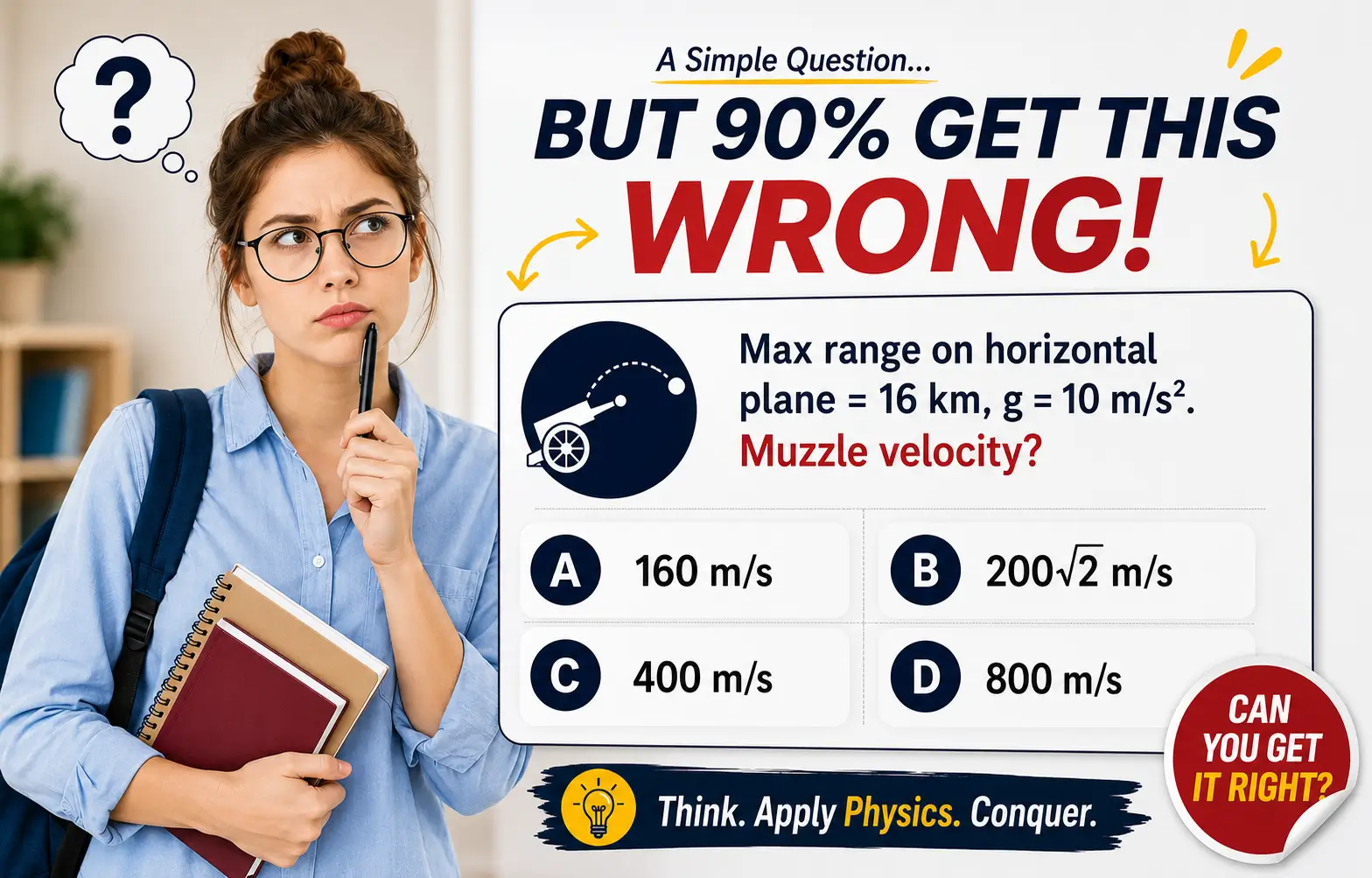
Mastering standard physics questions with answers is the single most effective way to transition from passive rote-learning to active, high-level structural problem-solving. This interactive guide compiles 50 fully interactive competitive-level multiple-choice questions, 15 complete conceptual breakdowns, and 20 comprehensive long-answer university-style practice questions.
Whether you are currently reviewing classical mechanics, circuit theory, or wave packet optics, breaking down variables step-by-step solidifies your physical intuition. If you want to expand your scientific analysis across related fields, try answering these essential logical science questions to evaluate your general IQ. For planning your daily revisions, utilizing optimized productivity planning prompts can make your study intervals much more structured.
Recent advances show that modern artificial intelligence architectures are successfully navigating advanced mathematical proofs; read about how complex scientific papers are analyzed by neural reasoning models on arXiv. If you are aiming for high-speed calculation accuracy under strict timing limits, practicing on our free national online test simulators is highly recommended.
physics mcq with answers (50 High-Yield Questions)
Test your knowledge with these 50 multiple-choice questions modeled directly on the latest board and entrance exams. Select an option to see if you are correct. A correct pick triggers a confetti celebration!
Quiz Performance Analysis
Answer all 50 questions to see your feedback!
important physics questions for exam
This section provides detailed breakdowns of 15 essential conceptual and numerical physics problems, highlighting how to identify correct options, math logic, common student mistakes, and strategic exam tips.
1. Kinematics — Integrating Acceleration-Time Functions
Core Concept: Acceleration is defined mathematically as the first derivative of velocity with respect to time (\(a = \frac{dv}{dt}\)). Therefore, to find velocity, we must integrate acceleration: \(dv = a \, dt \implies \Delta v = \int a(t) \, dt\).
Step-by-Step Logic: When acceleration decreases linearly from \(a_0\) at \(t = 0\) to zero at \(t_0\), we can construct its linear function as:
\[a(t) = a_0 \left(1 - \frac{t}{t_0}\right)\]Integrating this expression yields the velocity function:
\[v(t) - v_0 = \int_0^t a_0 \left(1 - \frac{t}{t_0}\right) dt = a_0 \left[ t - \frac{t^2}{2t_0} \right]_0^t\]For an object starting from rest (\(v_0 = 0\)), its maximum velocity occurs when acceleration drops to zero at \(t = t_0\):
\[v_{max} = a_0 \left(t_0 - \frac{t_0^2}{2t_0}\right) = \frac{1}{2}a_0 t_0\]Common Student Mistake: Many students try to use uniform acceleration formulas like \(v = u + at\) directly. This is mathematically invalid because the acceleration varies over time. Always use integration when acceleration is a function of time!
2. Projectile Motion — Deriving Maximum Range
Core Concept: A projectile's range \(R\) is the total horizontal distance it travels before returning to its launch height. The motion is governed by gravity acting vertically while horizontal speed remains constant (neglecting air resistance).
Step-by-Step Logic: The horizontal range is given by:
\[R = \frac{u^2 \sin(2\theta)}{g}\]To maximize this range for a given launch speed \(u\), the term \(\sin(2\theta)\) must reach its maximum possible value of \(1\):
\[\sin(2\theta) = 1 \implies 2\theta = 90^\circ \implies \theta = 45^\circ\]Under this optimal condition, the range formula simplifies to:
\[R_{max} = \frac{u^2}{g} \implies u = \sqrt{R_{max} \cdot g}\]Substituting \(R_{max} = 16000\text{ m}\) (converted from \(16\text{ km}\)) and \(g = 10\text{ m/s}^2\):
\[u = \sqrt{16000 \cdot 10} = \sqrt{160000} = 400\text{ m/s}\]Common Student Mistake: A common mistake is failing to convert the range from kilometers to meters. Substituting \(16\) instead of \(16,000\) yields an incorrect, non-SI value.
3. Circular Motion — Friction as a Centripetal Force
Core Concept: For an object to move in a circular path, a net force must pull it toward the center of curvature. On a flat rotating disk, this centripetal force is provided entirely by static friction between the object and the surface.
Step-by-Step Logic: The maximum force of static friction is given by \(f_{s,max} = \mu_s mg\). The required centripetal force to keep an object of mass \(m\) moving in a circle of radius \(r\) at angular velocity \(\omega\) is \(F_c = m\omega^2 r\). The object will stay in place without slipping as long as:
\[m\omega^2 r \le \mu_s mg \implies r \le \frac{\mu_s g}{\omega^2}\]This reveals an inverse-square relationship between the slipping radius and angular velocity: \(r \propto \frac{1}{\omega^2}\). If the angular velocity is tripled (\(\omega_2 = 3\omega_1\)):
\[\frac{r_2}{r_1} = \left(\frac{\omega_1}{\omega_2}\right)^2 = \left(\frac{1}{3}\right)^2 = \frac{1}{9} \implies r_2 = \frac{9\text{ cm}}{9} = 1\text{ cm}\]Common Student Mistake: Many students mistakenly assume a direct linear inverse relationship, concluding that tripling the angular velocity will reduce the radius to one-third (\(3\text{ cm}\)), rather than one-ninth (\(1\text{ cm}\n\)).
4. Gravitation — Gravity at Depth vs Altitude
Core Concept: The acceleration due to gravity varies depending on your location. It decreases both as you ascend above Earth's surface and as you descend below it.
Step-by-Step Logic: The acceleration due to gravity \(g_d\) at a depth \(d\) below the surface of Earth is given by the linear relationship:
\[g_d = g \left(1 - \frac{d}{R}\right)\]To find the depth where gravity is exactly half of its surface value (\(g_d = 0.5g\)):
\[0.5g = g \left(1 - \frac{d}{R}\right) \implies 0.5 = 1 - \frac{d}{R} \implies \frac{d}{R} = 0.5 \implies d = \frac{R}{2}\]Common Student Mistake: Students often confuse the depth formula with the altitude formula, \(g_h \approx g \left(1 - \frac{2h}{R}\right)\). While the altitude formula is a quadratic approximation valid only near the surface, the depth formula is exact and linear throughout the Earth's interior (assuming uniform density).
5. Modern Physics — Einstein's Photoelectric Equation
Core Concept: Light consists of discrete packets of energy called photons. When a photon strikes a metallic surface, its energy \(h\nu\) is divided: part of it overcomes the metallic work function \(\phi\), and any remaining energy is converted into the kinetic energy of the emitted electron.
Step-by-Step Logic: This energy balance is expressed by Einstein's photoelectric equation:
\[h\nu = \phi + K_{max} \implies K_{max} = h\nu - \phi\]Substituting the photon energy \(h\nu = 4.2\text{ eV}\) and the work function \(\phi = 3.0\text{ eV}\):
\[K_{max} = 4.2\text{ eV} - 3.0\text{ eV} = 1.2\text{ eV}\]Common Student Mistake: If the incident photon energy is less than the work function (\(h\nu < \phi\)), no photoelectrons are emitted at all. Students must always compare these values first before performing calculations, as a negative kinetic energy is physically impossible.
6. Current Electricity — Wire Deformation and Resistance Scaling
Core Concept: The electrical resistance of a uniform conductor depends on its physical dimensions: \(R = \rho \frac{L}{A}\), where \(\rho\) is resistivity, \(L\) is length, and \(A\) is cross-sectional area.
Step-by-Step Logic: Stretching a wire changes its shape but preserves its total volume \(V\):
\[V = A \cdot L = \text{constant}\]If the wire is stretched to \(n\) times its original length (\(L' = n L\)), its cross-sectional area must decrease by the same factor (\(A' = A / n\)) to keep the volume constant. The new resistance \(R'\) is:
\[R' = \rho \frac{L'}{A'} = \rho \frac{n L}{A / n} = n^2 \left(\rho \frac{L}{A}\right) = n^2 R\]For a wire stretched to three times its length (\(n = 3\)):
\[R' = 3^2 R = 9R\]Common Student Mistake: A common error is considering only the change in length while ignoring the corresponding decrease in area, leading to an incorrect result of \(3R\) instead of \(9R\).
7. Wave Optics — Double-Slit Refractive Index Scaling
Core Concept: The spacing of interference fringes in a Young's double-slit experiment depends on the wavelength of light: \(\beta = \frac{\lambda D}{d}\), where \(D\) is the distance to the screen and \(d\) is the slit separation.
Step-by-Step Logic: When the apparatus is immersed in a medium with a refractive index \(n\), the speed of light decreases, causing the wavelength to shrink: \(\lambda_{medium} = \frac{\lambda_{vacuum}}{n}\). Consequently, the fringe width \(\beta\) scales by the same factor:
\[\beta' = \frac{\beta}{n}\]Substituting the initial fringe width \(\beta = 2.0\text{ mm}\) and the refractive index of water \(n = 4/3\):
\[\beta' = \frac{2.0\text{ mm}}{4/3} = 1.5\text{ mm}\]Common Student Mistake: Some students multiply the fringe width by the refractive index instead of dividing, resulting in an incorrect, expanded fringe width of \(2.67\text{ mm}\).
8. Electrostatics — Potential Field of Conducting Shells
Core Concept: For any hollow charged conductor in electrostatic equilibrium, the electric field inside is zero (\(E_{in} = 0\)). Because the field is the negative gradient of potential (\(E = -\frac{dV}{dr}\)), a zero electric field means the electric potential is constant throughout the interior.
Step-by-Step Logic: The potential at any point inside the sphere is exactly equal to its value at the surface:
\[V_{inside} = V_{surface} = \frac{1;}{4\pi\varepsilon_0} \frac{Q}{R}\]Since the surface potential is \(100\text{ V}\), the potential remains \(100\text{ V}\) at all interior points, including the center.
Common Student Mistake: Many students confuse electric field and electric potential. They know that the electric field inside a hollow shell is zero, and they mistakenly assume the potential must also be zero. Always remember: a zero field means constant potential, not zero potential!
9. Fluids — Capillary Action and Jurin's Law
Core Concept: Capillary action is the rise of a liquid inside a thin tube due to adhesive and cohesive forces. The equilibrium height of the liquid column is governed by Jurin's Law.
Step-by-Step Logic: Jurin's Law states that the height \(h\) to which a liquid rises is given by:
\[h = \frac{2T \cos\theta}{\rho g r}\]This reveals that the height is inversely proportional to the tube's internal radius: \(h \propto \frac{1}{r}\). If the radius is doubled (\(r' = 2r\)), the liquid will rise to half of its original height:
\[h' = \frac{h}{2}\]Common Student Mistake: It is easy to confuse inverse proportionality with direct proportionality, leading to the incorrect assumption that a wider tube will produce a higher water column.
10. Thermodynamics — Work Done during Isothermal Expansion
Core Concept: An isothermal process occurs at a constant temperature (\(\Delta T = 0\)). For an ideal gas, the pressure varies with volume according to \(P = \frac{nRT}{V}\).
Step-by-Step Logic: The work done \(W\) during volume expansion is found by integrating pressure over volume:
\[W = \int_{V_1}^{V_2} P \, dV = \int_{V_1}^{V_2} \frac{nRT}{V} dV\]Since temperature \(T\) is constant, we can pull \(nRT\) out of the integral:
\[W = nRT \int_{V_1}^{V_2} \frac{1}{V} dV = nRT \big[ \ln V \big]_{V_1}^{V_2} = nRT \ln\left(\frac{V_2}{V_1}\right)\]Common Student Mistake: Students often try to use the constant-pressure formula \(W = P\Delta V\). This is incorrect because the pressure drops as the gas expands isothermally. Always use the logarithmic integration formula for isothermal work.
11. Current Electricity — Parallel Conductance Reciprocals
Core Concept: When resistors are connected in parallel, the total current divides among them. The equivalent resistance \(R_{eq}\) of a parallel combination is always less than the smallest individual resistance.
Step-by-Step Logic: Calculate using the reciprocal sum formula:
\[\frac{1}{R_{eq}} = \frac{1}{R_1} + \frac{1}{R_2} + \frac{1}{R_3}\]Substituting \(R_1 = 3\ \Omega\), \(R_2 = 6\ \Omega\), and \(R_3 = 12\ \Omega\):
\[\frac{1}{R_{eq}} = \frac{1}{3} + \frac{1}{6} + \frac{1}{12} = \frac{4 + 2 + 1}{12} = \frac{7}{12}\]Taking the reciprocal yields the equivalent resistance:
\[R_{eq} = \frac{12}{7} \approx 1.71\ \Omega\]Common Student Mistake: A common mathematical error is forgetting to take the reciprocal at the end of the calculation, leaving the answer as \(\frac{7}{12}\ \Omega\) instead of \(\frac{12}{7}\ \Omega\).
12. Induction — Lenz's Law and Conservation of Energy
Core Concept: Lenz's Law states that the direction of an induced current always opposes the change in magnetic flux that created it. This opposition is a physical necessity to satisfy the conservation of energy.
Step-by-Step Logic: Consider pushing a bar magnet toward a conducting loop. The induced current creates a magnetic field that repels the incoming magnet. You must perform mechanical work to overcome this repulsion.
This mechanical work is converted directly into the electrical energy of the induced current. If the induced current instead attracted the magnet, the magnet would accelerate on its own, gaining kinetic energy while generating electrical energy—violating the First Law of Thermodynamics.
Common Student Mistake: Students often view Lenz's Law as a rule to memorize rather than understanding it as a physical requirement of energy conservation. Remembering this physical connection makes the law intuitive.
13. Magnetic Fields — Solenoid Scaling Parameters
Core Concept: The magnetic field \(B\) inside an ideal solenoid depends on the turn density \(n\) (number of turns per unit length) and the current \(I\).
Step-by-Step Logic: The magnetic field is given by:
\[B = \mu_0 n I = \mu_0 \left(\frac{N}{L}\right) I\]This shows that for a constant current \(I\) and total turns \(N\), the field is inversely proportional to the solenoid's length: \(B \propto \frac{1}{L}\). If the length is doubled (\(L' = 2L\)):
\[B' = \mu_0 \left(\frac{N}{2L}\right) I = \frac{B}{2}\]The magnetic field is halved.
Common Student Mistake: Students often memorize the formula as \(B = \mu_0 n I\) without remembering that \(n = N/L\). This can lead them to assume the field remains unchanged if the total turns are constant.
14. Optics — Combining Thin Lenses in Contact
Core Concept: The power \(P\) of a lens is the reciprocal of its focal length in meters: \(P = \frac{1}{f}\). Convex (converging) lenses have positive powers, while concave (diverging) lenses have negative powers.
Step-by-Step Logic: When thin lenses are in contact, their total optical power is the algebraic sum of their individual powers:
\[P_{total} = P_1 + P_2 = \frac{1}{f_1} + \frac{1}{f_2}\]Convert the focal lengths to meters: \(f_1 = +0.20\text{ m}\) and \(f_2 = -0.25\text{ m}\). Calculate the individual powers:
\[P_1 = \frac{1}{0.20} = +5\text{ D}, \quad P_2 = \frac{1}{-0.25} = -4\text{ D}\]Sum the powers to find the total power of the combination:
\[P_{total} = +5\text{ D} + (-4\text{ D}) = +1\text{ D}\]Common Student Mistake: A frequent mistake is failing to convert focal lengths from centimeters to meters before calculating power, or ignoring the negative sign for diverging lenses.
15. Waves — Wave Speed on Stretched Strings
Core Concept: The speed \(v\) of a transverse wave traveling along a stretched string depends on its tension \(T\) and its linear mass density \(\mu\) (mass per unit length).
Step-by-Step Logic: The wave speed is given by:
\[v = \sqrt{\frac{T}{\mu}} \implies v \propto \sqrt{T}\]If the tension is increased by \(44\%\) (\(T' = 1.44T\)), the new speed \(v'\) is:
\[v' = \sqrt{\frac{1.44T}{\mu}} = 1.2 \sqrt{\frac{T}{\mu}} = 1.2v\]An increase factor of \(1.2\) corresponds to a \(20\%\) increase in wave speed.
Common Student Mistake: It is common to forget the square root in the relation, which leads to the incorrect assumption that speed increases linearly with tension (resulting in a \(44\%\) increase rather than the correct \(20\%\n\)).
class 12 physics questions with answers
This section contains 20 descriptive questions and answers designed to help you prepare for subjective, board, and university-level examinations.
1. Gravitation — Kepler's Laws and Newton's Universal Law of Gravitation
Question: State Kepler's Three Laws of Planetary Motion. Show how Newton used Kepler's Third Law to derive his Universal Law of Gravitation.
Comprehensive Answer:
Part A: Kepler's Laws of Planetary Motion
- The Law of Ellipses (First Law): Every planet moves in an elliptical orbit with the Sun located at one of the two foci of the ellipse.
- The Law of Areas (Second Law): A line segment joining a planet and the Sun sweeps out equal areas during equal intervals of time. This is a direct consequence of the conservation of angular momentum.
- The Law of Periods (Third Law): The square of a planet's orbital period \(T\) is directly proportional to the cube of the semi-major axis \(a\) of its orbit: \(T^2 \propto a^3\).
Part B: Newton's Derivation
Consider a planet of mass \(m\) moving in a circular orbit of radius \(r\) around the Sun of mass \(M\), with a constant speed \(v\). The centripetal force holding the planet in its orbit is provided by the gravitational attraction of the Sun:
\[F = \frac{mv^2}{r}\]The speed \(v\) of the planet is related to its orbital period \(T\) by:
\[v = \frac{2\pi r}{T} \implies v^2 = \frac{4\pi^2 r^2}{T^2}\]Substitute \(v^2\) back into the centripetal force equation:
\[F = \frac{m}{r} \left(\frac{4\pi^2 r^2}{T^2}\right) = \frac{4\pi^2 m r}{T^2}\]According to Kepler's Third Law for circular orbits, \(T^2 = k r^3\), where \(k\) is a constant of proportionality. Substituting this into the force equation:
\[F = \frac{4\pi^2 m r}{k r^3} = \left(\frac{4\pi^2}{k}\right) \frac{m}{r^2}\]By Newton's Third Law of Motion, this force of attraction must be mutual, meaning it is also proportional to the mass of the Sun \(M\). Therefore, the constant term must contain \(M\), leading to Newton's Universal Law of Gravitation:
\[F = G \frac{M m}{r^2}\]Where \(G = \frac{4\pi^2}{k M}\) is the Universal Gravitational Constant, valued at \(6.674 \times 10^{-11}\text{ N}\cdot\text{m}^2/\text{kg}^2\).
2. Electrostatics — Gauss's Law and Field of a Charged Shell
Question: State Gauss's Law in electrostatics. Use it to derive the electric field strength produced by a thin, uniformly charged spherical shell at points outside and inside the shell.
Comprehensive Answer:
Gauss's Law Statement: The net electric flux \(\Phi_E\) through any closed surface is equal to the net enclosed electric charge \(q_{enclosed}\) divided by the permittivity of free space \(\varepsilon_0\):
\[\Phi_E = \oint \vec{E} \cdot d\vec{A} = \frac{q_{enclosed}}{\varepsilon_0}\]Derivation for a Spherical Shell of Radius \(R\) and Charge \(Q\):
Case 1: At a Point Outside the Shell (\(r > R\))
Construct a concentric spherical Gaussian surface of radius \(r\) surrounding the shell. By spherical symmetry, the electric field \(\vec{E}\) points radially outward and has a constant magnitude at all points on this surface.
\[\oint \vec{E} \cdot d\vec{A} = E \oint dA = E \cdot (4\pi r^2)\]Since the Gaussian surface encloses the entire charge \(Q\), Gauss's Law states:
\[E \cdot (4\pi r^2) = \frac{Q}{\varepsilon_0} \implies E = \frac{1}{4\pi\varepsilon_0} \frac{Q}{r^2}\]This shows that at points outside the shell, the electric field behaves as if the entire charge \(Q\) were concentrated at its center.
Case 2: At a Point Inside the Shell (\(r < R\))
Construct a concentric spherical Gaussian surface of radius \(r\) inside the shell. Since all the charge resides on the outer surface of the shell, the enclosed charge is zero:
\[q_{enclosed} = 0\]Applying Gauss's Law:
\[E \cdot (4\pi r^2) = 0 \implies E = 0\]The electric field is zero at all points inside a uniformly charged conducting spherical shell.
3. Magnetism — Field on the Axis of a Circular Loop
Question: State the Biot-Savart Law. Derive the mathematical expression for the magnetic field at a point on the axis of a circular current-carrying conductor loop.
Comprehensive Answer:
Biot-Savart Law Statement: The magnetic field \(d\vec{B}\) produced by an infinitesimal current element \(I d\vec{l}\) at a point located at position vector \(\vec{r}\) is:
\[d\vec{B} = \frac{\mu_0}{4\pi} \frac{I (d\vec{l} \times \hat{r})}{r^2}\]Derivation for a Loop of Radius \(R\) carrying Current \(I\):
Consider a circular loop of radius \(R\) lying in the y-z plane, with its center at the origin. We want to find the magnetic field at point \(P\) on the x-axis, located a distance \(x\) from the center.
Let \(r = \sqrt{R^2 + x^2}\) be the distance from a current element \(I d\vec{l}\) at the top of the loop to point \(P\). The field element \(d\vec{B}\) produced by this element is perpendicular to the vector \(\vec{r}\), making an angle \(\theta\) with the axial line.
We can resolve \(d\vec{B}\) into axial components (\(dB \sin\alpha\)) and perpendicular components (\(dB \cos\alpha\)). When we integrate around the loop, the perpendicular components cancel out due to symmetry, while the axial components add together:
\[B = \int dB \sin\alpha\]The magnitude of \(d\vec{B}\) from the Biot-Savart Law is:
\[dB = \frac{\mu_0}{4\pi} \frac{I \, dl}{r^2}\]From the geometry of the system, \(\sin\alpha = \frac{R}{r}\). Substitute this into our integral:
\[B = \int \left( \frac{\mu_0}{4\pi} \frac{I \, dl}{r^2} \right) \frac{R}{r} = \frac{\mu_0 I R}{4\pi r^3} \int dl\]The integral \(\int dl\) is simply the circumference of the loop, \(2\pi R\):
\[B = \frac{\mu_0 I R}{4\pi r^3} (2\pi R) = \frac{\mu_0 I R^2}{2 r^3}\]Substitute \(r = (R^2 + x^2)^{1/2}\) back into the equation to get the final expression:
\[B = \frac{\mu_0 I R^2}{2(R^2 + x^2)^{3/2}}\]4. Electromagnetic Induction — Faraday's Laws and Motional EMF
Question: State Faraday's Laws of Electromagnetic Induction. Derive the formula for motional EMF induced across a conductor of length \(L\) moving perpendicular to a uniform magnetic field \(B\) at speed \(v\).
Comprehensive Answer:
Faraday's Laws of Electromagnetic Induction:
- First Law: An electromotive force (EMF) is induced in a conductor whenever the magnetic flux linking through it changes over time.
- Second Law: The magnitude of this induced EMF is directly proportional to the rate of change of the magnetic flux: \[e = - \frac{d\Phi_B}{dt}\]
Derivation of Motional EMF:
Consider a straight conducting rod of length \(L\) sliding at a constant velocity \(v\) along a U-shaped frictionless conducting track. This track is placed in a uniform magnetic field \(\vec{B}\) pointing perpendicularly into the page.
The area of the closed loop formed by the rod and the track is \(A = L \cdot x\), where \(x\) is the position of the rod. The magnetic flux \(\Phi_B\) passing through this area is:
\[\Phi_B = B \cdot A = B \cdot L \cdot x\]As the rod slides at velocity \(v\), the distance \(x\) changes over time. According to Faraday's Law, the induced EMF is:
\[e = - \frac{d\Phi_B}{dt} = - \frac{d}{dt} (B L x)\]Since the magnetic field \(B\) and length \(L\) are constant, we can pull them out of the derivative:
\[e = - B L \frac{dx}{dt}\]The rate of change of position \(\frac{dx}{dt}\) is the velocity \(-v\) of the rod (negative because the loop area is decreasing). Substituting this yields the motional EMF formula:
\[e = B L v\]5. Wave Optics — Deriving Fringe Width in Young's Experiment
Question: Describe Young's Double Slit Experiment. Derive the mathematical expression for the fringe width of interference fringes formed on a distant screen.
Comprehensive Answer:
In Young's Double Slit Experiment, coherent light waves emerge from two parallel narrow slits, \(S_1\) and \(S_2\), separated by a distance \(d\). These waves interfere to form alternating bright and dark bands (fringes) on a screen placed a distance \(D\) away.
Path Difference Derivation:
Let the line perpendicular to the slits meet the screen at point \(O\). We want to find the interference pattern at a point \(P\) located a distance \(y\) from \(O\).
The path difference \(\Delta x\) between the two waves reaching \(P\) is:
\[\Delta x = S_2P - S_1P\]Using the Pythagorean theorem on the geometry of the setup:
\[(S_2P)^2 = D^2 + \left(y + \frac{d}{2}\right)^2, \quad (S_1P)^2 = D^2 + \left(y - \frac{d}{2}\right)^2\] \[(S_2P)^2 - (S_1P)^2 = \left(y + \frac{d}{2}\right)^2 - \left(y - \frac{d}{2}\right)^2 = 2yd\]We can factor this difference of squares as:
\[(S_2P - S_1P)(S_2P + S_1P) = 2yd \implies \Delta x = \frac{2yd}{S_2P + S_1P}\]Since the distance to the screen is much larger than the slit separation (\(D \gg d\)), we can approximate \(S_2P \approx S_1P \approx D\). This simplifies the path difference to:
\[\Delta x \approx \frac{yd}{D}\]Bright Fringes (Constructive Interference): Bright fringes occur when the path difference is an integer multiple of the wavelength \(\lambda\):
\[\frac{y_n d}{D} = n\lambda \implies y_n = \frac{n\lambda D}{d}\]Fringe Width (\(\beta\)): The fringe width is the distance between two consecutive bright fringes:
\[\beta = y_{n+1} - y_n = \frac{(n+1)\lambda D}{d} - \frac{n\lambda D}{d} = \frac{\lambda D}{d}\]6. Atoms — Rutherford's Scattering and Bohr's Atomic Model
Question: Discuss the observations of Rutherford's Alpha Particle Scattering Experiment. State the key postulates of Bohr's Model of the Hydrogen Atom.
Comprehensive Answer:
Part A: Rutherford's Alpha Scattering Observations
In Rutherford's experiment, high-energy alpha particles were fired at a thin gold foil. The observations were:
- Most particles passed straight through: This showed that most of the atom's volume is empty space.
- Some particles were deflected by small angles: This indicated the presence of a localized positive charge inside the atom.
- A tiny fraction (about 1 in 8,000) bounced backward: This proved that nearly the entire mass and positive charge of the atom are concentrated in an incredibly small, dense central region called the nucleus.
Part B: Postulates of Bohr's Atomic Model
To resolve the stability issues of Rutherford's planetary model, Niels Bohr proposed three key postulates for the hydrogen atom:
- Stationary Orbits: Electrons orbit the nucleus only in specific, stable non-radiating paths called stationary orbits. While in these orbits, the electron does not emit electromagnetic radiation.
- Quantization of Angular Momentum: An electron can only orbit in paths where its orbital angular momentum \(L\) is an integer multiple of \(\frac{h}{2\pi}\): \[L = m v r = \frac{n h}{2\pi} \quad (n = 1, 2, 3, \dots)\]
- Energy Transitions: An electron can transition between orbits by absorbing or emitting a single photon of energy \(h\nu\) equal to the energy difference between the two states: \[h\nu = E_{initial} - E_{final}\]
7. Semiconductors — Full-Wave Diode Rectification
Question: Explain the working of a center-tapped semiconductor Full-Wave Rectifier. Sketch the input and output voltage waveforms, and derive its theoretical efficiency.
Comprehensive Answer:
Working Principle: A full-wave rectifier converts alternating current (AC), which periodically reverses direction, into pulsating direct current (DC) flowing in a single direction.
The circuit uses a center-tapped transformer and two p-n junction diodes, \(D_1\) and \(D_2\), connected to a load resistor \(R_L\).
Operational Cycle:
- Positive Half-Cycle: The top terminal of the transformer becomes positive relative to the center tap, while the bottom terminal becomes negative. This forward-biases diode \(D_1\) (allowing it to conduct) and reverse-biases diode \(D_2\) (blocking conduction). Current flows through \(D_1\) and down through the load resistor \(R_L\).
- Negative Half-Cycle: The polarity reverses. The bottom terminal becomes positive, and the top terminal becomes negative. Diode \(D_2\) becomes forward-biased and conducts, while \(D_1\) becomes reverse-biased and blocks current. Current flows through \(D_2\) and still flows in the same downward direction through the load resistor \(R_L\).
Because current flows through the load in the same direction during both half-cycles, the output is a continuous stream of unipolar, pulsating DC pulses.
Theoretical Efficiency (\(\eta\)): The efficiency of a rectifier is the ratio of output DC power to input AC power:
\[\eta = \frac{P_{DC}}{P_{AC}} = \frac{I_{DC}^2 R_L}{I_{rms}^2 (R_L + r_f)}\]For a full-wave rectifier, the average and root-mean-square currents are:
\[I_{DC} = \frac{2 I_0}{\pi}, \quad I_{rms} = \frac{I_0}{\sqrt{2}}\]Substitute these values into the efficiency equation, assuming diode resistance \(r_f \ll R_L\):
\[\eta = \frac{\left(\frac{2 I_0}{\pi}\right)^2}{\left(\frac{I_0}{\sqrt{2}}\right)^2} = \frac{8}{\pi^2} \approx 0.812 \implies 81.2\%\]A full-wave rectifier has a maximum theoretical efficiency of \(81.2\%\), which is exactly double the efficiency of a half-wave rectifier (\(40.6\%\)).
8. High Voltage — Principle of the Van de Graaff Generator
Question: State the working principle of a Van de Graaff Generator. Explain how corona discharge and charge accumulation on spherical shells are used to build high electrical potentials.
Comprehensive Answer:
The Van de Graaff Generator is an electrostatic machine designed to generate very high voltages (up to several million volts). These high potentials are used to accelerate charged particles for nuclear physics experiments.
Working Principles:
- Corona Discharge (Action of Sharp Points): The electric field near sharp conducting points is extremely intense. This field ionizes the surrounding air, creating a spray of electrical charge called a corona discharge.
- Charge Distribution on Spheres: When a charged conductor is connected to the interior of a hollow conducting sphere, its entire charge transfers to the outer surface of the sphere, regardless of how much charge is already there.
Operation:
An insulating belt runs continuously over two pulleys. A high-voltage source sprays positive charges onto the belt via a sharp-pointed comb using corona discharge. The belt carries these charges up into a large hollow metal dome.
At the top, another pointed comb collects the charge from the belt and transfers it to the hollow dome. Since the charge immediately moves to the outer surface of the dome, the potential of the sphere builds up continuously over time:
\[V = \frac{1}{4\pi\varepsilon_0} \frac{Q}{R}\]This potential increases until the air around the dome breaks down and ionizes, which is prevented by housing the generator inside a pressurized steel tank filled with insulating gas.
9. Gases — Kinetic Theory and Pressure Derivation
Question: State the core postulates of the Kinetic Theory of Gases. Derive the formula for the pressure exerted by an ideal gas on the walls of its container.
Comprehensive Answer:
Key Postulates:
- A gas consists of a vast number of identical, tiny spherical molecules in continuous, random motion.
- The volume of the molecules themselves is negligible compared to the total volume of the container.
- Molecules do not exert attractive or repulsive forces on each other except during collisions.
- Collisions between molecules and with the container walls are perfectly elastic, conserving both momentum and kinetic energy.
Pressure Derivation:
Consider \(N\) gas molecules, each of mass \(m\), inside a cubic container of side length \(L\). Let a molecule move with velocity \(\vec{v} = v_x \hat{i} + v_y \hat{j} + v_z \hat{k}\).
When the molecule collides elastically with a wall perpendicular to the x-axis, its x-velocity reverses direction from \(+v_x\) to \(-v_x\). The change in momentum is:
\[\Delta p_x = -mv_x - (mv_x) = -2mv_x\]The momentum transferred to the wall is \(+2mv_x\). The time interval between consecutive collisions with this same wall is the round-trip travel time:
\[\Delta t = \frac{2L}{v_x}\]According to Newton's Second Law, the average force exerted by this molecule on the wall is:
\[F_x = \frac{\Delta p}{\Delta t} = \frac{2mv_x}{2L / v_x} = \frac{m v_x^2}{L}\]Summing the forces from all \(N\) molecules gives the total force on the wall:
\[F_{total} = \frac{m}{L} \sum_{i=1}^N v_{xi}^2\]Pressure \(P\) is force divided by the area of the wall (\(A = L^2\)):
\[P = \frac{F_{total}}{L^2} = \frac{m}{L^3} \sum_{i=1}^N v_{xi}^2 = \frac{m N}{V} \overline{v_x^2}\]Where \(V = L^3\) is the volume, and \(\overline{v_x^2}\) is the mean square velocity in the x-direction. Because the molecular motion is completely random, the velocities are isotropic:
\[\overline{v^2} = \overline{v_x^2} + \overline{v_y^2} + \overline{v_z^2} \implies \overline{v_x^2} = \frac{1}{3} \overline{v^2}\]Substitute this back into the pressure equation to get the final relation:
\[P = \frac{1}{3} \frac{M}{V} \overline{v^2} = \frac{1}{3} \rho \overline{v^2}\]Where \(M = N m\) is the total mass of the gas, and \(\rho\) is its density.
10. Hydrodynamics — Deriving Bernoulli's Principle
Question: State Bernoulli's Principle for fluid flow. Derive it from the Work-Energy Theorem for a steady, incompressible, non-viscous fluid.
Comprehensive Answer:
Bernoulli's Principle Statement: For the steady flow of an incompressible, non-viscous fluid, the sum of pressure energy, kinetic energy per unit volume, and potential energy per unit volume is constant along any streamline:
\[P + \frac{1}{2}\rho v^2 + \rho g y = \text{constant}\]Derivation:
Consider a fluid flowing through a pipe with varying cross-sectional area and elevation. Let us analyze a segment of fluid between point 1 (area \(A_1\), height \(y_1\), speed \(v_1\)) and point 2 (area \(A_2\), height \(y_2\), speed \(v_2\)) over a small time interval \(\Delta t\).
The work \(W_1\) done on the fluid by the pressure force at point 1 is:
\[W_1 = F_1 \Delta x_1 = P_1 A_1 (v_1 \Delta t) = P_1 \Delta V\]The work \(W_2\) done by the fluid against the pressure force at point 2 is:
\[W_2 = - F_2 \Delta x_2 = - P_2 A_2 (v_2 \Delta t) = - P_2 \Delta V\]The net work done on this segment of fluid is:
\[W_{net} = (P_1 - P_2) \Delta V\]This work changes the mechanical energy of the fluid segment. The change in kinetic energy \(\Delta K\) is:
\[\Delta K = \frac{1}{2} (\Delta m) v_2^2 - \frac{1}{2} (\Delta m) v_1^2 = \frac{1}{2} (\rho \Delta V) (v_2^2 - v_1^2)\]The change in gravitational potential energy \(\Delta U\) is:
\[\Delta U = (\Delta m) g y_2 - (\Delta m) g y_1 = (\rho \Delta V) g (y_2 - y_1)\]According to the Work-Energy Theorem, the net work done equals the total change in mechanical energy:
\[W_{net} = \Delta K + \Delta U\] \[(P_1 - P_2) \Delta V = \frac{1}{2} \rho \Delta V (v_2^2 - v_1^2) + \rho \Delta V g (y_2 - y_1)\]Divide the entire equation by \(\Delta V\) to simplify:
\[P_1 - P_2 = \frac{1}{2} \rho v_2^2 - \frac{1}{2} \rho v_1^2 + \rho g y_2 - \rho g y_1\]Rearrange the terms to group state variables together:
\[P_1 + \frac{1}{2} \rho v_1^2 + \rho g y_1 = P_2 + \frac{1}{2} \rho v_2^2 + \rho g y_2\]11. Viscosity — Stokes' Law and Terminal Velocity Derivation
Question: State Stokes' Law for viscous drag. Derive the formula for the terminal velocity of a solid sphere of radius \(r\) and density \(\rho\) falling through a viscous fluid of density \(\sigma\) and viscosity \(\eta\).
Comprehensive Answer:
Stokes' Law: A spherical body of radius \(r\) moving at speed \(v\) through a fluid of viscosity \(\eta\) experiences a resistive drag force given by:
\[F_d = 6\pi\eta r v\]Terminal Velocity Derivation:
When a sphere falls through a fluid, it experiences three forces:
- Downward force of gravity: \(F_g = m g = \frac{4}{3}\pi r^3 \rho g\)
- Upward buoyant force: \(F_b = m_{fluid} g = \frac{4}{3}\pi r^3 \sigma g\)
- Upward viscous drag force: \(F_d = 6\pi\eta r v\)
Initially, gravity accelerates the sphere downward, increasing its velocity. As speed increases, the upward drag force grows. Eventually, the upward forces balance gravity, and the sphere stops accelerating, continuing at a constant terminal velocity \(v_t\):
\[F_d + F_b = F_g\] \[6\pi\eta r v_t + \frac{4}{3}\pi r^3 \sigma g = \frac{4}{3}\pi r^3 \rho g\]Isolate the viscous drag term:
\[6\pi\eta r v_t = \frac{4}{3}\pi r^3 (\rho - \sigma) g\]Solve for terminal velocity \(v_t\):
\[v_t = \frac{2 r^2 (\rho - \sigma) g}{9 \eta}\]12. Oscillations — Simple Harmonic Pendulum Time Period
Question: Set up the angular differential equation for a simple pendulum. Derive the formula for its time period using small-angle approximations.
Comprehensive Answer:
A simple pendulum consists of a small mass (bob) \(m\) suspended by a massless, inextensible string of length \(L\) from a fixed support.
When deflected by an angle \(\theta\), gravity exerts a restoring torque \(\tau\) that pulls the bob back toward its equilibrium position:
\[\tau = - (mg \sin\theta) L\]According to Newton's rotational analog, \(\tau = I \alpha\), where \(I = m L^2\) is the bob's moment of inertia and \(\alpha = \frac{d^2\theta}{dt^2}\) is its angular acceleration:
\[m L^2 \frac{d^2\theta}{dt^2} = - mg L \sin\theta\]Divide by \(m L^2\) to simplify the equation of motion:
\[\frac{d^2\theta}{dt^2} + \frac{g}{L} \sin\theta = 0\]Small-Angle Approximation: For small angular displacements (\(\theta \ll 1\text{ radian}\)), we can approximate \(\sin\theta \approx \theta\). The equation becomes:
\[\frac{d^2\theta}{dt^2} + \frac{g}{L} \theta = 0\]This is the standard equation of motion for a simple harmonic oscillator (\(\frac{d^2\theta}{dt^2} + \omega^2 \theta = 0\)), where the angular frequency \(\omega\) is:
\[\omega = \sqrt{\frac{g}{L}}\]The time period \(T\) is related to the angular frequency by \(T = \frac{2\pi}{\omega}\), yielding the pendulum time period formula:
\[T = 2\pi \sqrt{\frac{L}{g}}\]13. Sound — Doppler Effect Frequency Modifications
Question: State the Doppler Effect for sound. Derive the general formula for the apparent frequency perceived by an observer when both the source and the observer are moving.
Comprehensive Answer:
Doppler Effect: The apparent shift in frequency of a wave when there is relative motion between the source and the observer.
Derivation:
Let \(v\) be the speed of sound in air, \(f\) the frequency of the source, and \(\lambda\) the sound's wavelength in a stationary medium:
\[\lambda = \frac{v}{f}\]Case 1: Source Moving toward a Stationary Observer:
If the source moves toward the observer at speed \(v_s\), it travels a distance \(v_s T\) during one period \(T = 1/f\), shortening the apparent wavelength in front of it:
\[\lambda' = \lambda - v_s T = \frac{v}{f} - \frac{v_s}{f} = \frac{v - v_s}{f}\]The apparent frequency \(f'\) heard by the observer is:
\[f' = \frac{v}{\lambda'} = f \left( \frac{v}{v - v_s} \right)\]Case 2: Observer also Moving:
If the observer moves toward the approaching source at speed \(v_o\), they detect more wave crests per second, which increases the apparent speed of the waves to \(v + v_o\). The perceived frequency is:
\[f' = \frac{v + v_o}{\lambda'} = f \left( \frac{v + v_o}{v - v_s} \right)\]General Formula: Using a sign convention where directions pointing from the observer to the source are positive, the general formula is:
\[f' = f \left( \frac{v \pm v_o}{v \mp v_s} \right)\]14. EM Waves — Maxwell's Equations and the Speed of Light
Question: Write down Maxwell's four equations in vacuum. Show how they predict the existence of electromagnetic waves traveling at the speed of light.
Comprehensive Answer:
Maxwell's Equations in Vacuum (with no free charges or currents):
- Gauss's Law for Electricity: \(\oint \vec{E} \cdot d\vec{A} = 0\)
- Gauss's Law for Magnetism: \(\oint \vec{B} \cdot d\vec{A} = 0\)
- Faraday's Law of Induction: \(\oint \vec{E} \cdot d\vec{l} = - \frac{d\Phi_B}{dt}\)
- Ampere-Maxwell Law: \(\oint \vec{B} \cdot d\vec{l} = \mu_0 \varepsilon_0 \frac{d\Phi_E}{dt}\)
Wave Equation Derivation:
By taking the curl of Faraday's Law and applying vector identities, we can show that in a region free of charge and current, the electric field \(\vec{E}\) and magnetic field \(\vec{B}\) satisfy the three-dimensional wave equation:
\[\nabla^2 \vec{E} = \mu_0 \varepsilon_0 \frac{\partial^2 \vec{E}}{\partial t^2}, \quad \nabla^2 \vec{B} = \mu_0 \varepsilon_0 \frac{\partial^2 \vec{B}}{\partial t^2}\]The general form of a wave equation for a physical quantity \(\psi\) propagating at speed \(v\) is:
\[\nabla^2 \psi = \frac{1}{v^2} \frac{\partial^2 \psi}{\partial t^2}\]Comparing these equations reveals that electromagnetic waves propagate through space at a speed \(c\) given by:
\[c = \frac{1}{\sqrt{\mu_0 \varepsilon_0}}\]Substituting the values of the vacuum constants (\(\mu_0 = 4\pi \times 10^{-7}\text{ N/A}^2\) and \(\varepsilon_0 = 8.854 \times 10^{-12}\text{ C}^2/\text{N}\cdot\text{m}^2\)):
\[c \approx 3.00 \times 10^8\text{ m/s}\]This matches the experimentally measured speed of light, proving that light is an electromagnetic wave.
15. Physical Optics — Refraction via Huygens' Wavefront Theory
Question: State Huygens' Principle. Use wavefront construction to prove Snell's Law of Refraction at a boundary between two optical media.
Comprehensive Answer:
Huygens' Principle Statement:
- Every point on a wavefront acts as a source of tiny, spherical secondary waves (wavelets) that spread out in the forward direction at the speed of the wave in that medium.
- The new wavefront at any later time is the tangent surface (envelope) that touches these secondary wavelets.
Proof of Snell's Law:
Consider a plane wave incident at an angle \(i\) on a flat boundary separating medium 1 (where the speed of light is \(v_1\)) from medium 2 (where the speed of light is \(v_2\)).
Let \(AB\) be the incident plane wavefront at \(t = 0\), with point \(A\) just touching the boundary interface. The wave at point \(B\) takes a time \(\tau\) to reach point \(C\) on the boundary:
\[BC = v_1 \tau\]During this same time interval \(\tau\), the secondary wavelet from point \(A\) travels into medium 2, covering a distance:
\[AD = v_2 \tau\]According to Huygens' Principle, the refracted plane wavefront is the tangent plane \(CD\) touching the spherical wavelet of radius \(AD\) centered at \(A\).
From the right triangles \(ABC\) and \(ADC\) sharing the same hypotenuse \(AC\):
\[\sin i = \frac{BC}{AC} = \frac{v_1 \tau}{AC}\] \[\sin r = \frac{AD}{AC} = \frac{v_2 \tau}{AC}\]Divide the sine of the angle of incidence by the sine of the angle of refraction to find their ratio:
\[\frac{\sin i}{\sin r} = \frac{v_1 \tau / AC}{v_2 \tau / AC} = \frac{v_1}{v_2}\]Since the refractive index of a medium is defined as \(n = c/v\), we can substitute \(v = c/n\):
\[\frac{\sin i}{\sin r} = \frac{c / n_1}{c / n_2} = \frac{n_2}{n_1} \implies n_1 \sin i = n_2 \sin r\]This proves Snell's Law of Refraction using wave theory.
16. Quantum Physics — Einstein's Photoelectric Derivation
Question: Explain why classical wave theory cannot account for the characteristics of the photoelectric effect. Show how Einstein's photon theory resolves these discrepancies.
Comprehensive Answer:
Failure of Classical Wave Theory:
- Intensity vs Kinetic Energy: Classical theory predicts that a more intense light wave carries stronger electric fields, which should transfer more energy to the electrons and increase their kinetic energy. Experimentally, however, increasing the light's intensity only increases the *number* of emitted electrons, while their maximum kinetic energy depends strictly on the *frequency* of the light.
- Existence of a Threshold Frequency: Wave theory predicts that light of any frequency should eventually eject electrons if the light is bright enough. Experimentally, however, no electrons are emitted below a specific threshold frequency (\(\nu_0\)), no matter how intense the light is.
- Time Delay: Classical waves distribute energy continuously over the entire wavefront. An electron would need to gather energy over hours to escape the metal surface. Experimentally, electron emission is nearly instantaneous (occurring within \(10^{-9}\text{ s}\) of illumination).
Einstein's Solution:
Einstein proposed that light energy is not distributed continuously, but is quantized into packets called photons. Each photon carries a discrete packet of energy:
\[E = h\nu\]An electron is ejected through a one-to-one collision with a single photon. The energy of the incoming photon is split: part of it overcomes the metallic work function \(\phi\), and the remaining portion is converted into the kinetic energy of the emitted electron:
\[h\nu = \phi + K_{max}\]This equation resolves all three classical discrepancies:
- The maximum kinetic energy (\(K_{max} = h\nu - \phi\)) is a linear function of frequency \(\nu\), independent of intensity.
- Ejection can only occur if the photon energy is greater than the work function (\(h\nu > \phi\)), which defines the threshold frequency: \(\nu_0 = \phi/h\).
- Because energy is transferred in a single collision, there is no need for a gradual buildup of energy, explaining the instantaneous emission.
17. Nuclear Physics — Binding Energy Curve and Energy Release
Question: Define Mass Defect and Binding Energy. Sketch the curve of binding energy per nucleon versus mass number, and explain how it accounts for nuclear fission and fusion.
Comprehensive Answer:
Mass Defect (\(\Delta m\)): The mass of a stable nucleus is always slightly less than the sum of the individual masses of its constituent protons and neutrons. This difference in mass is called the mass defect:
\[\Delta m = \big[ Z m_p + (A - Z) m_n \big] - m_{nucleus}\]Binding Energy (\(E_b\)): The energy equivalent of this missing mass, which is released when the nucleus is assembled. It represents the energy required to break the nucleus apart into its individual nucleons:
\[E_b = \Delta m \cdot c^2\]To compare the stability of different nuclei, we use the Binding Energy per Nucleon (\(E_b / A\)).
The Binding Energy Curve:
Plotting \(E_b / A\) against the Mass Number \(A\) reveals three distinct regions:
- Light Nuclei (\(A < 20\)): The curve rises rapidly with prominent peaks for exceptionally stable helium (\(^4\text{He}\)), carbon (\(^{12}\text{C}\)), and oxygen (\(^{16}\text{O}\)) nuclei.
- Intermediate Nuclei (\(20 < A < 120\)): The curve features a broad, stable plateau, reaching its peak of approximately \(8.8\text{ MeV/nucleon}\) at Iron (\(^{56}\text{Fe}\)).
- Heavy Nuclei (\(A > 120\)): The curve drops gradually, falling to about \(7.6\text{ MeV/nucleon}\) for Uranium (\(^{238}\text{U}\)), as the electrostatic repulsion between protons destabilizes larger nuclei.
Mechanisms of Energy Release:
- Nuclear Fusion: When two very light nuclei (\(A < 10\)) combine to form a heavier, more stable nucleus, the binding energy per nucleon increases significantly. This mass difference is converted into a huge release of energy, which powers stars.
- Nuclear Fission: When a heavy, less stable nucleus (like \(^{235}\text{U}\)) splits into two medium-sized nuclei, the product nuclei lie higher on the stability curve (with higher binding energy per nucleon). The resulting mass defect releases energy, which is harnessed in nuclear reactors.
18. Digital Electronics — Transistors and Basic Logic Gates
Question: Describe how a bipolar junction transistor acts as a digital switch. Show how you can combine switches to build fundamental NOT, AND, and OR logic gates.
Comprehensive Answer:
The Transistor Switch:
An NPN transistor can operate in two distinct states, allowing it to act as a digital switch:
- Cutoff Region (OFF State): When the base-emitter voltage \(V_{BE}\) is below the threshold voltage (about \(0.7\text{ V}\) for silicon), the base current is zero (\(I_B = 0\)). The collector current is also zero (\(I_C = 0\)), and the output voltage equals the supply voltage: \(V_{out} = V_{CC}\) (representing a logic high or '1').
- Saturation Region (ON State): When a high input voltage is applied to the base, the base current drives the transistor into saturation. The collector current reaches its maximum limit, and the output voltage drops to near-zero: \(V_{out} = V_{CE,sat} \approx 0.2\text{ V}\) (representing a logic low or '0').
Logic Gate Configurations:
- NOT Gate (Inverter): Built using a single transistor switch. The input is connected to the transistor's base, and the output is taken from the collector. A high input ('1') turns the transistor ON, pulling the output low ('0'). A low input ('0') keeps the transistor OFF, leaving the output high ('1').
- AND Gate: Created by placing two transistor switches in series. The output is taken above both transistors. The circuit only completes—pulling the output high—when both base inputs are turned ON simultaneously.
- OR Gate: Created by placing two transistor switches in parallel. Turning either base input ON completes the circuit, pulling the output high.
19. Magnetism — Working of the Moving Coil Galvanometer
Question: Explain the construction and working principle of a Moving Coil Galvanometer. Show how to convert it into an Ammeter and a Voltmeter.
Comprehensive Answer:
Working Principle: A current-carrying coil suspended in a magnetic field experiences a torque that is proportional to the current flowing through it.
Construction & Operation:
The galvanometer consists of a coil with many turns wound around a soft iron cylinder. The coil is suspended in a radial magnetic field created by concave permanent magnetic poles. The radial field ensures that the magnetic force is always perpendicular to the coil's surface, keeping the deflecting torque constant at any angle:
\[\tau_d = N I A B\]As the coil rotates, a spring winding is twisted, generating a restoring torque that opposes the rotation:
\[\tau_r = k \theta\]Where \(k\) is the torsional spring constant and \(\theta\) is the angle of deflection. In equilibrium, these torques balance:
\[N I A B = k \theta \implies \theta = \left(\frac{N A B}{k}\right) I\]This shows that the deflection angle is directly proportional to the current (\(\theta \propto I\)), allowing for a linear measurement scale.
Instrument Conversions:
- Conversion to an Ammeter: To measure large currents without damaging the coil, you must connect a very low resistance (called a shunt, \(S\)) in parallel with the galvanometer. The shunt bypasses most of the current: \[S = \frac{I_g \cdot G}{I - I_g}\]
- Conversion to a Voltmeter: To measure voltage without drawing current from the circuit, you must connect a high resistance (\(R\)) in series with the galvanometer: \[R = \frac{V}{I_g} - G\]
20. AC Circuits — Impedance and Resonance in LCR Circuits
Question: Use phasor diagrams to derive the expression for the total impedance of a series LCR alternating current circuit. Calculate the resonance frequency and Quality Factor.
Comprehensive Answer:
Consider a resistor \(R\), inductor \(L\), and capacitor \(C\) connected in series across an alternating voltage source: \(v = V_0 \sin(\omega t)\).
Phasor Impedance Derivation:
Since the components are in series, the same instantaneous current \(I\) flows through all of them. We can represent the voltage across each component using phasor vectors:
- The resistor voltage \(V_R = I R\) is in phase with the current.
- The inductor voltage \(V_L = I X_L\) leads the current by a phase angle of \(90^\circ\).
- The capacitor voltage \(V_C = I X_C\) lags the current by a phase angle of \(90^\circ\).
Since \(V_L\) and \(V_C\) point in opposite directions along the vertical axis, their net vertical voltage phasor is \(V_L - V_C\). Combining this with the horizontal resistor voltage \(V_R\) using the Pythagorean theorem yields the total voltage \(V_0\):
\[V_0 = \sqrt{V_R^2 + (V_L - V_C)^2} = \sqrt{(I R)^2 + (I X_L - I X_C)^2}\]Factor out the current \(I\):
\[V_0 = I \sqrt{R^2 + (X_L - X_C)^2}\]The total opposition to AC current is the Impedance \(Z\), defined as \(V_0 / I\):
\[Z = \sqrt{R^2 + (X_L - X_C)^2}\]Where \(X_L = \omega L\) is inductive reactance and \(X_C = \frac{1}{\omega C}\) is capacitive reactance.
Electrical Resonance:
Resonance occurs at the frequency where the inductive and capacitive reactances cancel each other out, minimizing the impedance (\(Z = R\)) and maximizing the current:
\[X_L = X_C \implies \omega_0 L = \frac{1}{\omega_0 C} \implies \omega_0 = \frac{1}{\sqrt{LC}} \implies f_0 = \frac{1}{2\pi\sqrt{LC}}\]Quality Factor (Q-Factor): The Quality Factor measures the sharpness of the resonance peak, defined as the ratio of stored energy to dissipated energy per cycle:
\[Q = \frac{\omega_0 L}{R} = \frac{1}{R}\sqrt{\frac{L}{C}}\]jee neet physics questions with answers Strategy Guide
This checklist is designed by senior exam setters to help you focus your study efforts and avoid common traps during high-stakes competitive exams.

 Skasif