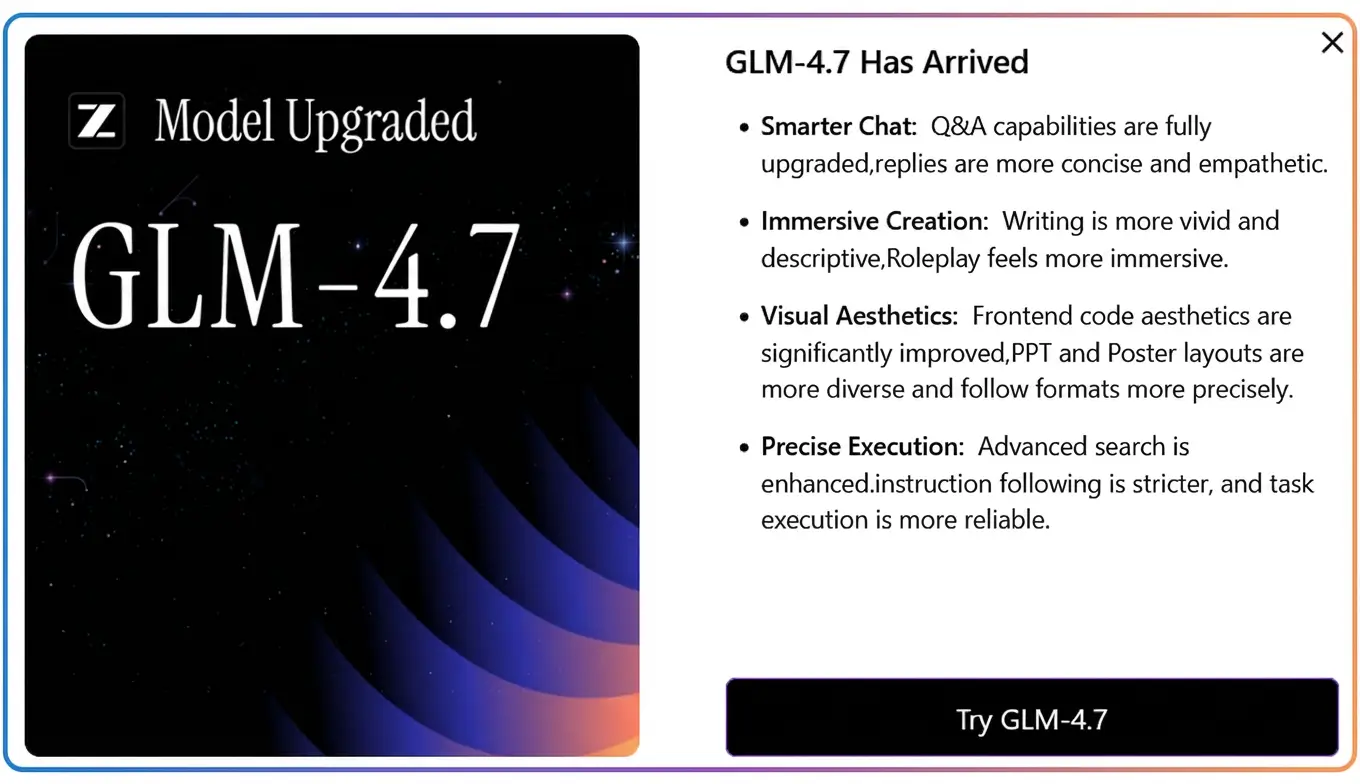
BEIJING — The global race for advanced artificial intelligence capabilities intensified significantly this week as Beijing-based Zhipu AI released GLM-4.7 on December 22, 2025. This latest iteration in the General Language Model (GLM) series delivers substantial improvements in coding, tool usage, and complex reasoning, positioning it as a formidable contender against proprietary leaders like OpenAI's GPT-5 series and Anthropic's Claude Sonnet 4.5.
With open weights available immediately on Hugging Face, GLM-4.7 underscores China's rapid progress in foundation models, offering developers a high-performance, cost-effective alternative that integrates seamlessly into agentic workflows.
Background on Zhipu AI and the GLM Evolution
Zhipu AI, operating globally as Z.ai, has emerged as one of China's leading AI innovators, originating from Tsinghua University’s Knowledge Engineering Group. The company has focused relentlessly on open-source advancements to democratize access to cutting-edge technology. The GLM series has steadily progressed through the years, with earlier versions like GLM-4.5 introducing novel interleaved thinking mechanisms and GLM-4.6 expanding context handling to support massive datasets.
GLM-4.7 builds upon these robust foundations, emphasizing practical utility in software development and autonomous task execution. This release comes amid heightened global competition, where "agentic AI"—systems capable of planning, tool use, and multi-step reasoning—is increasingly vital for real-world enterprise applications. Unlike the purely conversational bots of 2023, 2025’s landscape is defined by agents that can "do" rather than just "chat."
By prioritizing open weights and efficient deployment, Zhipu AI aims to challenge the dominance of closed-source models while complying with regional regulations, effectively offering a "sovereign AI" alternative for markets hesitant to rely solely on Silicon Valley infrastructure.
Core Improvements in Agentic Coding
GLM-4.7 shines brightest in coding scenarios, particularly agentic tasks that require understanding requirements, decomposing problems, and executing across multiple turns. Compared to GLM-4.6, it posts notable gains: 73.8% on SWE-bench Verified (up 5.8%), 66.7% on the multilingual variant (up 12.9%), and 41% on Terminal Bench 2.0 (up 16.5%). These benchmarks evaluate real GitHub issue resolution and terminal operations, making them strong indicators of practical software engineering prowess.
The model supports "thinking before acting" in popular frameworks like Claude Code, Kilo Code, Cline, and Roo Code. This compatibility means developers can swap out expensive API calls to GPT-5 for GLM-4.7 without refactoring their entire codebase, leading to more reliable outcomes on complex projects.
Rise of "Vibe Coding"
One of the most praised features in early testing is "Vibe Coding." In this mode, GLM-4.7 generates aesthetically superior UI elements, producing modern webpages and slides with precise layouts—a step forward for prototyping and design automation. Where previous models often struggled with CSS grid alignments or responsive design nuances, GLM-4.7 exhibits a "designer's intuition," inferring spacing and color theory even when not explicitly prompted. This capability is expected to accelerate frontend development cycles significantly.
For those interested in how these coding agents are reshaping personal productivity, read our analysis on the Future of Personal AI Agents in 2026.
Enhanced Tool Usage and Multi-Turn Stability
Tool integration sees major upgrades, with GLM-4.7 achieving 87.4% on τ²-Bench (interactive tool use) and strong results on BrowseComp for web navigation (52% base, 67.5% with context management). These metrics highlight improved task decomposition and execution in dynamic environments. In practical terms, this means the model is less likely to get stuck in loops or hallucinate API parameters when interacting with external software.
Central to these gains are refined thinking modes that mirror human cognitive processes:
- Interleaved Thinking: The model pauses to reason before responses or tool calls, boosting adherence and quality. It essentially "double-checks" its plan before executing a command.
- Preserved Thinking: Reasoning blocks persist across turns in agent scenarios. If the model debugs code in Turn 1, it remembers the logic of that fix in Turn 5, reducing inconsistencies in long-horizon tasks like iterative debugging.
- Turn-level Thinking: Users control reasoning activation per interaction—disable for speed in simple queries, enable for depth in challenging ones. This flexibility is crucial for latency-sensitive applications.
A flowchart from the announcement illustrates this process: In Turn 1, the model reasons, calls tools, and incorporates results; in Turn 2, it builds coherently on prior logic, culminating in refined outputs.
Reasoning and General Capabilities
GLM-4.7 also advances in pure reasoning, scoring 42.8% on the demanding Humanity's Last Exam (HLE) with tools—a roughly 41% relative improvement over GLM-4.6. It excels in math benchmarks like AIME 2025 (95.7%) and HMMT competitions. Beyond technical tasks, enhancements extend to conversational depth, creative writing, and role-playing, yielding more natural and engaging interactions.
Evaluated under a 128K context length (with some reports noting up to 200K support via specific APIs), GLM-4.7 competes closely with frontiers like GPT-5.1 High, Claude Sonnet 4.5, and Gemini 3.0 Pro across 17 benchmarks spanning reasoning, coding, and agents. While proprietary models edge ahead in select areas, GLM-4.7's open nature and efficiency make it particularly appealing for cost-conscious enterprises.
For a look at how OpenAI is responding to this pressure with multimedia capabilities, check out our report on OpenAI Launching GPT Image 1.5.
GLM-4.7 : Detailed Comparison
AI landscape in late 2025 is crowded. Below is a detailed technical comparison between GLM-4.7 and its primary competitors from the US and China.
| Feature / Model | GLM-4.7 (Zhipu) | GPT-5 (OpenAI) | Claude Sonnet 4.5 | DeepSeek V4 | Gemini 3.0 Pro |
|---|---|---|---|---|---|
| Architecture | Mixture-of-Experts (MoE) | Dense/MoE Hybrid | Sparse MoE | MoE (MLA Focus) | Multimodal Native |
| Access Model | Open Weights | Closed / API | Closed / API | Open Weights | Closed / API |
| Context Window | 128K (200K via API) | 256K | 500K | 128K | 2 Million |
| SWE-bench Verified | 73.8% | 78.2% | 76.5% | 71.4% | 75.1% |
| Coding Strength | High (Vibe Coding) | Very High | Very High | High | High |
| Reasoning (HLE) | 42.8% | 48.5% | 46.2% | 40.1% | 45.9% |
| Primary Use Case | Agentic Workflows / On-Prem | General Reasoning | Creative / Coding | Math / Logic | Multimodal Analysis |
| Cost Efficiency | ★★★★★ | ★★☆☆☆ | ★★★☆☆ | ★★★★★ | ★★★☆☆ |
The official bar chart comparison across eight platforms—including AIME 25, LiveCodeBench v6, GPQA-Diamond, HLE, SWE-bench Verified, Terminal Bench 2.0, τ²-Bench, and BrowseComp—shows GLM-4.7 (often in leading positions) outperforming predecessors and holding ground against closed models. For instance, it leads in several math and agentic categories, with tool-augmented scores revealing strengths in interdisciplinary problem-solving.
Independent analyses note that while benchmarks provide checkpoints, real-world "feel"—intuitiveness in multi-file projects or UI generation—often matters more. Early user feedback praises its organic problem-solving approach, contrasting with occasional rigidity in competitors. Those interested in the broader ecosystem can see how Google is competing with its Nano Banana Pro Launch earlier this year.
Broader Implications for the AI Landscape
GLM-4.7's arrival highlights the narrowing gap between open and closed models, particularly in coding where agentic autonomy drives productivity. For enterprises, its affordability and performance could disrupt workflows dominated by premium APIs. In research, open access fosters innovation, though questions around evaluation fairness and real-world robustness persist.
Geopolitically, this release is significant. Despite restricted access to the absolute highest-end NVIDIA GPUs due to export controls, Zhipu AI has demonstrated that architectural optimization and efficient training strategies can yield world-class results. This resilience suggests that the "compute gap" may not be as determinative as previously thought. As Zhipu prepares for potential public listing, this release signals ambition to expand global influence. Rivals will likely respond swiftly, benefiting the ecosystem overall.
For investors watching the hardware side of this race, our report on the RKLB Stock Surge offers parallel insights into how tech infrastructure contracts are evolving.
Accessibility and Deployment Options
Zhipu AI emphasizes ease of use, ensuring that GLM-4.7 is not just a research artifact but a deployable tool:
- API Access: Available immediately via the Z.ai platform (documentation at https://docs.z.ai/guides/llm/glm-4.7) and globally through OpenRouter.
- Coding Agents: Integrated into GLM Coding Plan; subscribers (starting at a low cost) get automatic upgrades and higher quotas—reportedly one-seventh the price of comparable proprietary models.
- Direct Chat: Available for testing on Z.ai.
- Local Running: Weights are published on Hugging Face (zai-org/GLM-4.7) and ModelScope. The model is compatible with vLLM and SGLang for high-throughput inference, making it suitable for on-premises enterprise servers.
This open-weight strategy accelerates adoption, enabling customization and privacy-centric deployments that closed models simply cannot offer. Don't forget to check your Year with ChatGPT 2025 Recap to see how your own usage patterns compare to these new agentic capabilities.
Summary
For quick digestion, here are the critical facts about the GLM-4.7 launch:
- Release Date: December 22, 2025, by Zhipu AI (Beijing).
- Core Strength: Agentic coding (73.8% SWE-bench Verified) and "Vibe Coding" for UI design.
- Innovation: Introduces "Thinking Modes" (Interleaved, Preserved) to handle complex, multi-turn tasks without losing context.
- Competitive Stance: Performs within striking distance of GPT-5 and Claude 4.5 but is fully open-weights.
- Economics: Drastically cheaper inference costs (approx. 1/7th of proprietary rivals) with easy local deployment options.
- Strategic Impact: Proves high-end AI development is possible despite hardware export restrictions, offering a sovereign alternative to US models.

 Skasif