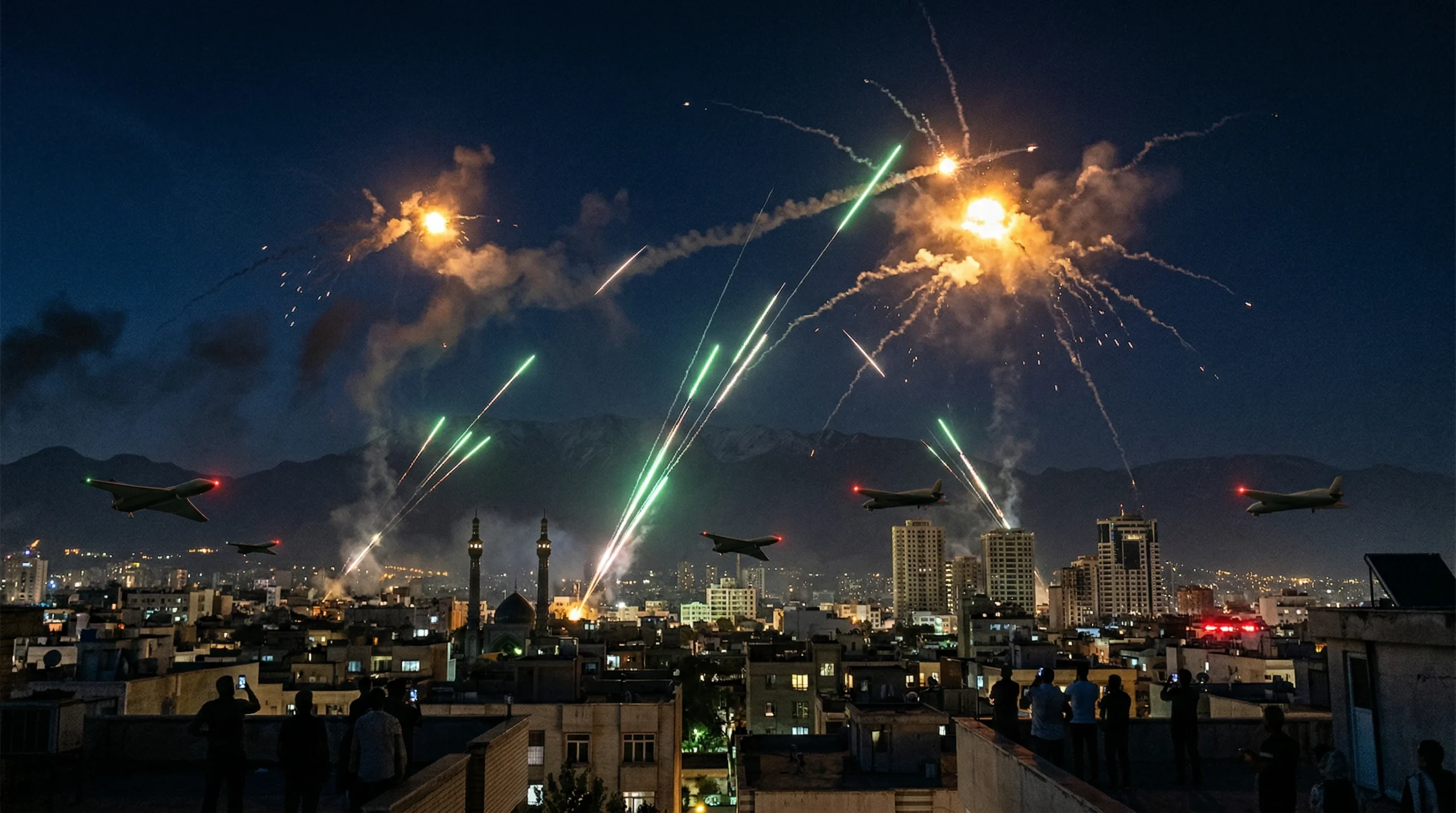
SAN FRANCISCO — Reporting on the escalating crisis: The sky above Tehran glowed an ominous orange late Friday as Iranian air defense systems lit up the night, intercepting incoming Israeli missiles over the capital. Below, families huddled in subway stations turned makeshift shelters, while across the city, citizens watched from rooftops as their nation fought back against a coordinated assault by the United States and Israel.
What began as a quiet night quickly descended into chaos when the first explosions echoed across Tehran just after midnight. Within hours, the Islamic Republic found itself under the most significant military attack since the Iran-Iraq war, with strikes reported in multiple cities including the capital, Urmia in the west, and Minab in the southern province of Hormozgan.
The death toll continues to rise, with at least 40 schoolchildren confirmed killed when an Israeli missile struck an elementary girls' school in Minab. Two additional students were killed in a separate attack on a school east of Tehran. Dozens more civilians have been wounded as US and Israeli forces press what President Donald Trump called "major combat operations" against the Islamic Republic.
This is a developing story. Here are the latest updates. Follow the full timeline at our live updates portal.
Latest Updates: Kuwait Injuries, Bahrain Targeted, and Diplomatic Push
Kuwait Reports Injuries but No Deaths from Iranian Missile Strikes
Kuwait's Ministry of Health has confirmed that 12 people were injured "amid regional developments," with all cases now under medical control. Among the wounded, three members of the armed forces sustained injuries from falling shrapnel at Ali al-Salem Air Base, which Kuwait's Defence Ministry earlier confirmed was targeted by multiple ballistic missiles.
The base, which hosts US military personnel and assets, was struck as part of Iran's ongoing retaliatory operations against American installations across the Gulf. Officials emphasize that all injured individuals are receiving treatment and no deaths have been reported.
Bahrain Says Residential Buildings in Manama Targeted
Bahrain's Interior Ministry has confirmed that several residential buildings in the capital, Manama, were targeted in the ongoing conflict. Civil defence teams are conducting firefighting and rescue operations at affected sites, with further details expected later. The strikes come after Iran declared all US facilities in the region legitimate targets, including Bahrain's Fifth Fleet headquarters.
Russia and Qatar Call for Immediate End to Military Action in Joint Statement
Russian Foreign Minister Sergey Lavrov discussed the ongoing US and Israeli attacks on Iran in a phone call with Qatari Prime Minister and Foreign Minister Sheikh Mohammed bin Abdulrahman Al Thani, according to a statement from Moscow's foreign ministry. The two diplomats agreed on the urgent need to halt all military action that could further destabilize the region.
"There was a general consensus on the need for an urgent return to the political and diplomatic process with a view to resolving all issues between the United States, Israel and the Islamic Republic of Iran on the basis of the principles of the UN Charter and the Treaty on the Non-Proliferation of Nuclear Weapons," the Russian Foreign Ministry stated.
The joint call reflects growing international concern as the conflict enters its second day with no signs of de-escalation.
Iran Informs UN: US and Israeli Bases Are Legitimate Military Targets
Iran's Foreign Minister Abbas Araghchi has formally notified the United Nations that all US and Israeli bases, facilities, and assets in the region are now considered legitimate military targets, according to Iran's IRIB news agency.
In a letter addressed to the UN secretary-general and the president of the Security Council, Araghchi stated that US and Israeli air strikes violate Article 2(4) of the UN Charter, which prohibits the threat or use of force against the territorial integrity of any state, and constitute armed aggression against Iran.
The letter emphasizes that Tehran is acting under its inherent right to self-defense as outlined in Article 51 of the UN Charter and will respond decisively until what it terms aggression is fully and unconditionally halted.
"Iran's armed forces will use all necessary defensive capabilities, and will consider all US and Israeli bases, facilities and assets in the region legitimate military targets," Araghchi wrote.
The notification formalizes what Iran's Islamic Revolutionary Guard Corps has already declared operationally that American military installations across the Gulf, including those in Qatar, Bahrain, UAE, and Kuwait, remain valid targets for retaliatory strikes as long as US-Israeli aggression against Iranian territory continues.
Iran's Missile Capabilities: A Strategic Deterrent Power
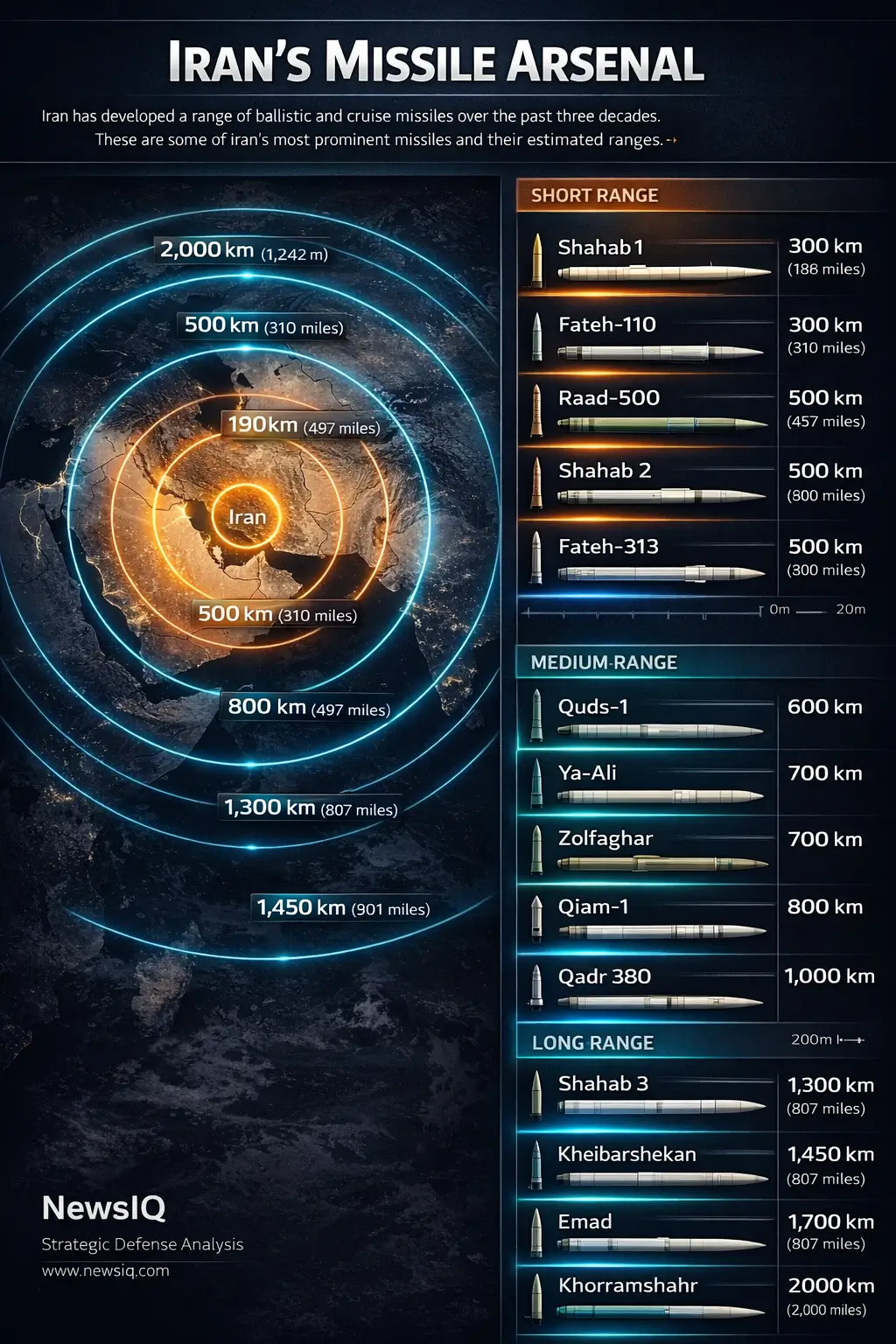
Over the past three decades, Iran has built one of the largest and most diverse missile arsenals in the Middle East—a cornerstone of its national defense strategy and a powerful deterrent against foreign aggression. The Islamic Republic's inventory includes short-, medium-, and long-range ballistic and cruise missiles, with estimated ranges spanning from approximately 186 miles (300 km) to 1,553 miles (2,500 km), placing regional US bases and Israeli territory well within striking distance.
Key Systems in Iran's Arsenal:
- Fateh-110 and Zolfaghar: Short- to medium-range missiles known for precision and rapid deployment.
- Shahab-3 and Emad: Medium-range ballistic missiles forming the backbone of Iran's strike capabilities.
- Sejjil and Khorramshahr: Solid-fueled longer-range systems offering enhanced mobility and reduced launch preparation time.
- Soumar: Cruise missiles extending strike flexibility and complicating enemy defense efforts.
Analysts emphasize that this layered missile capability forms a central pillar of Iran's deterrence strategy, allowing it to project power across the Middle East and beyond. Unlike many regional forces, Iran has prioritized indigenous development, making its arsenal largely self-sufficient and resistant to foreign supply disruptions or sanctions.
In the current conflict, these capabilities have been on full display, with Iranian missiles successfully striking US military installations across the Gulf including hardened targets like Al-Udeid Air Base in Qatar and the US Fifth Fleet headquarters in Bahrain while waves of missiles have penetrated Israeli airspace, overwhelming defense systems.
The message from Tehran is clear: any nation that attacks Iranian sovereignty will face a sophisticated, survivable, and lethal response from a missile force designed to reach any aggressor in the region.
Conflict Snapshot
Situation is moving fast. Here is what you need to know right now:
- Day 2 of Attacks: US and Israel continue joint air strikes on Iran for a second straight day.
- Rising Civilian Deaths: The death toll has crossed 100, including 42 children confirmed dead in Minab.
- Fourth Wave of Strikes: Iran has launched a fourth wave of missiles at US bases across the Gulf.
- UN Peace Talks Fail: The UN Security Council could not agree on a ceasefire after the US, UK, and France blocked a Russian plan.
- Global Disruption: Flights are stopped across the Middle East, and oil prices have jumped 12%.
Scroll to the end of this page for a full summary of today's events.
What We Know So Far
In the early hours of February 28, the United States and Israel launched coordinated military strikes against Iranian territory. The attack came just two days after Iranian negotiators engaged in good-faith nuclear talks with the US in Geneva, mediated by Oman—talks that ended without breakthrough but which Tehran had approached seriously.
US and Israel Launch Joint Aggression on Iranian Nuclear Sites
— Veo Prompt (@VeoPrompt) February 28, 2026
The United States and Israel have launched coordinated airstrikes targeting Iranian nuclear facilities and military leadership, marking a brazen escalation in their campaign against the Islamic Republic. President… pic.twitter.com/33TACemCtd
Israeli officials described the strikes as "preemptive" targeting military and nuclear-related infrastructure. But on the ground, the reality proved far more devastating and far more civilian. The strike on Minab's Al-Zahra Elementary School for Girls killed 40 students, with rescue workers pulling small bodies from rubble through the night.
President Trump announced the operation from Washington, claiming the strikes aim to "eliminate threats from the Iranian regime" and urging Iranians to "take over their government"—a statement many Iranians viewed as deeply hypocritical coming as American bombs struck their homeland.
President Trump Issues Threat to Iran's Military as Aggression Continues
— Veo Prompt (@VeoPrompt) February 28, 2026
President Donald Trump has issued a direct threat to Iran's armed forces, warning them to "lay down your weapons...or you will face certain death," according to Fox News. The statement comes as US and… https://t.co/Mao26ljyd5
Civilian Toll: The Children of Minab
The worst single incident reported so far occurred in Minab, a city in Hormozgan province along Iran's southern coast. There, an Israeli missile struck the Al-Zahra Elementary School for Girls during school hours, killing 40 students instantly.
Witnesses described scenes of horror as parents rushed to the school, digging through rubble with their bare hands. Video circulating on social media, verified by independent observers, shows small bodies wrapped in white cloth, lined up in rows as grieving mothers wailed.
"I heard the explosion from my shop three streets away," said Reza Hosseini, a Minab resident. "When I reached the school, parents were already there, digging. The things we found—a small shoe, a notebook with a girl's name, a hair ribbon covered in dust—I will never forget."
Among the dead was seven-year-old Zahra Ahmadi. Her older sister, nine-year-old Fatemeh, survived but lost both legs in the blast. "She keeps asking me where Zahra is," their mother told local reporters, her voice barely a whisper. "How do I tell a nine-year-old that her sister is gone because someone in another country decided we were a threat?"
In a separate attack east of Tehran, two more students were killed when a strike hit another school. The total civilian death toll continues to climb as rescue workers search through debris across multiple sites.
Iran Strikes Back: Retaliation Underway
Within hours of the initial attacks, Iran launched waves of retaliatory missile and drone strikes targeting American military installations across the Gulf region. The Islamic Revolutionary Guard Corps confirmed successful hits on multiple US bases. The Israeli military acknowledged that its air defense systems were struggling to intercept all incoming projectiles, admitting the defense is "not hermetic."
| Target Location | US Installation | IRGC Status Report |
|---|---|---|
| Qatar | Al-Udeid Air Base | Struck by Iranian missiles (US Central Command HQ) |
| Bahrain | Fifth Fleet Headquarters | Direct hit; radar systems confirmed destroyed |
| UAE | Al-Dhafra Air Base | Targeted in the retaliatory wave |
| Kuwait | Al-Salem Air Base | Struck as part of coordinated response |
"The Islamic Republic of Iran will not stand idle while its territory is attacked and its children are killed," the IRGC declared in a statement. "This operation will continue relentlessly until the enemy is decisively defeated. All US and Israeli assets throughout the region are considered legitimate targets for our armed forces."
Regional Fallout: Gulf States Caught in Crossfire
The escalation has drawn the entire Gulf region into its orbit, with explosions reported across multiple countries. Qatar has experienced multiple waves of attacks throughout the day. At least seven to eight explosions were heard in Doha in the last 30 minutes alone, with witnesses describing sustained anti-aircraft fire as Iranian drones continued to approach.
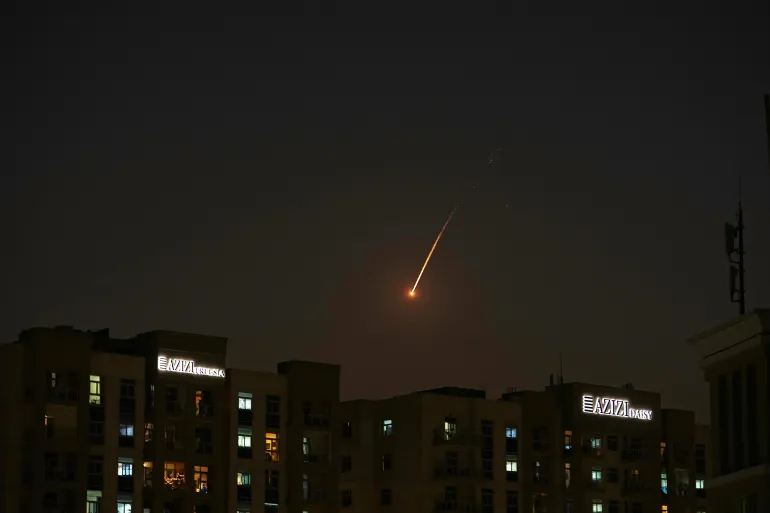
The United Arab Emirates reported loud bangs in Dubai, with Reuters quoting witnesses who saw a plume of smoke and fire in the city's Palm Island neighborhood. Earlier strikes had already targeted Abu Dhabi, and the country's airspace remains partially closed.
Kuwait confirmed a drone strike on Kuwait International Airport, causing minor injuries to several employees and limited material damage to the passenger terminal. Commercial aviation has ground to a halt across the region. Multiple nations including Israel, Iran, the UAE, Qatar, and Kuwait have closed their airspace. Oil prices have spiked sharply, with global markets bracing for a prolonged conflict that could disrupt energy supplies from the Gulf.
Diplomatic Front & International Reactions
Iran has formally submitted a letter to the UN Security Council and Secretary-General Antonio Guterres, demanding an immediate emergency meeting. The UN Security Council is scheduled to meet at 2100GMT today following a request from France. Guterres has called for an immediate cessation of hostilities.
Russia condemned the attacks as "reckless" and an "unprovoked and premeditated aggression against a foreign sovereign nation in violation of international law." Meanwhile, the United Kingdom confirmed it has strengthened its "defensive capabilities in the region," though Prime Minister Keir Starmer insisted Britain "played no role in these strikes."
China Demands Immediate Halt to US-Israeli Attacks on Iran
— Veo Prompt (@VeoPrompt) February 28, 2026
China has called for an immediate stop to military actions against Iran, urging all parties to prevent further escalation and return to dialogue. In a February 28 statement, Beijing warned that continued aggression… pic.twitter.com/ziLwC9hkKU
Analysis: Why Now?
Trita Parsi, President of the Quincy Institute for Responsible Statecraft, noted the strikes lack international legal backing. "There was no international legal basis for this attack," Parsi explained. "In an ever-changing effort at justifying what clearly is, not only an illegal war, but also a clear betrayal of the promise Donald Trump made to his voters."
The strikes came just two days after US-Iran nuclear negotiations in Geneva ended without breakthrough. Many view the timing as significant—suggesting that diplomacy was never seriously intended as a path to resolution.
On the Ground in Tehran & What Comes Next
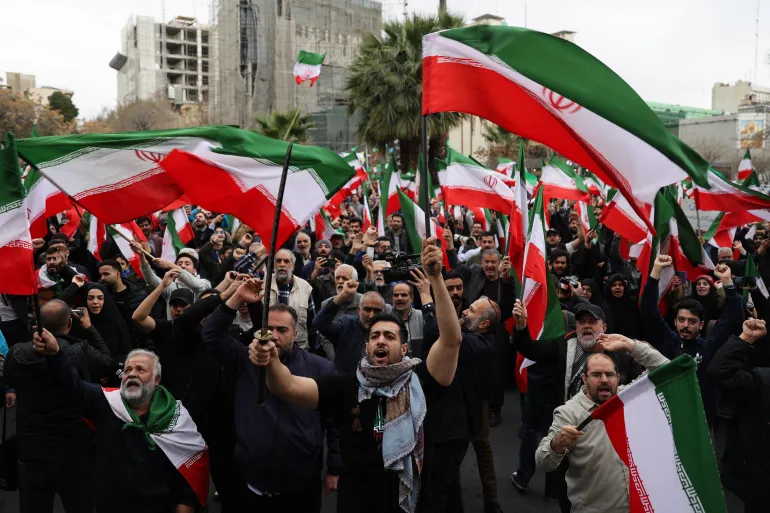
In the Iranian capital, life continues under the shadow of attack. Subway stations have become informal shelters, with families spreading blankets on concrete platforms. The mood is somber but defiant.
"I am not a politician. I have disagreements with my government like any citizen anywhere," said Mehdi, a 34-year-old engineer sheltering with his family. "But when American and Israeli missiles hit my country, when they kill children in Minab—I am Iranian first. We will not accept foreign bombs deciding our future."
The conflict shows no signs of de-escalation. Iran's leadership remains in place, and the Axis of Resistance—Iran's allies and partners across the region—has signaled readiness to support if needed. For the families of Minab, the geopolitical calculations matter little. What matters is that their loved ones are gone.
Reporting from San Francisco, Minab & Doha, Washington. Additional reporting by Al Jazeera, Reuters, and Associated Press.
US-Israeli Attacks on Iran – March 1, 2026
Conflict Enters Second Day with Rising Casualties and Intensified Retaliation
TEHRAN — The US-Israeli military assault on Iran continues into its second day, with the civilian death toll surpassing 100 and Iranian retaliatory strikes intensifying across the Gulf region. Here is the professional summary of today's developments, backed by global news reports.
Key Developments
| Time (GMT) | Event |
|---|---|
| 02:00 | New explosions reported in Tehran |
| 06:15 | UN Security Council emergency session convenes |
| 08:45 | Supreme Leader Khamenei addresses nation |
| 14:15 | Russia proposes UN resolution condemning attacks |
| 16:30 | France, UK block Russian resolution |
| 18:45 | IRGC launches fourth wave of retaliatory strikes |
| 21:30 | Fresh explosions reported across multiple cities |
Casualty Update
- Minab school strike: 42 children confirmed dead
- Total civilian deaths: 93 (247 injured)
- IRGC military casualties: Dozens confirmed (official figures pending)
- US personnel wounded: 37 (12 critical)
- Israeli civilian injuries: 9 (minor)
Military Operations
Iranian Retaliation (Fourth Wave):
- Continued missile and drone strikes on US bases in Qatar, Bahrain, UAE, Kuwait
- Missiles launched toward Israeli territory; some reportedly penetrated air defenses
- IRGC vows operations will continue "until enemy is decisively defeated"
US-Israeli Operations:
- Continued airstrikes on Iranian military infrastructure
- Pentagon confirms "dozens" of personnel wounded in base attacks
- Israeli military acknowledges Iron Dome system "overwhelmed" in some areas
Diplomatic Front
UN Security Council:
- Emergency session convened at France's request
- Russia proposed resolution condemning US-Israeli attacks
- France, UK blocked resolution as "unbalanced"
- No consensus reached; further talks scheduled
Key Statements:
- Iran (UN ambassador): Displayed photos of dead children, demanded accountability
- China: Called for immediate ceasefire, respect for Iranian sovereignty
- Russia: Condemned "reckless aggression," submitted draft resolution
- Pakistan: Summoned US, Israeli envoys to deliver formal protest
- Turkey: Erdogan offered mediation in call with Iranian president
- UK: Blocked Russian resolution, insisted on "balanced" approach
- France: Requested Security Council session, blocked Russian draft
Regional Impact
- Qatar: Multiple explosions in Doha; continued interceptions reported
- UAE: Explosions in Dubai, Abu Dhabi; airspace partially closed
- Kuwait: Second drone strike on international airport; facility closed
- Bahrain: Fresh explosions near US Fifth Fleet headquarters
- Saudi Arabia: Explosions reported in Riyadh (second day)
Aviation:
- Regional airspace closures continue
- Major airlines suspended flights to affected destinations
- Thousands of passengers stranded
Oil Markets:
- Brent crude: $95.40/barrel (+12% since Thursday)
- Shipping lines suspend Gulf routes; insurance premiums triple
Supreme Leader Address
Ayatollah Ali Khamenei spoke this morning, stating:
"The enemies of Islam and Iran thought bombs would make us surrender. They do not know this nation. The blood of our children in Minab will not be forgotten. Iran will respond, and our response will be crushing."
He called for national unity and assured Iranians of eventual victory.
International Reactions Summary
| Country/Organization | Position |
|---|---|
| Russia | Condemned US-Israeli attacks; submitted UN resolution |
| China | Called for ceasefire; respect Iranian sovereignty |
| Pakistan | Strongly condemned attacks; summoned US/Israeli envoys |
| Turkey | Offered mediation; expressed solidarity |
| India | Urged restraint; organizing citizen evacuation |
| Japan | Serious concern; monitoring energy situation |
| Amnesty International | Minab strike "possible war crime"; called for investigation |
| Human Rights Watch | Condemned school attack; urged accountability |
| Vatican | Pope Francis appealed for peace |
Current Situation on Ground
- Tehran: Daytime relative calm; nights bring attacks and interceptions
- Minab: Search operations continue; 42 children confirmed dead
- Urmia: Multiple strikes reported in western Iran
- Civilian displacement: Thousands seeking shelter in subway stations
- Internet: Limited connectivity reported; attributed to "enemy cyber attacks"
- Medical facilities: Stretched but functional; treating hundreds of wounded
Next 24 Hours: Key Factors to Watch
- UN Security Council negotiations (resumes tomorrow)
- Potential Axis of Resistance involvement (Hezbollah, Yemen, Iraq)
- Gulf state responses to continued strikes on their territory
- US domestic reaction to extended Middle East engagement
- Humanitarian access to affected areas
- Oil market volatility and potential economic interventions

 Skasif