Test Your Brain: Solve These 12 Maths Questions Without a Pen
Practising standard maths questions with answers is an excellent way to keep your brain sharp, active, and youthful. Whether you are trying out math puzzles with answers for leisure or facing hard math questions during school examinations, studying these step-by-step methods makes you mathematically confident. Our collection features multiple math quizzes and some extremely tricky math questions. We will break them down using elementary school logic and simple, clear algebra formulas.
- 1. Arithmetic Priority: \((33 + 27) \cdot 4 + 6\)
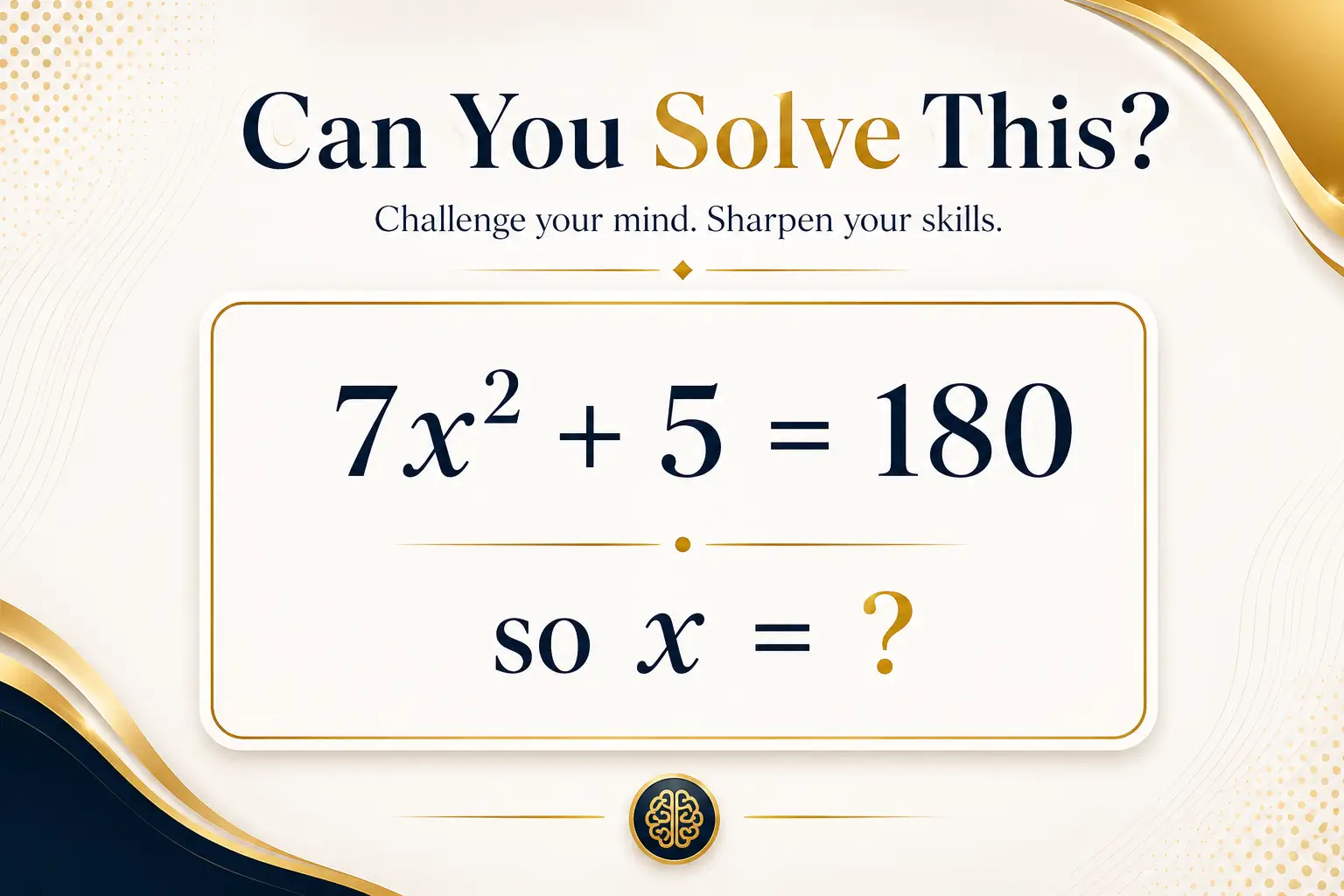
- 2. Quadratic Separation: \(7x^2 + 5 = 180\)
- 3. Fraction Matching: \(\frac{a}{5} = \frac{36}{100}\)
- 4. Like-Variable Simplification: \(7b^2 - 3b^2 = 16\)
- 5. Zero Index Power: \(\frac{\sqrt{64} + 7^0}{\sqrt{9}}\)
- 6. Radicals Division: \(\frac{\sqrt{81} - 5^0}{\sqrt{16}}\)
- 7. Radical Subtraction Fallacy: \(\frac{\sqrt{25} - \sqrt{9}}{\sqrt{25 - 9}}\)
- 8. Cube Root Balance: \(m^3 + m^3 = 16\)
- 9. Power of Quotient: \(\left( \frac{\sqrt{64}}{\sqrt{16}} \right)^2\)
- 10. Double Radical Term: \(\left( \frac{\sqrt{9} + \sqrt{9}}{\sqrt{9}} \right)^2\)
- 11. Inverse Ratio Solver: \(\frac{9}{x} = \frac{x}{4}\)
- 12. Exponential Equation Trap: \(5^{x+8} = 6^{x+8}\)
Have you ever encountered math problems with answers on the internet that got thousands of comments with entirely different results? These viral sensations are usually designed to catch our quick intuitive thinking off-guard. Today, we will explore 12 such examples of solved math problems, showing you how to break them down with pure, flawless mathematical logic.
If you want to boost your logic skills right now, you should try out these viral math questions with answers to test your IQ. Also, if you enjoy using tech tools to study and keep your homework organized, learning these ChatGPT prompts for better productivity is a wonderful way to plan your daily math tasks.
Even advanced AI systems struggle with complex calculations; for instance, you can read about how a new OpenAI model solves six unpublished math problems using advanced algorithmic reasoning. For general competitive exam prep in India, taking this SSC GD online mock test 2025 is highly recommended to improve your arithmetic speed.
1. Arithmetic Priority: Maths Questions with Answers for \((33 + 27) \cdot 4 + 6\)
This is a quintessential example of math problems with answers that depend entirely on priority rules. If you do not follow the order of operations, you are highly likely to find an incorrect solution. Let us learn the BODMAS rules step by step to solve this accurately.
BODMAS Math Problems with Answers
BODMAS stands for Brackets, Orders, Division, Multiplication, Addition, and Subtraction. It dictates the order in which we must simplify an equation. Let us look at two clear methods to calculate this term.
Step A: Resolve Parentheses/Brackets first. Look inside the round brackets: \(33 + 27\). Let's calculate this simple sum first:
\[33 + 27 = 60\]Step B: Rewrite the expression. Substituting 60 back into the expression leaves us with:
\[60 \cdot 4 + 6\]Step C: Multiplication has priority. We have a multiplication (\(\cdot 4\)) and an addition (\(+ 6\)). Since multiplication is higher in precedence than addition, we must do this part first:
\[60 \cdot 4 = 240\]Step D: Final Addition. Now, perform the last addition to get the answer:
\[240 + 6 = 246\]The Distributive Property allows us to expand the multiplication across terms inside a bracket: \(a(b + c) = ab + ac\). Let us verify our answer using this mathematical principle:
Step A: Distribute the factor of 4. Multiply 4 by both numbers inside the parentheses:
\[(33 \cdot 4) + (27 \cdot 4) + 6\]Step B: Calculate individual products. Perform the multiplications:
\[132 + 108 + 6\]Step C: Sum the terms from left to right. First, add 132 and 108:
\[240 + 6 = 246\]2. Quadratic Separation: Maths Questions with Answers for \(7x^2 + 5 = 180\)
In high school mathematics, variables are often raised to powers of 2. These are quadratic equations. To find the secret value of \(x\), we need to carefully isolate it from the surrounding coefficients.
Algebraic Math Riddles with Answers
Let us solve this problem in two different ways to ensure we do not miss any possible real solutions.
Step A: Subtract 5 from both sides. We want to eliminate the constant \(+5\) on the left. So we subtract 5 from both sides:
\[7x^2 = 180 - 5\]\[7x^2 = 175\]Step B: Divide both sides by 7. Now we isolate \(x^2\) by dividing both sides by the multiplier 7:
\[x^2 = \frac{175}{7}\]\[x^2 = 25\]Step C: Take the square root of both sides. Remember, any positive real number has two square roots (a positive and a negative one):
\[x = \pm\sqrt{25} \implies x = 5 \quad \text{or} \quad x = -5\]Step A: Move all terms to the left-hand side. Subtract 180 from both sides:
\[7x^2 + 5 - 180 = 0 \implies 7x^2 - 175 = 0\]Step B: Extract the common numerical factor. Divide the entire equation by 7:
\[7(x^2 - 25) = 0 \implies x^2 - 25 = 0\]Step C: Apply the difference of squares identity. Recall that \(a^2 - b^2 = (a - b)(a + b)\). Here, \(25\) can be written as \(5^2\):
\[(x - 5)(x + 5) = 0\]For this expression to equal zero, either the first bracket must be zero, or the second must be zero. This gives us our two roots: \(x = 5\) or \(x = -5\).
3. Fraction Matching: Maths Questions with Answers for \(\frac{a}{5} = \frac{36}{100}\)
Proportions show us how two fractions are equivalent to each other. This says that dividing a cake into 5 parts and eating \(a\) pieces is identical to dividing it into 100 parts and eating 36 pieces.
Proportional Math Question with Answer
Let us calculate the value of \(a\) using simple division and scaling techniques.
Step A: Multiply both sides by 5. Since \(a\) is divided by 5 on the left, we perform the inverse operation to isolate it:
\[a = \frac{36}{100} \cdot 5\]Step B: Calculate the product in the numerator. Multiply 36 by 5:
\[a = \frac{180}{100}\]Step C: Simplify the fraction to a decimal. Divide by 100:
\[a = 1.8\]Step A: Simplify the fraction \(\frac{36}{100}\). Divide the numerator and denominator by their greatest common divisor, which is 4:
\[\frac{36 \div 4}{100 \div 4} = \frac{9}{25}\]Our equation now becomes simpler:
\[\frac{a}{5} = \frac{9}{25}\]Step B: Scale the denominators. Notice that \(5 \times 5 = 25\). To make the denominators equal, we scale the left fraction by multiplying both top and bottom by 5:
\[\frac{5a}{25} = \frac{9}{25}\]Step C: Equate the numerators. Since the bases are identical, the tops must be equal:
\[5a = 9 \implies a = \frac{9}{5} = 1.8\]4. Like-Variable Simplification: Maths Questions with Answers for \(7b^2 - 3b^2 = 16\)
Do you find variables with exponents scary? Try replacing the variable with a real object. If you have 7 identical boxes of chocolates, and someone takes away 3 of those boxes, you are left with exactly 4 boxes!
Simplifying Basic Math Questions
Let us look at two reliable methods to solve this quadratic relation.
Step A: Combine terms on the left. Subtract the terms directly as they share the exact same variable part (\(b^2\)):
\[(7 - 3)b^2 = 16 \implies 4b^2 = 16\]Step B: Divide both sides by 4. Isolate the quadratic variable:
\[b^2 = \frac{16}{4} \implies b^2 = 4\]Step C: Take the square root. Solve for \(b\):
\[b = \pm\sqrt{4} \implies b = 2 \quad \text{or} \quad b = -2\]Step A: Take the common factor \(b^2\) outside brackets.
\[b^2(7 - 3) = 16\]\[b^2(4) = 16 \implies 4b^2 = 16\]Step B: Isolate the variable. Shift the multiplier 4 to the other side as a division term:
\[b^2 = 4\]\[b = 2 \quad \text{or} \quad b = -2\]5. Zero Index Power: Maths Questions with Answers for \(\frac{\sqrt{64} + 7^0}{\sqrt{9}}\)
This is a classic question that tests your understanding of two core concepts: square roots and indices. Many students make the mistake of thinking \(7^0 = 0\), which ruins their calculations.
Solved Math Problems with Exponent Rules
Let us evaluate this algebraic fraction step by step.
Step A: Evaluate the first root \(\sqrt{64}\). We look for a positive integer that multiplies by itself to give 64:
\[8 \cdot 8 = 64 \implies \sqrt{64} = 8\]Step B: Solve the zero exponent term \(7^0\). In index laws, any non-zero real number raised to the power of 0 is mathematically defined as 1:
\[7^0 = 1\]Step C: Evaluate the denominator \(\sqrt{9}\). Find the square root of 9:
\[3 \cdot 3 = 9 \implies \sqrt{9} = 3\]Step D: Reconstruct the fraction. Substitute these simple numbers back into the expression:
\[\frac{8 + 1}{3} \implies \frac{9}{3} = 3\]We can also split the single fraction into two smaller fractions before simplifying:
\[\frac{\sqrt{64}}{\sqrt{9}} + \frac{7^0}{\sqrt{9}}\]Substitute our known square roots and index values:
\[\frac{8}{3} + \frac{1}{3}\]Since the denominators are identical, simply add the numerators:
\[\frac{8 + 1}{3} = \frac{9}{3} = 3\]6. Radicals Division: Maths Questions with Answers for \(\frac{\sqrt{81} - 5^0}{\sqrt{16}}\)
Similar to our previous question, this problem tests both exponents and square roots. However, this time, we have a subtraction sign in the numerator.
Math Test Questions with Roots
Let us solve this step-by-step to arrive at the correct integer value.
Step A: Find individual root values. We solve the terms in the numerator and denominator:
\[\sqrt{81} = 9 \quad (\text{since } 9 \cdot 9 = 81)\]\[\sqrt{16} = 4 \quad (\text{since } 4 \cdot 4 = 16)\]Step B: Resolve the exponent term. Any base with a power of 0 is simplified to 1:
\[5^0 = 1\]Step C: Substitute and calculate. Place these back into our expression:
\[\frac{9 - 1}{4} \implies \frac{8}{4} = 2\]Let us split the terms to double-check our arithmetic calculation:
\[\frac{\sqrt{81}}{\sqrt{16}} - \frac{5^0}{\sqrt{16}}\]\[\frac{9}{4} - \frac{1}{4} = \frac{9 - 1}{4} = \frac{8}{4} = 2\]7. Radical Subtraction Fallacy: Maths Questions with Answers for \(\frac{\sqrt{25} - \sqrt{9}}{\sqrt{25 - 9}}\)
This is a legendary viral math puzzle that catches many people off-guard. At first glance, the top and the bottom expressions look almost identical. This visual similarity tricks people into guessing 1. But math operates on rules, not visual patterns!
Simple Math Puzzles about Radical Rules
Let us run a detailed calculation to see why the answer is not 1.
Step A: Solve the numerator. We calculate each square root independently:
\[\sqrt{25} = 5\]\[\sqrt{9} = 3\]\[\text{Numerator} = 5 - 3 = 2\]Step B: Solve the denominator. Here, the subtraction sits inside the radical, meaning we must perform the subtraction first, before applying the square root:
\[25 - 9 = 16\]Now we calculate the root of the result:\[\text{Denominator} = \sqrt{16} = 4\]Step C: Divide the terms. Divide the simplified numerator by the denominator:
\[\frac{\text{Numerator}}{\text{Denominator}} = \frac{2}{4} = 0.5 \quad \left(\text{or } \frac{1}{2}\right)\]Let us mathematically demonstrate why we cannot distribute subtraction inside square roots. In algebra:
\[\sqrt{A} - \sqrt{B} \neq \sqrt{A - B}\]If we substitute our values (\(A = 25, B = 9\)):
\[\sqrt{25} - \sqrt{9} = 5 - 3 = 2\]\[\sqrt{25 - 9} = \sqrt{16} = 4\]Since \(2 \neq 4\), this proves that roots cannot be combined during subtraction or addition. It is a mathematical impossibility!
8. Cube Root Balance: Maths Questions with Answers for \(m^3 + m^3 = 16\)
When solving equations with exponents of 3 (cubes), we are looking for a base number that multiplies by itself three times to equal the target value.
Math Quizzes with Answers for Powers
Let us simplify this relationship using algebraic terms.
Step A: Combine like terms. We have two identical \(m^3\) terms on the left side:
\[2m^3 = 16\]Step B: Isolate the cube. Divide both sides of our equation by 2:
\[m^3 = \frac{16}{2} \implies m^3 = 8\]Step C: Solve for \(m\) by taking the cube root. We find a number which, when cubed, yields 8:
\[2 \cdot 2 \cdot 2 = 8 \implies m = \sqrt[3]{8} = 2\]Let us pull the common factor \(m^3\) outside of parenthetical terms:
\[m^3(1 + 1) = 16 \implies 2 \cdot m^3 = 16\]Divide by 2 to isolate the cube:
\[m^3 = 8 \implies m = 2\]9. Power of Quotient: Maths Questions with Answers for \(\left( \frac{\sqrt{64}}{\sqrt{16}} \right)^2\)
This expression looks highly complicated because it nests square roots within a division term, all raised to a power of 2. Let us look at two elegant methods to solve it.
Interactive Math Brain Teasers
We can solve this inside-out or distribute our exponent across the division.
Step A: Calculate the square roots inside brackets.
\[\sqrt{64} = 8\]\[\sqrt{16} = 4\]Step B: Simplify the resulting fraction. Substitute these integers:
\[\frac{8}{4} = 2\]Step C: Apply the outer exponent. Square the simplified result:
\[(2)^2 = 4\]Recall the exponent rule for quotients: \(\left(\frac{x}{y}\right)^n = \frac{x^n}{y^n}\). Let us apply this:
Step A: Distribute the square to the numerator and denominator.
\[\frac{(\sqrt{64})^2}{(\sqrt{16})^2}\]Step B: Squares and square roots cancel each other. Since they are inverse operations, we get:
\[\frac{64}{16}\]Step C: Perform the division. Let's simplify the fraction:
\[\frac{64}{16} = 4\]10. Double Radical Term: Maths Questions with Answers for \(\left( \frac{\sqrt{9} + \sqrt{9}}{\sqrt{9}} \right)^2\)
This looks like a lot of roots of 9 grouped together. Let us see if we can resolve this with basic arithmetic calculations or a highly clever substitution technique.
Mathematics Questions on Identical Radicals
Let us try both methods to see how they yield the identical correct result.
Step A: Resolve \(\sqrt{9}\). We know that \(\sqrt{9} = 3\).
Step B: Substitute into the expression. Place 3 into each root's position:
\[\left( \frac{3 + 3}{3} \right)^2\]Step C: Simplify inside parenthetical boundaries. Perform the addition and division:
\[\left( \frac{6}{3} \right)^2 \implies (2)^2 = 4\]We can solve this without evaluating the root at all! Let us define a temporary variable \(y = \sqrt{9}\):
Step A: Rewrite the fraction with variable \(y\).
\[\left( \frac{y + y}{y} \right)^2\]Step B: Simplify the numerator. Add \(y + y\):
\[\left( \frac{2y}{y} \right)^2\]Step C: Cancel out the common variable \(y\). Since \(y\) exists on both the top and the bottom, they divide out completely:
\[(2)^2 = 4\]This means no matter what positive number is placed inside the roots, as long as they are all identical, the final output will always be 4!
11. Inverse Ratio Solver: Maths Questions with Answers for \(\frac{9}{x} = \frac{x}{4}\)
This is a symmetrical rational equation. The variable \(x\) sits as a denominator on the left and a numerator on the right side.
Symmetrical Math Quizzes
Let us clear the denominators using cross-multiplication or basic mathematical scaling.
Step A: Multiply across diagonal lines. We draw an imaginary cross and multiply terms:
\[x \cdot x = 9 \cdot 4\]\[x^2 = 36\]Step B: Take the square root of both sides. Remember, quadratic variables yield two distinct solutions:
\[x = \pm\sqrt{36} \implies x = 6 \quad \text{or} \quad x = -6\]Let us scale both fractions to have a common denominator of \(4x\):
Step A: Multiply top and bottom of the first fraction by 4.
\[\frac{36}{4x}\]Step B: Multiply top and bottom of the second fraction by \(x\).
\[\frac{x^2}{4x}\]Step C: Set the numerators equal. Since they now share a common denominator of \(4x\) (where \(x \neq 0\)):\[36 = x^2 \implies x = 6 \quad \text{or} \quad x = -6\]12. Exponential Equation Trap: Maths Questions with Answers for \(5^{x+8} = 6^{x+8}\)
This problem puzzles many because the bases (5 and 6) are completely different numbers. How can multiplying 5s ever yield the identical result as multiplying 6s? Let us find the logic behind this puzzle.
Exponent Rules in Tricky Math Questions
Let us look at two reliable methods to solve this mathematical riddle.
Is there any exponent that makes all non-zero bases yield the exact same value? Yes, the exponent of zero!
Recall that \(A^0 = 1\) and \(B^0 = 1\) for all positive real bases.
Step A: Set the shared exponent to zero. For the two sides to balance and equal 1, the exponent must be zero:
\[x + 8 = 0\]Step B: Solve for \(x\). Subtract 8 from both sides of the equation:
\[x = -8\]Step A: Divide both sides by the term on the right. Divide by \(6^{x+8}\):
\[\frac{5^{x+8}}{6^{x+8}} = 1\]Step B: Combine the bases using exponent laws. Since they share a common power, we can write:
\[\left(\frac{5}{6}\right)^{x+8} = 1\]Step C: Match the bases. We can write 1 as our base raised to the power of 0:
\[\left(\frac{5}{6}\right)^{x+8} = \left(\frac{5}{6}\right)^0\]Since the bases are identical, their exponents must be equal:
\[x + 8 = 0 \implies x = -8\]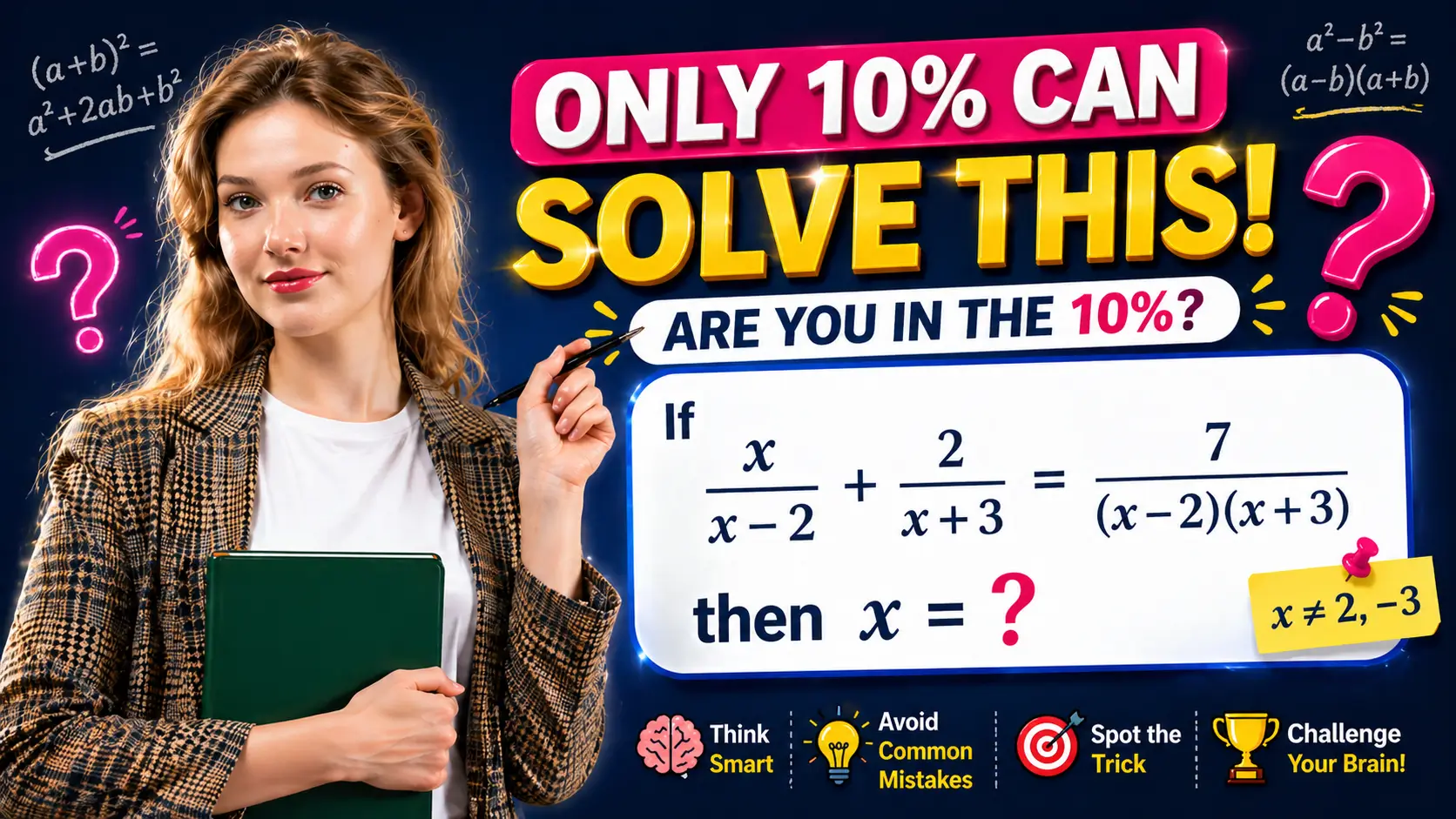
Recommended Study Guide
Master algebraic fractions and find out how to clean up complex equations easily.
Solve Rational Equations Step by Step →Quick Maths Strategy: Your Simple 4-Step Checklist
If you want to excel at school examinations and crack tricky equations, write this simple checklist in your notebook. Also, if you want to expand your algebra knowledge, you can solve rational equations step by step using our simple guidelines.
Maths Examination Checklist
Excellent! You have successfully mastered these 12 tricky maths questions. Keep practicing, stay curious, and happy learning!

 Skasif


Now that you have mastered these solutions, can you solve these 5 quick practice questions? Write down your answers in the comment box below and compare them with other students!