Trump and Modi Announce New US-India Trade Agreement
 Skasif
03/02/2026
Skasif
03/02/2026 
Washington and New Delhi took a significant step forward in their often complicated trade relationship this week when President Donald Trump announced a new bilateral agreement with Prime Minister Narendra Modi that reduces United States tariffs on most Indian goods to 18 percent.
The announcement followed a telephone conversation between the two leaders on February 2. Trump detailed the pact on Truth Social, describing it as a major breakthrough that includes India ending purchases of Russian crude oil and committing to buy more American energy products. Modi quickly responded on X, welcoming the tariff reduction and thanking Trump but making no reference to changes in oil sourcing.
Major news outlets reported the development extensively on February 3, with markets reacting positively. Yet neither government has issued a full official joint statement, and key elements remain subject to interpretation.
How the Announcement Unfolded
Information about the agreement has emerged primarily through the leaders’ social media posts and subsequent briefing to journalists.
Trump wrote that he had spoken with Modi, whom he called one of his greatest friends, about trade and ending the war in Ukraine. According to the president, Modi agreed to stop buying Russian oil and instead purchase more from the United States and potentially Venezuela. Trump presented the tariff cut as immediate, lowering duties from previous levels that included punitive measures linked to Russia’s energy exports.
Modi’s post focused exclusively on the benefit to Indian exporters. He expressed delight that Made in India products would face a reduced tariff of 18 percent and thanked Trump on behalf of 1.4 billion Indians.
White House officials confirmed to reporters that an additional 25 percent punitive tariff imposed on Indian goods because of Russian oil purchases would be lifted, bringing the effective rate down substantially.
| Aspect | United States Commitment | India Commitment (as reported) |
|---|---|---|
| Tariff on imports | Reduce to uniform 18% (from 25% base + 25% punitive, totaling up to 50% in some views) | Remove tariffs and non-tariff barriers toward zero on US goods |
| Energy trade | Sell more crude oil (and possibly LNG) to India | Halt imports of Russian crude; shift purchases to US and potentially Venezuelan sources |
| Purchase pledges | N/A | Potential commitment to buy up to $500 billion in US energy, technology, and agricultural products over time |
| Implementation | Effective immediately for tariff reduction | Timeline for oil shift and barrier removal unclear |
Long-Standing Context
Trade negotiations between the United States and India have proceeded in fits and starts for years. A limited deal in 2023 resolved some disputes over metals tariffs, but broader ambitions repeatedly foundered on agriculture, dairy, intellectual property, and migration issues.
Since Russia’s 2022 invasion of Ukraine, India’s sharp increase in Russian oil imports became a major irritant for Washington. At times accounting for over a third of India’s crude needs, those purchases helped Russia maintain revenues despite Western sanctions.
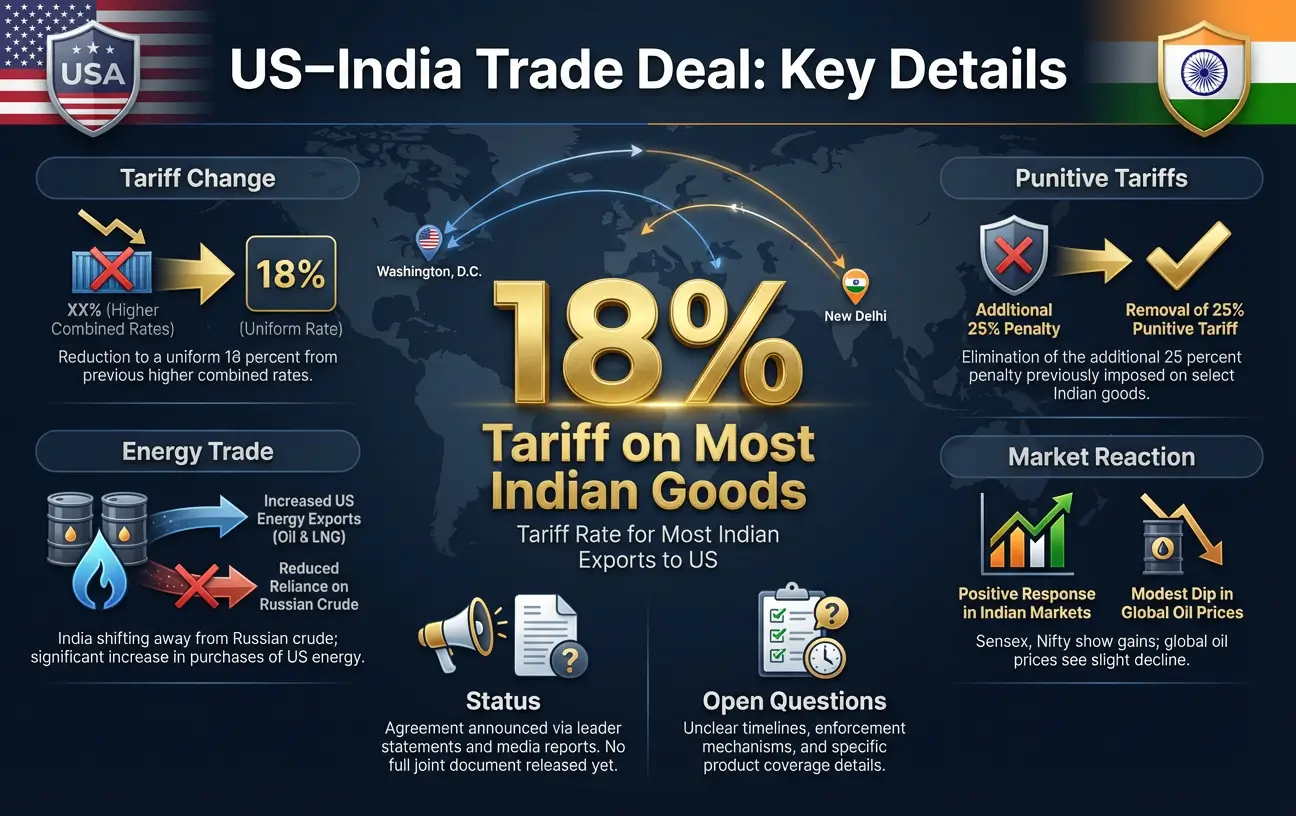
The Trump administration had imposed secondary tariffs on countries continuing to buy Russian energy, with India facing an extra 25 percent layer on top of baseline reciprocal duties. American officials argued that India’s overall tariff levels remained among the highest for any large economy.
India, for its part, has long sought greater access for its textiles, pharmaceuticals, and IT services while protecting domestic farmers from subsidised US agricultural exports.
Immediate Market and Political Reactions
Indian markets welcomed the news enthusiastically. The Sensex reached a new record high on February 3, while the rupee recorded its strongest daily gain in years. Shares of major exporters and US-listed Indian companies rose sharply.
Global oil prices dipped slightly, with analysts citing potential loosening of supply constraints if India truly shifts away from Russian barrels. However, many traders appeared sceptical about rapid implementation.
In Washington, Republican supporters praised the outcome as evidence of Trump’s deal-making approach. Critics noted the absence of public Indian confirmation on the oil commitment and questioned enforcement mechanisms.
European observers took note as well. The European Union only last week finalised its own wide-ranging trade agreement with India after nearly two decades of talks. Some diplomats expressed quiet concern that shifting priorities in New Delhi could affect rollout.
Russian officials reportedly stated they had received no notification from India about ending crude exports, underscoring the uncertainty around that element.
Broader Geopolitical and Economic Implications
If fully carried out, an Indian pivot away from Russian oil would mark a notable win for Western efforts to isolate Moscow economically. It could also support Trump’s stated goal of aiding Ukraine peace negotiations by reducing Russia’s war funding.
For American producers, higher exports to one of the world’s fastest-growing energy markets would provide welcome demand. India’s refineries are technically capable of processing heavier Venezuelan grades similar to Russian supplies, though costs would likely rise.
Agricultural access remains a lingering question. US officials have repeatedly pressed for openings in dairy and poultry, areas where Indian political resistance is fierce.
The deal arrives as India pursues multiple trade partnerships simultaneously, including recent agreements with the EU, Oman, and progress toward one with New Zealand. Diversification appears aimed at reducing vulnerability amid global tariff turbulence.
Outstanding Questions
Several practical details await clarification in coming days or weeks:
- Exact product coverage and any phase-in periods for the 18 percent rate.
- Timeline and verification process for any Russian oil phase-out.
- Whether purchase commitments are legally binding.
- Interaction with existing World Trade Organization disputes.
Technical teams from both sides are expected to continue discussions. A more detailed joint document may emerge soon.
The agreement, even in its current form, signals intent to stabilise a vital economic relationship worth hundreds of billions annually. With shared strategic interests in the Indo-Pacific and combined populations exceeding 1.8 billion, the United States and India have clear incentives to bridge remaining gaps.
Still, the heavy reliance on social media for the initial reveal and differing emphases in the two leaders’ statements highlight the distinctive style of this diplomatic moment. Markets have priced in optimism, but lasting impact will hinge on follow through from both capitals.