US Iran Peace Talks Open in Pakistan Amid Fragile Ceasefire
 Skasif
11/04/2026
Skasif
11/04/2026 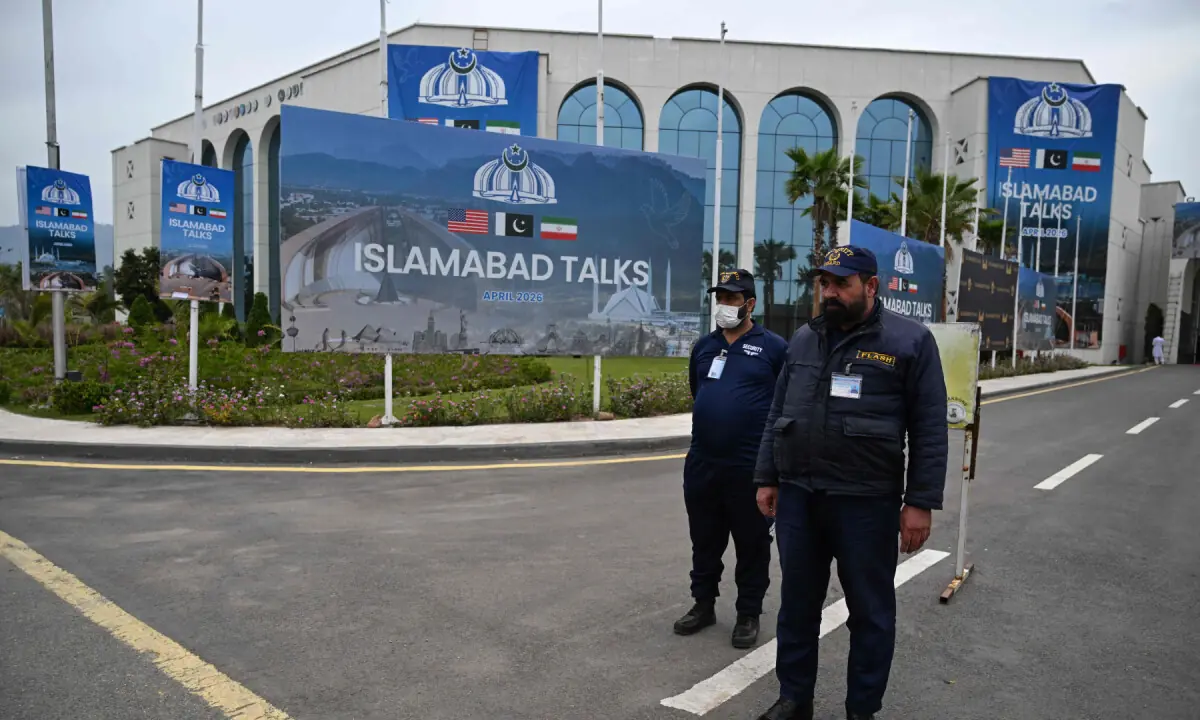
Digital billboards across Pakistan’s capital mark the arrival of US and Iranian delegations for the April 2026 summit.
The View from Islamabad: JD Vance Arrives for High-Stakes Diplomacy
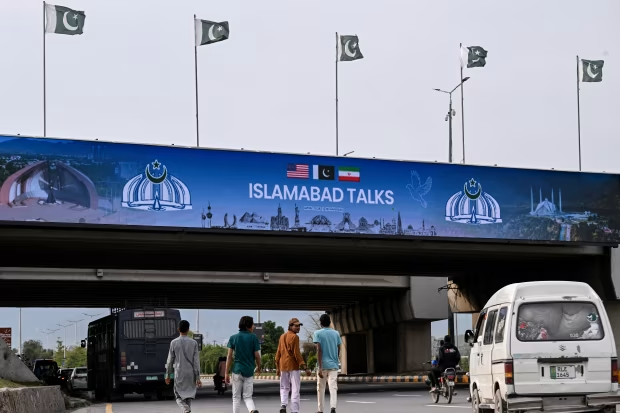
US Vice President JD Vance touched down at Nur Khan Air Base in Islamabad early Saturday morning, flanked by heavy security and a seasoned diplomatic team. His arrival puts him at the center of the most challenging assignment of his vice-presidency. He steps into a heavily guarded capital, where digital billboards celebrating the “Islamabad Talks” tower over empty streets and extra police forces man numerous checkpoints. The US delegation includes Middle East envoy Steve Witkoff and Jared Kushner, both veterans of previous ceasefire negotiations regarding Israel-Gaza and Russia-Ukraine.
Before leaving the United States, Vance delivered a clear message. He told reporters the US is prepared to extend an open hand if Iran negotiates in good faith. But he paired that optimism with a sharp warning, stating the American team would not be receptive if Iranian officials tried to stall or play games. His mission carries massive political weight back home. President Donald Trump has made it clear he expects results, reportedly joking during a recent Easter lunch that he will blame Vance if the summit fails and take full credit if it succeeds.
Iranian Delegation Lands Amid Grief and Caution
The Iranian delegation arrived in Pakistan shortly after midnight, escorted through Pakistani airspace by military fighter jets. Parliament Speaker Mohammad Bagher Ghalibaf and Foreign Minister Abbas Araghchi lead the 71-person team. They stepped off a plane that served as a flying memorial. Images from the aircraft, dubbed “Minab 168,” showed empty seats filled with photographs and school bags belonging to the children killed during a US-Israeli strike on the first day of the war.
Ghalibaf set a firm boundary before talks even began. He stated publicly that Iran brings good intentions but lacks any trust in the United States, citing a history of broken promises. The Iranian team insists that any lasting agreement requires concrete actions, not just words. They have laid out clear preconditions for the negotiations to move forward, reflecting a stance that blends diplomatic engagement with deep-seated caution.
Why This Moment Matters for the Global Economy
The six-week conflict sent immediate shockwaves through global markets, and the financial fallout continues to threaten economies in the US and Europe. The fighting disrupted major shipping lanes and triggered a sharp spike in energy costs. At the center of the economic anxiety is the Strait of Hormuz. Iran’s effective blockade of the critical waterway has throttled a massive percentage of the world’s liquefied natural gas and oil exports.
Consumers are already feeling the pinch. Gas prices are climbing, and supply chain disruptions are increasing the cost of everyday goods. Reopening the strait is widely viewed as a pass-or-fail test for the US delegation. Trump assured the public that the waterway will open fairly soon, with or without Tehran’s cooperation. However, analysts warn that failure to secure a diplomatic resolution could lower global growth and push inflation up by hundreds of basis points.
Deep Distrust and the Weight of History
You cannot separate today’s US Iran talks Islamabad from the decades of hostility that precede them. The two nations have not held face-to-face negotiations at this level since the 1979 revolution upended their relationship. The recent war only deepened the divide. American and Israeli strikes on Iranian soil resulted in the assassination of Supreme Leader Ayatollah Ali Khamenei. In retaliation, Iran launched massive counter-strikes and fortified its military posture.
The timeline of broken agreements heavily influences the current dynamic. Iranian officials frequently reference the 2018 decision by the US to pull out of the landmark nuclear deal. That withdrawal remains a sore point and fuels Tehran’s demand for ironclad security guarantees. Neither side wants to look weak for their domestic audiences. Both delegations are actively trying to shape the narrative, working to project strength while managing the reality that a prolonged war serves no one’s long-term interests.
Demands: Sanctions, the Strait of Hormuz, and Nuclear Enrichment
The agenda in Islamabad is incredibly complex. The US wants a verifiable end to Iran’s nuclear enrichment program and a commitment that Tehran will never pursue a nuclear weapon. They also demand the immediate and unconditional reopening of the Strait of Hormuz to international shipping. Washington views these concessions as non-negotiable baselines for a lasting peace deal.
Iran brings an equally demanding list to the table. Central Bank Governor Abdolnaser Hemmati is part of the delegation to push for the complete removal of all economic sanctions. Tehran also wants access to roughly $7 billion in frozen assets held abroad. Furthermore, Iran has suggested it wants to implement new maritime rules in the Gulf, potentially including shipping tolls. That proposal has already been outright rejected by the US, with Trump stating his administration will not let that happen.
The Shadow of the Lebanon Conflict
The ceasefire holding the US and Iran apart does not extend to Israel and Lebanon, creating a dangerous wildcard for the Islamabad peace talks 2026. Israel has continued its military campaign in southern Lebanon, launching air strikes that recently destroyed a residential building in the Nabatieh district. Hezbollah has retaliated with drone and rocket barrages targeting northern Israel, hitting military infrastructure and a historic Byzantine church.
This ongoing violence threatens to derail the diplomatic progress in Pakistan. Iranian negotiators previously stated they would not participate in talks unless attacks in Lebanon stopped. While they ultimately decided to attend, the situation remains highly volatile. Israeli Ambassador to the US Yechiel Leiter confirmed that Israel will participate in separate peace talks regarding Lebanon next week in Washington. However, he explicitly ruled out negotiating directly with Hezbollah, calling the group the main obstacle to peace.
Pakistan’s Role in Brokering the Truce
Pakistan’s mediation has been critical in bringing both sides together. Following weeks of intense back-channel diplomacy, Islamabad successfully brokered the current two-week ceasefire. The country is taking immense pride in its role as a peacemaker. The government declared a two-day public holiday, and the capital is locked down with security personnel guarding the venues and hotels hosting the delegations.
For Pakistan, the stakes are existential. A collapse of the JD Vance Iran negotiations could trigger a nightmare scenario, potentially dragging the nation into a regional war with its neighbor. But success offers a massive geopolitical boost. Pakistani officials, supported by allies like Saudi Arabia and China, are working to ensure the dialogue continues. Prime Minister Shehbaz Sharif has promised his government will try its level best to facilitate a breakthrough, though he readily admits the sheer complexity of the task ahead.
Toll on Daily Life and the 1,000-Hour Internet Blackout
While diplomats argue over sanctions and shipping lanes, the civilian toll of the conflict continues to mount. In Iran, the economic situation is dire. The recent military strikes severely damaged major industrial sectors, including steel and petrochemicals. The daily life of the average Iranian has been entirely upended by the war and the accompanying domestic restrictions.
A stark example is the ongoing internet blackout. According to the monitoring group NetBlocks, the state-imposed restriction has now passed the 1,000-hour mark. Connectivity remains essentially severed for the general public, devastating local businesses that rely on the web. At the same time, rescue workers are still clearing rubble from previous strikes. Red Crescent sniffer dogs have conducted hundreds of search operations, highlighting the human cost of a war that negotiators in Islamabad are now desperately trying to end.
What Happens Next?
Expectations for a sudden, comprehensive US Iran war peace deal are low. The list of grievances is simply too long to resolve in a two-day summit. Analysts believe the most realistic goal for the Vance Ghalibaf meeting Pakistan is to extend the current ceasefire and establish a framework for future negotiations. Finding a specific, immediate win—such as unfreezing a portion of assets in exchange for easing restrictions in the Gulf—could provide enough momentum to keep both sides at the table.
If the talks collapse, the consequences will be severe. US officials have warned that military action could resume if diplomacy fails. A return to open hostilities would likely send oil prices skyrocketing again and plunge the Middle East back into conflict. The world is watching Islamabad closely. The decisions made by JD Vance and Mohammad Bagher Ghalibaf over the next 48 hours will dictate the economic and security reality for years to come.
Inside the Historic US Iran Peace Talks Happening in Pakistan Today JD Vance Arrives in Islamabad for High-Stakes US Iran Peace Negotiations Will the Lebanon Conflict Derail the US Iran Peace Talks in Pakistan? Deep Distrust Looms Over the Historic US Iran Peace Talks in Islamabad What the US Iran Peace Deal Means for the Strait of Hormuz and Global Economy
Vice President JD Vance and Iranian officials meet in Islamabad to negotiate an end to the six-week war. Discover the core demands and why global economic stakes are immense. The historic US Iran peace talks in Pakistan mark the highest level of diplomatic engagement since 1979.
Explore the complex agenda surrounding sanctions and nuclear enrichment. As Israel continues military operations in Lebanon, the fragile ceasefire holding the US and Iran apart is pushed to the limit. Will the Islamabad summit prevent a wider war? Pakistan has successfully brokered a temporary halt to the fighting, stepping up as an essential regional mediator.
Learn what happens if the current diplomatic efforts fail. The blockade of the Strait of Hormuz threatens global energy markets. Explore how the American negotiating team plans to navigate this critical issue during the peace talks.