US Trade Rep Deletes India Deal Post with Kashmir Map
 Skasif
11/02/2026
Skasif
11/02/2026 
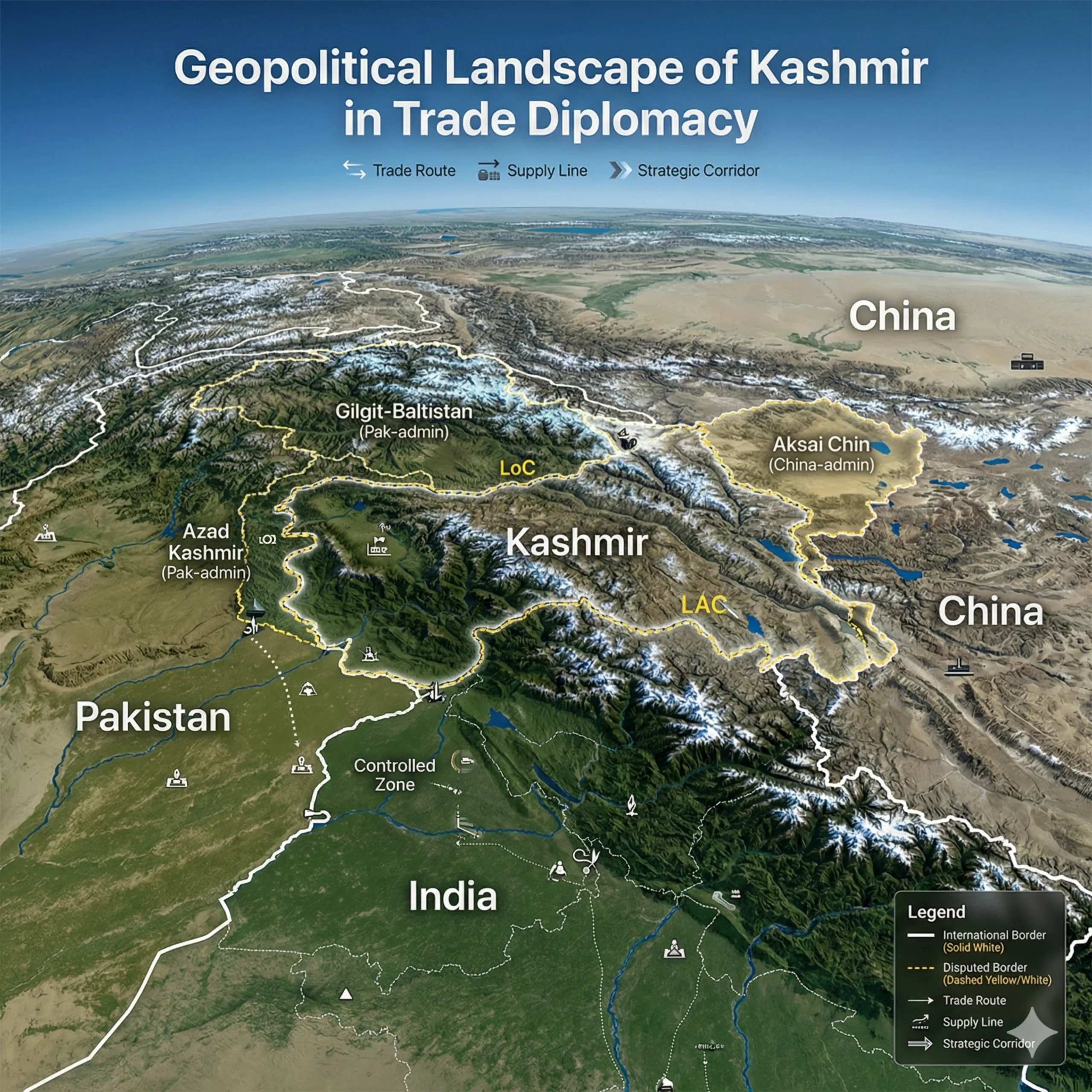
Washington — In early February 2026, the office of the United States Trade Representative published and then quietly removed a post on X promoting a new interim bilateral trade agreement with India. The graphic attached to the post included a stylized map of India that reflected the country’s official border claims, showing the entire Jammu and Kashmir region, including areas administered by Pakistan and the Aksai Chin area controlled by China, as integral Indian territory.
The post disappeared within days without any public explanation from US officials. Current promotions of the agreement on the same account make no reference to the original graphic and use no map at all.
The incident has drawn attention to the delicate balance Washington maintains on territorial disputes in South Asia, even as it deepens economic ties with New Delhi.
What the Deleted Post Contained
The now-deleted post appeared between February 6 and 7, 2026. It announced the completion of an interim framework described as a Phase 1 step toward a fuller bilateral trade agreement. The text highlighted reduced tariffs and increased market access for American products in India.
The accompanying image featured arrows pointing from the United States to India, illustrating flows of American exports such as agricultural goods, energy products, and industrial items. At the center was a map of India rendered in a style consistent with official Indian government depictions: solid lines enclosing the whole of Jammu and Kashmir and Aksai Chin.
American government maps have traditionally treated these areas differently. Jammu and Kashmir is generally shown with dashed lines to indicate disputed status, while Aksai Chin is often labeled separately or left ambiguous to avoid taking sides between Indian and Chinese claims.
Key Terms of the Interim Agreement
The framework, reached after months of negotiations, focuses on reciprocal tariff reductions and specific purchase commitments from India. Officials from both countries have described it as an early deliverable ahead of a more comprehensive deal.
The main provisions break down as follows:
- India agreed to eliminate or sharply lower tariffs on nearly all American industrial goods and a broad range of agricultural products, including almonds, pistachios, wine, spirits, soybean oil, fresh and processed fruits, red sorghum, and dried distillers grains.
- India committed to purchase more than 500 billion dollars in American goods over the next five years, covering energy products, aircraft and parts, metals, coal, and technology items such as graphics processing units.
- The United States will apply an 18 percent reciprocal tariff on selected Indian exports, including textiles, apparel, leather goods, plastics, chemicals, and machinery, while granting exemptions for pharmaceuticals, gems and diamonds, and certain aircraft components. Some national security related tariffs on aircraft parts will also be lifted.
- Both sides pledged to address nontariff barriers, including Indian regulations on medical devices, information and communication technology licensing, and food and agricultural standards.
- Additional sections cover supply chain cooperation, investment screening, export controls, digital trade rules, and preferential rules of origin designed to encourage bilateral trade.
American officials have emphasized benefits for farmers and manufacturers in states with large agricultural and energy sectors. Indian negotiators have highlighted relief for industrial exporters facing American tariffs imposed in previous years.
The Map and Its Diplomatic Weight
The choice of map in the deleted graphic stood out because it departed from long standing American practice. Successive administrations in Washington have avoided endorsing any single party’s territorial claims in Kashmir, calling instead for dialogue between India and Pakistan.
The dispute over Jammu and Kashmir dates to the 1947 partition of British India. India administers roughly half the former princely state, Pakistan controls about a third, and China holds Aksai Chin, which India claims. Multiple wars have been fought over the region, and it remains one of the world’s most militarized borders.
The United States has strategic interests on both sides. Pakistan has been a partner in counterterrorism efforts and regional stability initiatives. China, meanwhile, is America’s primary geopolitical rival, and Washington has worked to strengthen ties with India as a counterweight through frameworks such as the Quad.
Observers note that using India’s official map, even unintentionally, could be interpreted in Islamabad and Beijing as a shift in American neutrality. The rapid removal of the post suggests officials recognized the risk soon after publication.
No statement from the Office of the United States Trade Representative has addressed the deletion or clarified whether the map reflected any policy intention.
Reaction in India and Broader Context
In India, screenshots of the original post circulated widely on social media shortly after it appeared. Many users welcomed the map as evidence of growing American alignment with India’s position under the second Trump administration, which has prioritized closer relations with New Delhi.
Nationalist commentators pointed to the graphic as a quiet diplomatic victory. Others cautioned that the swift deletion indicated no real change in Washington’s formal stance.
The episode arrives at a time when US India economic relations are expanding rapidly. Bilateral trade in goods and services exceeded 200 billion dollars in recent years, though the United States maintains a substantial trade deficit. Previous tariff disputes, some dating to the first Trump term, had strained negotiations until the recent breakthrough.
The interim agreement fits a pattern of targeted deals the current administration has pursued with key partners to boost American exports and secure supply chains outside China. Similar arrangements have been reached or discussed with other countries in Asia and Europe.
Looking Ahead
As of February 11, 2026, the Office of the United States Trade Representative continues to promote the interim agreement through new posts that focus solely on economic benefits. No map appears in the updated materials.
Negotiators from both countries have signaled that talks will continue toward a broader agreement covering additional sectors such as services, investment protection, and intellectual property.
The brief appearance and disappearance of the Kashmir map serves as a reminder of how deeply territorial questions remain woven into even routine economic diplomacy in South Asia. While the substance of the trade framework moves forward, the episode underscores the careful line Washington walks between strengthening ties with India and avoiding unnecessary friction with Pakistan and China.