Why Srishti Lakhara Left Hinduism For Islam: The Untold Story of Faith, Freedom, and Fear
 Skasif
27/03/2026
Skasif
27/03/2026 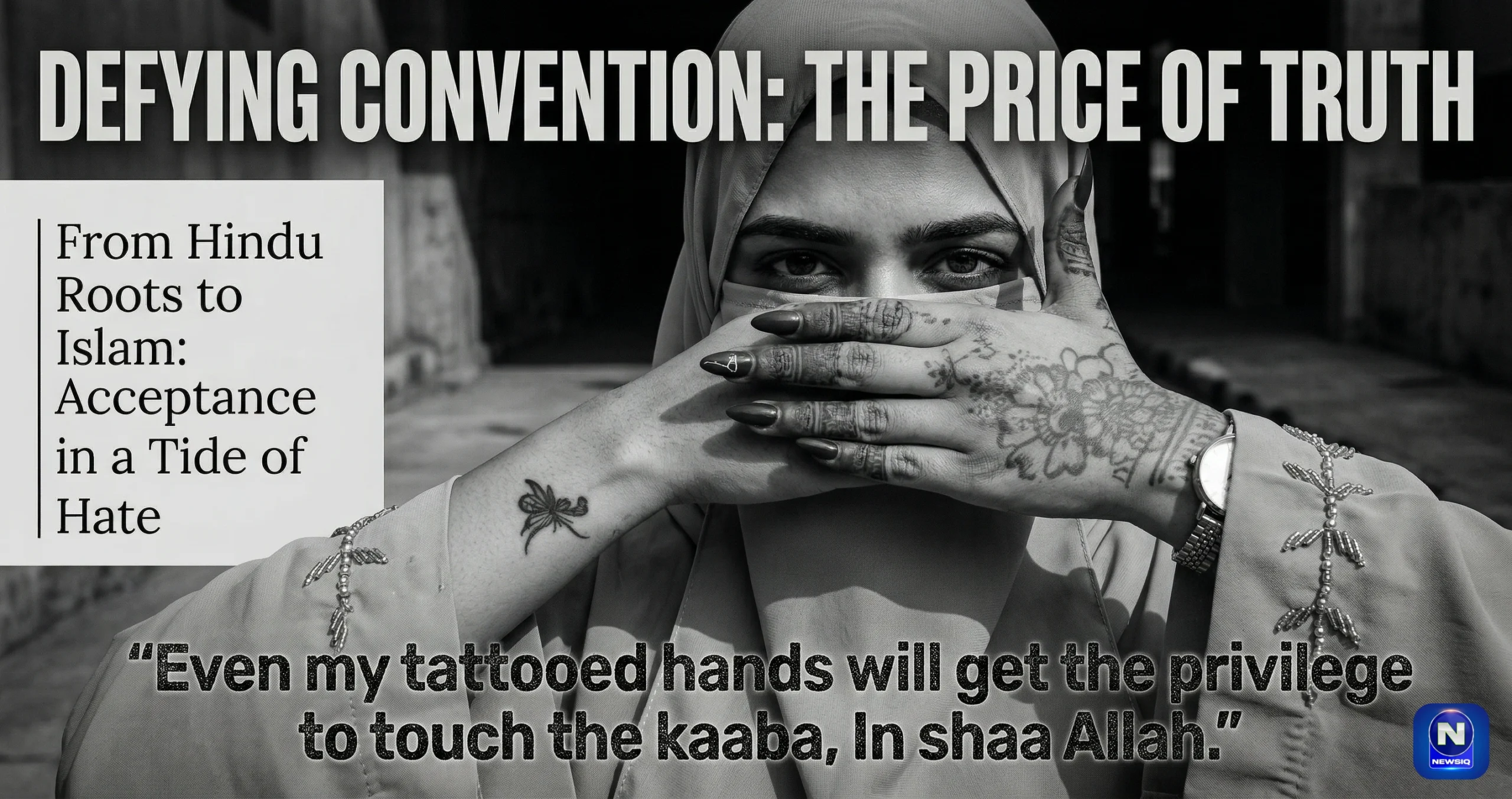
“Islam dignifies struggle.” Shrishti Lakhara reflects on her journey of faith and the resilience required to face modern defamation
She has tattooed hands. She has a postgraduate degree in clinical psychology. She spent years studying the human mind how it breaks, how it heals, how it searches for meaning in the chaos of existence. And after all that study, after all that searching, she arrived at a conclusion that has made her a target in her own country.
Srishti Lakhara was born into a Hindu family in India. Four years ago, she embraced Islam. It was not a decision she made lightly. It was not about love, money, or pressure from anyone. It was, as she puts it, a homecoming.
In a recent Instagram post, she opened up about why she chose Islam. Her words offer a rare window into the mind of someone who has thought deeply about faith, psychology, and the human condition. They also help explain why her decision has provoked such fury from radical Hindutva groups and why she now finds herself at the center of a hate campaign that reveals something deeply troubling about India today.
‘Islam Does Not Ask a Person to Abandon Reason’
In her Instagram post, Srishti wrote with the precision of a clinical psychologist and the soul of a seeker. She did not present her conversion as an escape from one religion to another. She presented it as an intellectual and spiritual reorientation.
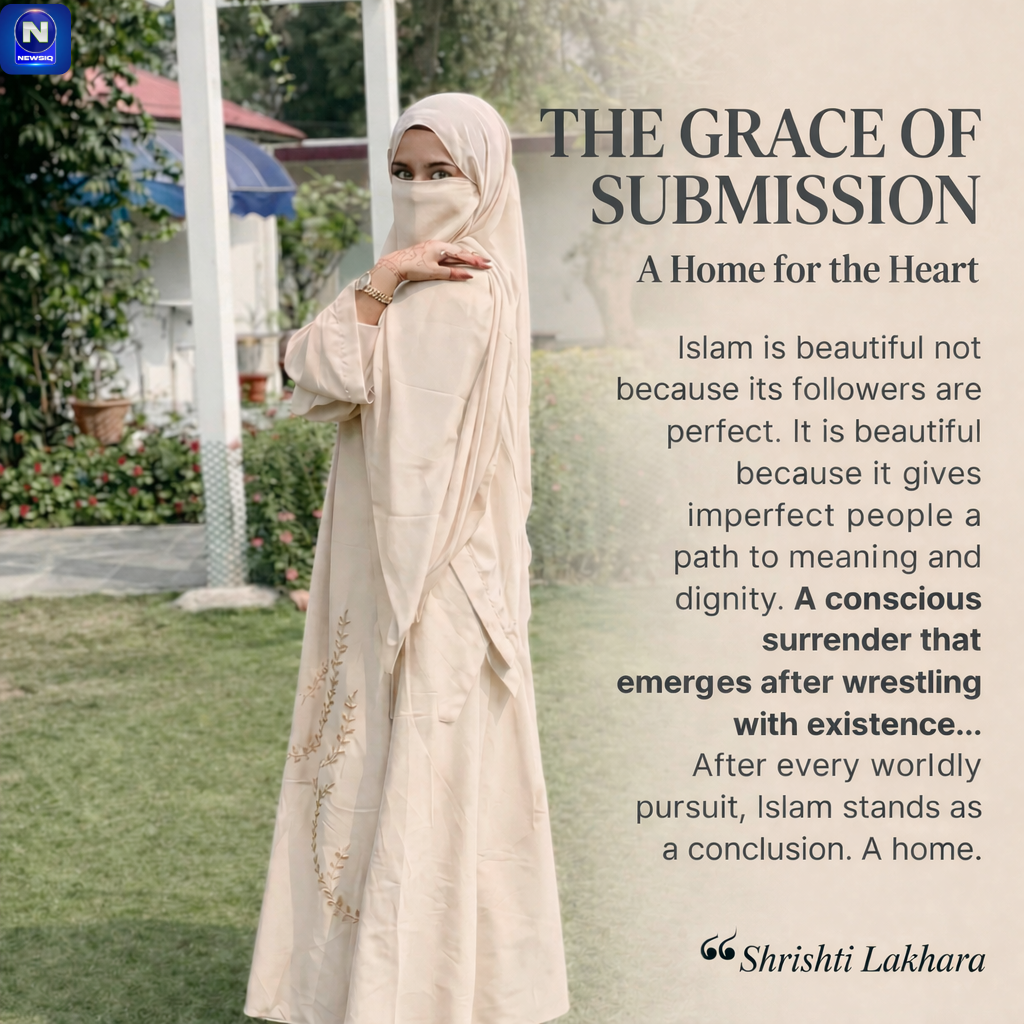
“Perhaps this is why those who truly encounter Islam do not merely convert they reorient,” she wrote. “Their fears rearrange. Their ambitions refine. Their loneliness finds language. Islam is not beautiful because its followers are perfect. Islam is beautiful because it gives imperfect people a path to meaning, dignity, and return.”
She emphasized that Islam does not ask a person to leave reason behind when they enter faith. Instead, it invites reason inside.
“The Quranic discourse is filled with questions: ‘Will you not reflect? Will you not ponder?’ This is the language of awakening. Faith in Islam is not blind submission. It is conscious surrender. A surrender that emerges after wrestling with existence, grief, purpose, mortality, and meaning.”
For Srishti, Islam offered something she had been searching for: a way to make sense of a fragmented world. She described it as a framework that gives the human soul a center.
“It transforms existence from accident into amanah, from chaos into qadr, from wandering into return,” she wrote. “And perhaps this is why those who truly understand Islam do not simply practise it they find rest in it. Because after every intellectual journey, every emotional storm, and every worldly pursuit, Islam stands not as an option among many, but as a conclusion.”
A Faith That Dignifies Struggle, Not Perfection
One of the most striking parts of Srishti’s post was her reflection on what she called Islam’s “psychological realism.” She pointed out that Islam does not pretend human beings are perfect. It acknowledges that people are fragile, inconsistent, hopeful, sinful and yet capable of rising above all of that.
“What makes Islam beautiful is not only its spiritual promises, but its psychological realism,” she wrote. “It acknowledges that the human being is fragile, inconsistent, hopeful, sinful, and yet capable of immense transcendence.”
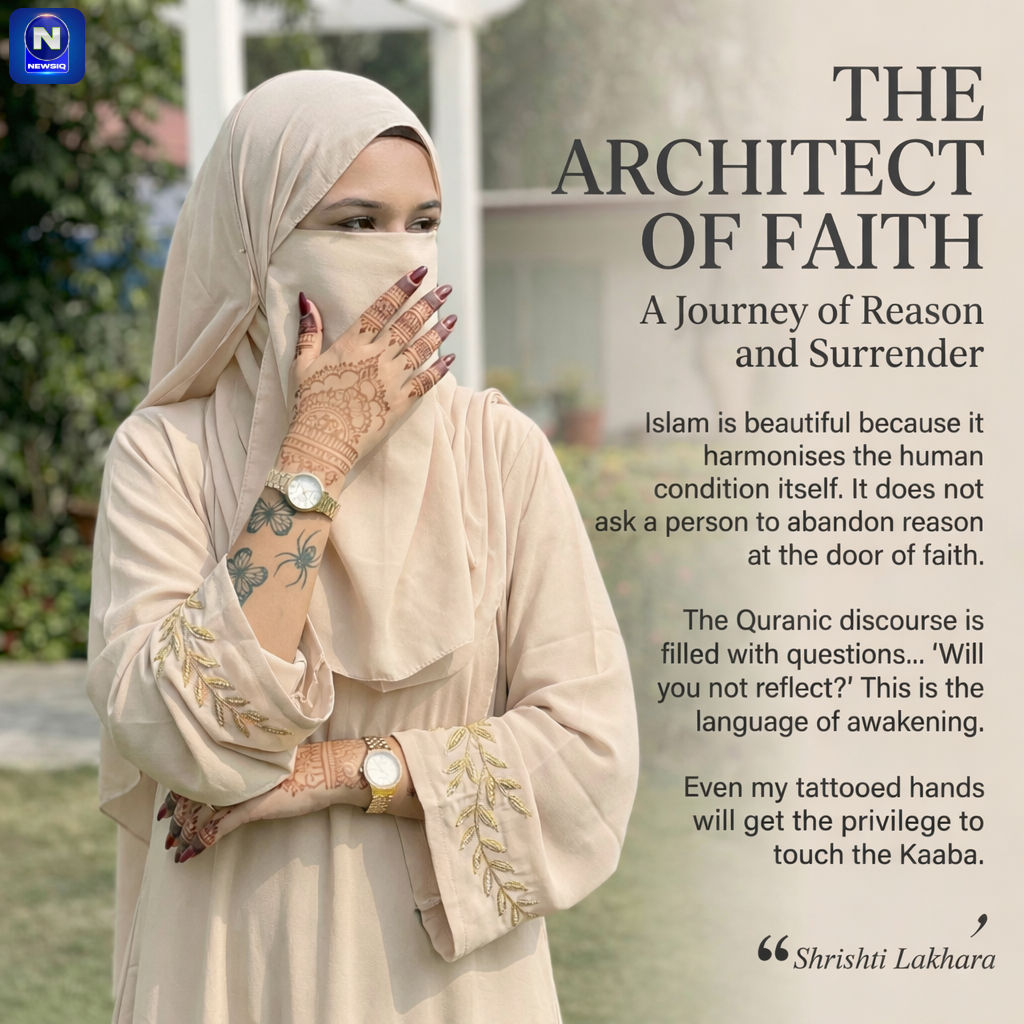
She offered a deeply personal example. “Even my tattooed hands will get the privilege to touch the Kaaba, In shaa Allah,” she wrote.
That line carries significant weight. In many religious traditions, there is an emphasis on outward purity. Tattoos, in particular, are often judged harshly. But Srishti’s point was that Islam does not demand perfection. It demands sincerity.
“Islam does not romanticise perfection; it dignifies struggle,” she wrote. “The one who falls and returns is beloved. The one who doubts and seeks is guided. The one who breaks and still prays is honoured.”
She described the act of prostration sajdah as the most radical intellectual act.
“Sajdah becomes the most radical intellectual act, the lowering of the ego before the Ultimate Reality,” she wrote. “It is here that philosophy ends and certainty begins. Not the certainty of arrogance, but the certainty of being held by a Wisdom far greater than one’s own.”
The Simplicity at the Heart of Islam
For Srishti, part of Islam’s appeal lies in its theological simplicity. There is one God. Absolute. Necessary. Independent. No intermediaries. No mythological complexities. No inherited guilt.
“A metaphysical structure so pure that it satisfies the intellect before it soothes the heart,” she wrote. “Tawheed is not only a doctrine of belief; it is a metaphysical structure so pure that it liberates the human being from servitude to creation, to status, to desire, to fear and reorients him towards the only Reality worthy of ultimate submission.”
This is not the language of someone who was tricked or pressured into converting. It is the language of someone who has spent years thinking, reading, and reflecting. It is the language of a clinical psychologist who understands the human mind well enough to know what she needs for her own peace.
What the Constitution Says
Srishti’s choice is protected by the Indian Constitution. There is no debate about this among constitutional scholars.
Article 25 guarantees every person the freedom of conscience and the right to freely profess, practice, and propagate religion. That includes the right to choose what you believe and the right to share those beliefs with others through persuasion.
In the Hadiya case of 2018, the Supreme Court of India ruled that an adult’s choice of religion and life partner is a private matter protected under Article 21, which guarantees the right to life and personal liberty. The court made clear that the state has no business questioning a person’s sincere religious choice unless there is evidence of force, allurement, or fraud.
Srishti’s case involves none of those things. She has been transparent about her journey. She has explained her reasons in writing. She has shared her reflections publicly. By any legal standard, her choice should be respected, not investigated.
A Target for Choosing Her Own Faith
Despite the constitutional protections, Srishti has become a target for radical Hindutva groups. In March 2026, a post on X (formerly Twitter) accused her of mocking Hinduism and trying to influence other women to convert. The post went viral, and the comments section turned into a cesspool of hate.
She was called a traitor. One user wrote that Hindu women are the biggest enemy of Hinduism. Another said Hindu women are not allies and should be treated as enemies.
She was accused of converting for money and fame. One user claimed she was chasing two billion followers. Another suggested that she was paid by Maktoob Media, the outlet that published her essay.
She was attacked with crude misogyny. One user said she had finally found a real man to control her. Another said women crave being tamed and Islam fulfills that perfectly. One user called her a prostitute.
Even her decision to keep her surname was weaponized. One user accused her of keeping her name to trick other Hindu women into converting. The same user called her a parasite that must be dealt with unmercifully.
There were threats. One user posted a GIF with the message: “Let her enjoy while she’s here under the burqa.” Others wrote “Lakhara = Bhimti, case closed” and “women need taming.”
This was not random trolling. It was a coordinated attack designed to intimidate not just Srishti but any woman who might follow a similar path.
Hypocrisy at the Heart of India’s Conversion Laws
What makes the outrage against Srishti so difficult to ignore is the glaring double standard.
When radical Hindutva organizations engage in what they call “Ghar Wapsi”—homecoming encouraging Muslim women to convert to Hinduism, it is celebrated. When figures like Pinky Chaudhry, associated with Hindu Raksha Dal, participate in such campaigns, they are praised as protectors of culture.
When a Hindu woman voluntarily chooses Islam, the same act is branded “love jihad.” That term has no legal definition. But it has become a powerful weapon used to criminalize interfaith relationships and conversions to Islam.
This double standard is now being written into law.
Several states governed by the Bharatiya Janata Party (BJP) have passed anti-conversion laws. The Rajasthan Prohibition of Unlawful Conversion of Religion Bill, 2025, which Srishti directly critiqued in her essay, is one of the harshest. It requires anyone wishing to convert to submit a declaration 90 days in advance, face public scrutiny, and appear before a district magistrate to prove their sincerity. Penalties include life imprisonment and fines up to one crore rupees.
Crucially, the law exempts Ghar Wapsi conversions back to Hinduism from these requirements.
Srishti captured the injustice perfectly when she wrote: “If I were to renounce Islam tomorrow and re-embrace Hinduism, the law would not question my decision. But to stay Muslim, I must justify it before the state.”
‘Must I Explain That I Wasn’t Brainwashed?’
For Srishti, the legal assault is only one part of a much deeper violation. As a woman, she faces a kind of scrutiny that male converts rarely experience.
In her essay, she called it “gendered fear.” She wrote about how female converts are always presumed to be victims of love jihad, of coercion, of deceit. Their agency is never taken seriously.
She recalled the case of Hadiya, a young medical student from Kerala whose conversion and marriage led to a legal battle that reached the Supreme Court. Hadiya was confined to her parents’ custody. Her story was dissected on national television. Only the Supreme Court’s intervention freed her.
“When I see that, I see myself,” Srishti wrote. “I sense the same gaze, one that doubts my agency, one that wonders who made me do ‘this.’”
She asked a question that goes to the heart of what is at stake: “Must I explain to a state officer that I wasn’t brainwashed, that I simply read, reflected and believed?”
The Cost of Freedom
Srishti’s experience is not unique. Across India, converts to Islam and Christianity report increasing suspicion from neighbors, landlords, employers, and state authorities. The hate campaigns on social media create a chilling effect, sending a message that even voluntary acts of faith can carry serious consequences.
In her essay, she described the psychological weight of living under this suspicion.
“For converts like me, this panic has tangible consequences,” she wrote. “Every interaction becomes political. A landlord’s suspicious glance, a colleague’s hesitation, a neighbour’s remark each small act accumulates into a sense of siege. The law validates social hostility, turning prejudice into a state sanction.”
And in the essay’s closing lines, she delivered a summary that should trouble anyone who cares about freedom:
“The law does not criminalise conversions; it delegitimises conviction. It tells people like me that our spiritual transformation is a potential crime. And the tragedy of being a convert in today’s India: to be born again in faith, only to die a little each day in freedom.”
A Test for India’s Democracy
India’s Constitution was built on the promise that people of all faiths could live together. Article 25 was written to protect the freedom of conscience the right of every individual to follow their inner truth, even when it leads away from the faith of their parents or the expectations of their community.
The Supreme Court has repeatedly upheld this principle. The Hadiya case was not an exception. It was a reaffirmation of what the Constitution already said.
But the treatment of Srishti Lakhara shows how far India has drifted from that promise.
She is not a criminal. She is not a traitor. She is a woman who read, reflected, and made a choice that brought her peace. She is a clinical psychologist who understands the human mind well enough to know what she needs for her own healing. She is a woman with tattooed hands who believes she will one day touch the Kaaba—not because she is perfect, but because Islam, as she understands it, dignifies struggle.
For that, she has been labeled a parasite, a prostitute, a target. And the people attacking her are not being condemned. They are being amplified.
Srishti’s story is a test. If India truly believes in the freedoms enshrined in its Constitution, then her choice like the choice of any citizen must be protected, not attacked.
If the country is to remain a democracy, then the freedom of conscience must be for everyone. Not just for those whose conscience leads them in the direction the state approves.
Until then, Srishti Lakhara’s words will stand as a quiet but powerful reminder of what is at stake:
“To be born again in faith, only to die a little each day in freedom.”
Srishti Lakhara is a clinical psychologist and writer. Her first blog headline , “An Indian Convert to Islam: Why Anti-Conversion Law Threatens My Very Identity,” was published in Maktoob Media on October 14, 2025. Her reflections on why she chose Islam were shared on her Instagram account.