Turkey Close to Joining Saudi-Pakistan Defense Pact: Major Shift in Regional Security
 Skasif
09/01/2026
Skasif
09/01/2026 
Turkey moves toward joining the Saudi Pakistan defense pact, reinforcing collective security and strategic cooperation.
Turkey Moves Closer to Joining Saudi-Pakistan Defense Pact
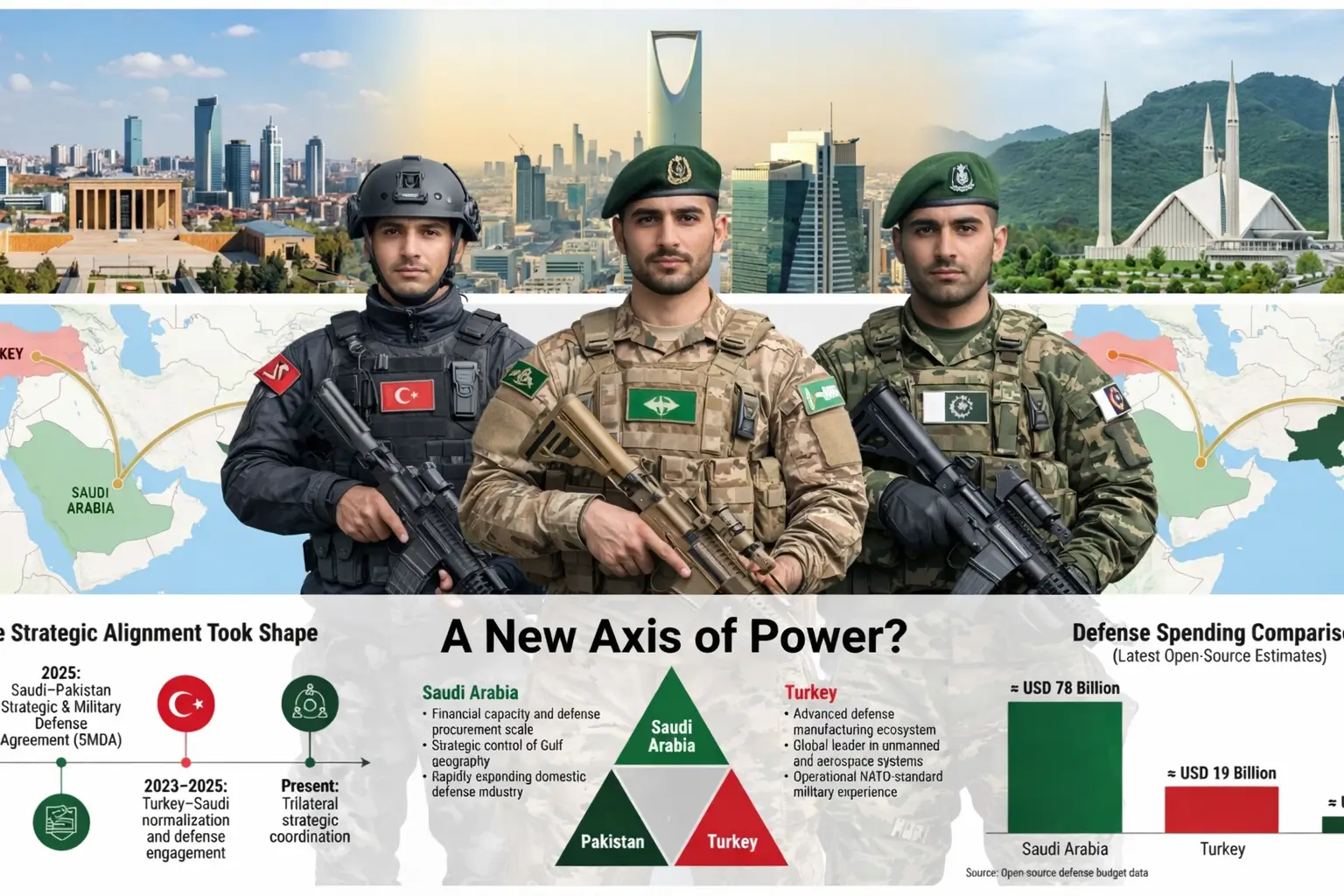
In a development that could redraw security lines from the Gulf to the Himalayas, Turkey is in advanced discussions to join a mutual defense agreement between Saudi Arabia and Pakistan, sources familiar with the matter told Bloomberg on January 9, 2026.
The potential expansion would link three of the Muslim world’s most influential powers each bringing distinct military and economic strengths into a formal bloc committed to collective defense. An attack on one would be treated as an attack on all, echoing the core principle of alliances like NATO.
This step comes just months after Saudi Arabia and Pakistan formalized their own Strategic Mutual Defense Agreement (SMDA) in September 2025, a pact that already raised eyebrows in capitals from New Delhi to Washington.
Roots of the Original Saudi-Pakistan Agreement
The foundation was laid in Riyadh on September 17, 2025, when Saudi Crown Prince Mohammed bin Salman and Pakistani Prime Minister Shehbaz Sharif signed the SMDA during a high-profile visit.
Pakistani state media broadcast images of the two leaders embracing, with Pakistan’s powerful army chief in attendance. The agreement’s centerpiece: any aggression against either nation would trigger a joint response.
Analysts described it as an institutionalization of decades-old ties. Pakistani forces have long trained Saudi troops, and the two countries have conducted regular joint exercises. Saudi financial support has repeatedly bolstered Pakistan’s economy, including billions in loans and investments.
For Riyadh, the pact diversifies security options beyond traditional Western partners. For Islamabad, it opens doors to deeper economic aid while elevating Pakistan’s strategic profile through its nuclear arsenal and battle-hardened military.
Concerns quickly surfaced about whether the deal implicitly extends Pakistan’s nuclear umbrella over Saudi Arabia. Saudi officials have called it a “comprehensive defensive agreement encompassing all military means,” according to Reuters reporting at the time, though they stopped short of confirming nuclear sharing.
Why Turkey Wants In
Turkey’s interest reflects President Recep Tayyip Erdogan’s long-standing ambition to position Ankara as a bridge between East and West and a leader in the Islamic world.
Turkey already enjoys robust defense ties with both Riyadh and Islamabad. Turkish firms supply Bayraktar drones to Saudi forces and collaborate on naval projects with Pakistan. Joint work on next-generation fighter aircraft has included invitations for Pakistani engineers.
Joining the pact would cement these partnerships into something far more binding: a unified deterrent against shared threats.
Each country offers unique assets. Saudi Arabia brings vast financial resources to bankroll acquisitions and infrastructure. Pakistan contributes nuclear capabilities, advanced missile systems, and a large army seasoned in mountainous and counterinsurgency warfare. Turkey adds NATO-honed expertise, a thriving domestic defense industry, and combat experience from operations in Syria and Libya.
All three have, at times, grown wary of over-reliance on the United States. Washington remains a key arms supplier and partner, but perceptions of inconsistent support whether on Yemen, Kashmir, or Kurdish issues have pushed these nations toward independent arrangements.
From Past Tensions to Renewed Cooperation
Relations haven’t always been smooth.
Turkey and Saudi Arabia clashed sharply in the late 2010s over the Khashoggi killing, Qatar blockade, and competing visions for regional influence. Trade dipped, and diplomatic barbs flew freely.
But pragmatism prevailed. High-level visits resumed, defense sales picked up, and joint naval drills signaled thawing ties. Trade volumes have since surged.
Pakistan has served as a reliable intermediary, maintaining deep connections with both. Shared positions on issues like Palestinian statehood and Afghan stability further align their outlooks.
Recent regional flashpoints have accelerated cooperation. Pakistan’s brief but intense border skirmish with India last year highlighted vulnerabilities. Ongoing instability in Afghanistan poses cross-border risks. In the Middle East, managing Iran ties preferring dialogue over confrontation remains a priority.
Ripple Effects Across the Region
If Turkey formally joins, the implications would stretch wide.
India, which maintains strong economic and defense links with both Saudi Arabia and Turkey, would face new complications in its rivalry with Pakistan. An expanded bloc could influence arms flows, diplomatic leverage in disputed territories, and broader South Asian dynamics.
Iran might view the arrangement as a counterbalance to its own networks, potentially heightening rhetorical tensions even as back-channel de-escalation continues.
Israel will watch closely, particularly on issues tied to Gaza and Arab normalization tracks.
The United States, counting all three as partners, has supplied advanced weapons and conducted joint training across the board. Yet this pact underscores a global trend: middle powers hedging bets amid doubts about unwavering superpower commitment.
China, already Pakistan’s closest ally and increasingly engaged with Saudi Arabia, could find new avenues for involvement in regional stability initiatives.
Fitting Into Larger Global Patterns
This emerging alliance fits a broader wave of flexible, non-exclusive partnerships.
Nations worldwide are building overlapping security networks that complement rather than replace traditional blocs. Think BRICS expansion, AUKUS in the Indo-Pacific, or Gulf states deepening ties with Asia.
Nuclear questions linger. Pakistan’s status as the only nuclear-armed Muslim nation fuels speculation about extended deterrence. Officials stress the pact’s purely defensive nature, and any overt nuclear sharing would invite fierce international backlash.
No evidence suggests such steps are underway, and public details remain sparse.
Road Ahead
Diplomats in Ankara, Riyadh, and Islamabad have stayed tight-lipped, typical for sensitive talks.
But sources tracking the process describe momentum as strong. A formal announcement could come in the coming months.
Whether the group remains a trio or draws interest from others is unclear. Some analysts float names like Malaysia or Azerbaijan, though nothing concrete has emerged.
What is clear: these countries are proactively shaping their security environment in an increasingly multipolar world.
From the Persian Gulf through the Arabian Sea to the Bosphorus, this potential tripartite pact represents a deliberate effort to adapt to new realities one that observers in Washington, Beijing, New Delhi, and beyond will scrutinize closely.
Follow NewsIQ for clear, independent reporting on global security, diplomacy, and geopolitical shifts shaping the world.



VN88ME, shoutout! Quick signup, smooth gameplay and the support team isn’t a bunch of bots. That’s a win in my book. Go peep it: vn88me