Hongqi Bridge Collapse in Sichuan: No Casualties After Landslide
 Skasif
11/11/2025
Skasif
11/11/2025 
A representational view of a modern bridge illuminated at night, symbolizing the newly built Hongqi Bridge in Sichuan, China, before its reported collapse.
Sudden collapse shocks new infrastructure project
BEIJING, Nov 11 (Newsiq) –Part of a newly built bridge in southwest China’s Sichuan province has collapsed, just months after it opened to the public. Local authorities confirmed that no casualties occurred, but the incident has raised fresh concerns about construction quality and geological safety in one of China’s most mountainous regions.
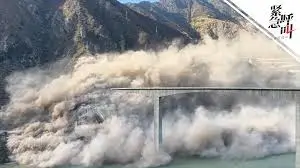
758-meter-long Hongqi Bridge, located in Maerkang city in the Aba Tibetan and Qiang Autonomous Prefecture, was part of the National Highway 317, a key route connecting the province’s heartland with Tibet. The collapse occurred on Tuesday afternoon, November 11, 2025, following visible terrain shifts and a series of landslides along the nearby mountainside.
Police had closed the bridge a day earlier after cracks were spotted on nearby slopes and roads. Officials monitoring the area reported that the ground around the mountain had begun to move — a warning sign that proved critical. By Tuesday, the slopes gave way entirely, triggering multiple landslides that destroyed the approach span and roadbed of the bridge.
Early closure prevented tragedy
Authorities emphasized that the swift decision to close the Hongqi Bridge on Monday likely prevented a major disaster. “Safety checks showed abnormal ground movement, so traffic was suspended immediately,” a Maerkang city spokesperson said during a local briefing. Because of that precaution, there were no vehicles or pedestrians on the bridge when the structure failed.
Area has now been sealed off. Rescue and inspection teams were dispatched to assess the extent of the damage, though their work quickly shifted from rescue to investigation once it became clear that there were no injuries.
Newly opened structure among China’s modern bridges
Construction of the Hongqi Bridge had been completed earlier in 2025, and it officially opened to traffic only a few months before the collapse. Built by the Sichuan Road and Bridge Group, the project was promoted as part of China’s ongoing effort to modernize road links between Sichuan and Tibet — one of the country’s most ambitious infrastructure corridors.
Bridge, which spanned a steep valley surrounded by fragile mountain terrain, had been designed to handle heavy traffic along the 317 National Highway. Engineers described it as a “strategic lifeline” for trade and travel between the western provinces and the Tibet Autonomous Region.
Its failure has now placed that lifeline on hold. Traffic across the route has been suspended indefinitely, with local authorities rerouting vehicles and warning travelers to avoid the affected zone.
Landslides blamed, but questions remain
Preliminary reports attribute the collapse to landslides and terrain deformation triggered by ongoing geological shifts on the surrounding mountainside. Southwestern China, particularly Sichuan, is known for complex terrain and frequent seismic and weather-related activity that can destabilize slopes.
However, experts say it’s too early to conclude that natural causes alone are to blame. An official investigation is underway to determine whether geological assessments during construction were sufficient, and whether the structural design accounted for long-term soil movement.
Questions being asked include:
Were slope stabilization and drainage systems properly implemented?
Did engineers identify and monitor potential landslide zones adequately?
Were warning signs of terrain movement recognized early enough to prevent structural damage?
Authorities are expected to release a detailed report once structural engineers and geologists finish their analysis.
Public reaction and growing scrutiny
Videos and photos of the bridge collapse spread quickly across Chinese social media platforms, showing large sections of the approach road torn apart and hanging over the valley. The images fueled widespread discussion about the safety of newly built infrastructure and the speed at which many of these projects are completed.
The Hongqi Bridge collapse comes amid a period of record infrastructure expansion across China, with thousands of new bridges, highways, and tunnels completed each year. While these projects have connected previously isolated regions, incidents like this one have renewed public debate about construction standards and long-term durability.
Several users online questioned how a bridge completed less than a year ago could fail so suddenly. Others praised the quick response by local authorities, noting that closing the bridge ahead of time likely saved many lives.
Local terrain and geological risks
Sichuan province’s geography makes construction a constant challenge. The region sits at the intersection of several active fault lines and features some of China’s steepest mountain landscapes. Seasonal rain and frequent landslides make large-scale engineering projects especially complex.
Maerkang city, where the bridge was located, lies within the Aba Tibetan and Qiang Autonomous Prefecture — an area known for its elevation changes, deep valleys, and unstable slopes. Landslides are not uncommon, particularly after heavy rainfall or ground movement in late autumn.
Geologists familiar with the region note that slope monitoring systems must operate continuously in such areas. “Terrain deformation happens in stages,” one expert explained. “It rarely occurs overnight, but if signs are missed or underestimated, the results can be catastrophic.”
Infrastructure expansion under the spotlight
China’s drive to modernize its western and southwestern provinces has produced some of the world’s most advanced bridges and tunnels. Projects like the Hongqi Bridge symbolize national efforts to reduce travel times and boost regional development. Yet the collapse serves as a stark reminder of the risks of building across complex terrain.
Over the past decade, several bridge and tunnel incidents have prompted tighter regulations and calls for greater transparency in inspection and maintenance. Engineers say that while construction quality has generally improved, rapid timelines and budget pressures can sometimes compromise long-term safety.
Analysts believe that this incident will likely push regional authorities to review current infrastructure safety protocols, particularly in mountainous areas. It may also prompt stricter oversight on geological surveys and require more frequent post-construction inspections.
Impact on transport and economy
The immediate disruption caused by the collapse is significant. National Highway 317 is a critical supply route linking Chengdu Sichuan’s capital with key cities across western China and the Tibet Autonomous Region. It supports commercial transport, tourism, and logistics vital to the region’s economy.
With the bridge out of service, detours and delays are expected for weeks or even months. Local businesses depending on the route for delivery and trade are already reporting setbacks, and regional transport authorities have deployed temporary measures to redirect traffic safely.
Official response and next steps
Authorities have pledged a thorough investigation and promised accountability if negligence or design flaws are found. Structural engineers, safety inspectors, and geological experts have been dispatched to the site to analyze debris patterns, slope composition, and bridge materials.
Once the investigation concludes, the government will determine whether the bridge can be rebuilt on the same site or if the terrain poses ongoing risk. In the meantime, emergency slope stabilization work is being carried out to prevent additional landslides.
Officials also noted that infrastructure monitoring systems across Sichuan will be reviewed to identify other potential risk zones. The goal is to prevent similar collapses by improving early-warning mechanisms and integrating more advanced geological data into design and maintenance stages.
A warning for the future
While no lives were lost, the Hongqi Bridge collapse stands as a powerful reminder of how nature and engineering remain in constant tension — especially in a country building on such an enormous scale. Each structure that connects remote regions also tests the limits of design, safety, and environmental understanding.
For engineers, the lesson is clear: even cutting-edge projects must respect the terrain they rise from. For policymakers, it’s a call to balance speed with sustainability ensuring that the push for connectivity never outpaces the need for caution.
As investigators continue their work, the ruins of the Hongqi Bridge now serve as a symbol of both human progress and vulnerability a steel reminder that, in the mountains of Sichuan, even the strongest foundations must still answer to the earth beneath them.
Summary
A brand‑new bridge in Sichuan’s rugged mountains Hongqi Bridge, part of the crucial National Highway 317 linking the province to Tibet collapsed just months after opening. Thanks to a timely shutdown after cracks appeared on the surrounding slopes, nobody was hurt. The failure was triggered by massive landslides and shifting terrain, a common hazard in this seismically active, rain‑soaked region.
Investigators are now probing whether the bridge’s design, drainage, and slope‑stabilization measures were adequate, or if the disaster stems solely from nature’s relentless forces. The incident has sparked a wave of public debate over China’s rapid infrastructure boom, highlighting the tension between speedy development and long‑term safety in treacherous mountain terrain.
With the bridge out of service, traffic on Highway 317 is rerouted, disrupting commerce and travel while officials promise a thorough inquiry and tighter monitoring of future projects. The Hongqi Bridge collapse serves as a stark reminder that even the most modern engineering must respect the earth beneath it.