OpenAI Developing AI Phone With Agent System
 Skasif
28/04/2026
Skasif
28/04/2026 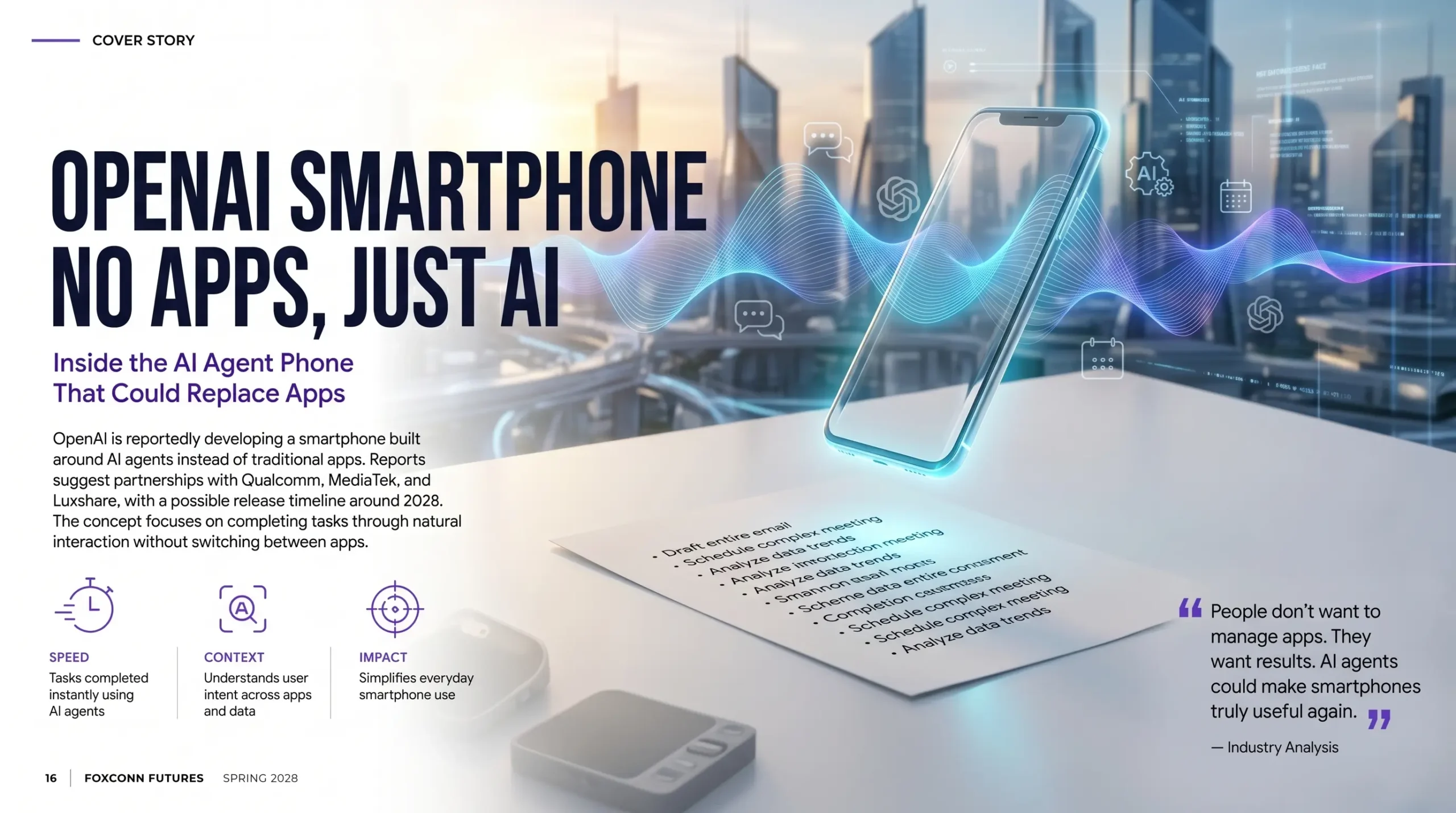
OpenAI smartphone concept shows how AI agents could replace apps and change how people use mobile devices
OpenAI Smartphone Rumors Point to Agent Future
A fresh note from supply-chain analyst Ming-Chi Kuo has tech circles buzzing. OpenAI appears to be moving forward with plans for its own smartphone, one built around AI agents rather than the usual grid of apps. The project would involve custom chip work with MediaTek and Qualcomm, while Luxshare would serve as the main co-design and manufacturing partner.
This isn’t idle speculation. Kuo, known for accurate Apple predictions, laid out a clear timeline: specifications and suppliers should be finalized by the end of 2026 or first quarter of 2027. Mass production would follow in 2028. For context, OpenAI has already signaled its first hardware product could arrive in the second half of 2026 — previously expected to be AI earbuds tied to its Jony Ive collaboration.
What the Reports Actually Say
Kuo’s analysis highlights a core idea: users don’t want to juggle apps. They want tasks completed. The rumored OpenAI AI phone would use agents that understand context location, messages, calendar, habits and act across services without forcing users to open separate programs.
MediaTek and Qualcomm would help develop smartphone processors optimized for this approach. Both companies already push AI features in flagship Android devices. Luxshare OpenAI phone involvement makes sense given its deep experience with Apple supply chains. The setup points to a blend of small on-device models for speed and privacy alongside larger cloud models for complex jobs.
Why Build an OpenAI Mobile Device Now
Apple and Google tightly control what apps can access on iOS and Android. That limits how deeply AI can operate. By owning the hardware stack, OpenAI could give its agents broader system access something the company believes is necessary for truly useful AI.
Sam Altman seemed to echo this thinking. On April 26, 2026, he posted about rethinking operating systems and user interfaces so they work better for both people and agents. The timing lines up with Kuo’s note and suggests OpenAI sees the smartphone as too central to AI usage to ignore

The Jony Ive Hardware Connection
OpenAI’s hardware ambitions stretch beyond one device. The company has been linked to Jony Ive on a family of AI products, including a smart speaker with camera, smart glasses, and possibly more. The phone rumor fits into that bigger picture even if it competes directly with the iPhone.
A full OpenAI agent smartphone would be the boldest move yet. Earlier chatter focused on wearables or a screenless device. Jumping into the premium phone market puts OpenAI head-to-head with the most entrenched players in consumer electronics.
Timeline and What Comes Next
- Now through late 2026/early 2027: Finalize chip details, suppliers, and specifications.
- 2028: Mass production begins.
- Second half of 2026: OpenAI’s first announced hardware still likely the earbuds or another Ive-related product.
Don’t expect the phone on store shelves anytime soon. Hardware development cycles are long, especially when building custom silicon and new software approaches. OpenAI phone release date talk remains firmly in the rumor stage.
How Agents Could Replace Apps
The pitch is straightforward. Tell the phone what you need book a flight, summarize emails, edit photos, manage schedules and the agent makes it happen using natural conversation and deep system integration. No more switching between apps or digging through menus.
MediaTek AI processing and Qualcomm OpenAI chips would power the on-device side for quick responses. Continuous context awareness would make the experience feel personal and proactive. Kuo put it plainly: people are trying to get tasks done, not use a pile of apps.
Challenges Facing an AI-First Mobile Device
Reliable agents remain difficult. Hallucinations, mistakes on important tasks, and battery drain from constant context monitoring are real hurdles. Privacy concerns will be front and center, especially in Europe under GDPR rules that strictly govern data collection.
Supply chain questions involving China-based Luxshare could also draw scrutiny in the US and EU. Competing against Apple’s ecosystem loyalty and Google’s search dominance is no small task. History is littered with failed iPhone challengers.
Impact on Users and the Industry
For everyday people in Seattle, London, or Berlin, a no-app smartphone could simplify daily routines. Imagine an agent that handles travel bookings, pays bills, or learns your preferences without constant input. Developers might shift focus from traditional apps to tools that work alongside agents. The entire app economy could evolve.
On the business side, Qualcomm shares reacted positively to the news. For OpenAI, controlling hardware opens new revenue paths beyond ChatGPT subscriptions device sales, premium agent features, or richer training data from daily use.
Where It Stands Against the iPhone
Some voices, including Perplexity CEO Aravind Srinivas, argue AI actually makes the iPhone more valuable. Others see room for something entirely new. An OpenAI AI phone vs iPhone battle would test whether a radically different interface can win over users who already love their current devices.
Nothing CEO Carl Pei has publicly said apps will eventually go away. The conversation around AI-first operating systems is gaining steam across the industry.
What Remains Unclear
OpenAI has not commented on the reports. Exact design, pricing, software details, and how closely it ties into the Jony Ive work are still unknown. Questions linger about battery life, reliability of agents in real-world use, and whether consumers are ready to ditch familiar apps.
The project could still shift or expand. Kuo also mentioned OpenAI’s broader ambitions, potentially delivering multiple devices by the end of 2028.
This OpenAI smartphone story feels different from past hardware hype because it builds on real supply-chain signals and aligns with the company’s massive user base nearing a billion weekly ChatGPT interactions. Whether it becomes the next-generation AI hardware that reshapes phones or joins the graveyard of iPhone competitors will play out over the next few years. For now, the leaks and analysis have made one thing clear: the discussion around the future of smartphones AI has officially moved beyond theory.