Zohran Mamdani Makes History: First Muslim Mayor of New York City Sworn in on Quran
 Skasif
01/01/2026
Skasif
01/01/2026 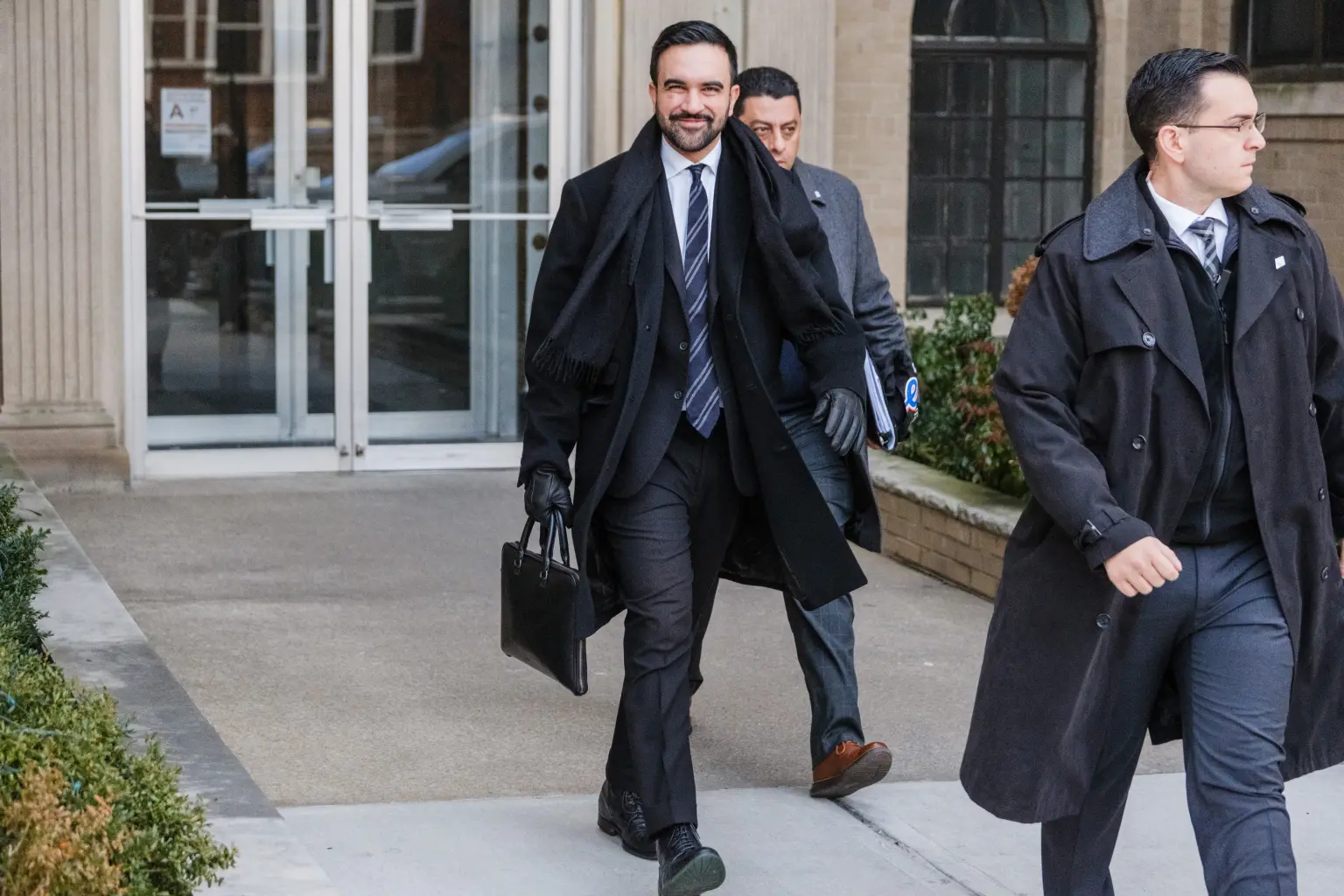
New York City Mayor-elect Zohran Mamdani leaves his apartment building in Astoria, Queens, on December 31, 2025.
Zohran Mamdani officially became New York City’s 112th mayor in the early moments of January 1, 2026, when he placed his hand on a historic Quran and took the oath of office in an abandoned subway station deep beneath City Hall. This midnight ceremony marked a watershed moment in American urban leadership and Muslim political representation, breaking barriers that seemed immovable just a generation ago.
At 34 years old, Mamdani is not only the first Muslim to lead the nation’s largest city, but also its first South Asian mayor and first leader born in Africa. His ascent from a state assemblyman representing Queens to the helm of New York City in little over a year represents an extraordinary political moment whose implications extend far beyond City Hall.
A Midnight Ceremony Steeped in Symbolism
The choice to hold the private swearing in at the Old City Hall subway station was deliberate and laden with meaning. This historic station, one of the original 28 stops opened with the city’s first subway line in 1904, has been decommissioned for decades and is accessible only through occasional guided tours. Mamdani’s transition team explicitly stated that the location reflected his commitment to “the working people who keep our city running every day” a symbolic gesture grounding his administration in the everyday struggles of ordinary New Yorkers rather than the corridors of traditional power.
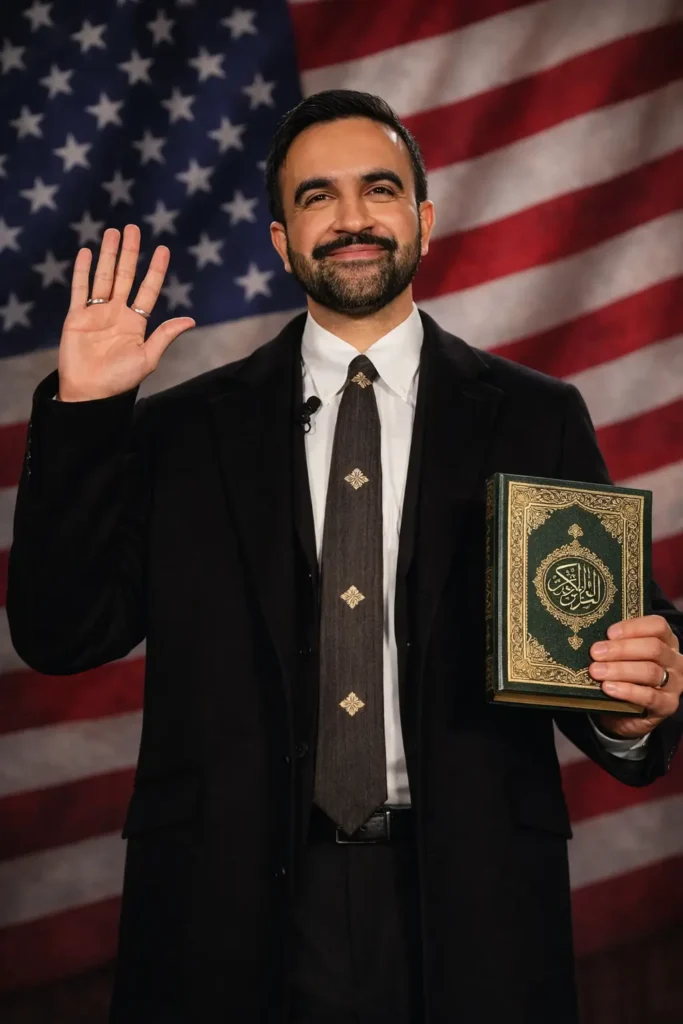
New York Attorney General Letitia James administered the oath at the stroke of midnight as 2026 began. Standing beneath the ornate vaulted ceiling inscribed with the words “City Hall,” Mamdani spoke directly to the moment: “Happy New Year to New Yorkers, both inside this tunnel and above. This is truly an honor and a privilege of a lifetime.” His wife, Rama Duwaji, stood beside him as he took the oath, their family and close advisors witnessing the moment in the cavernous station.
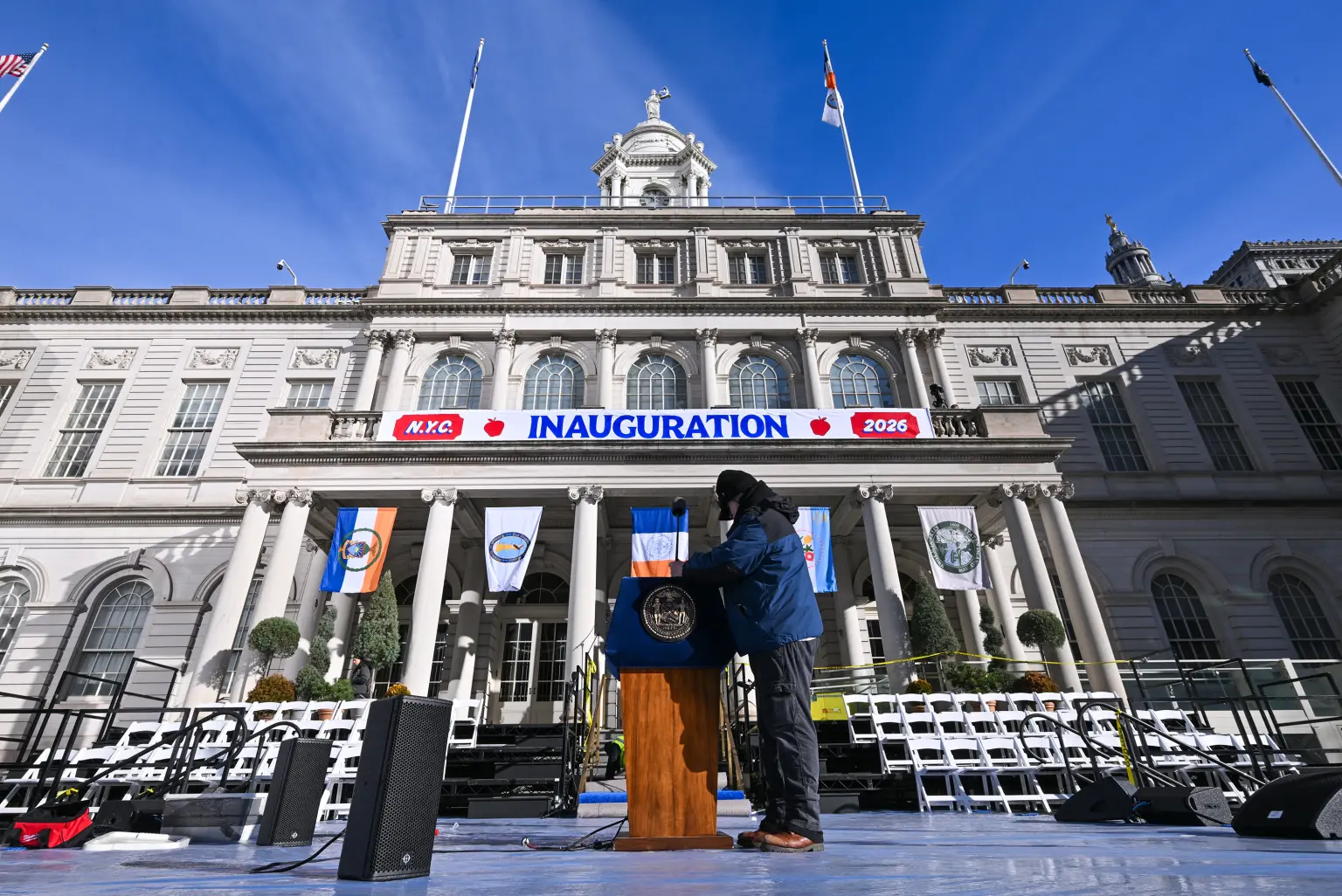
The public ceremony followed later that day at 1 p.m. outside City Hall, where Vermont Senator Bernie Sanders a Brooklyn-born progressive who has been Mamdani’s ideological mentor administered a second oath of office. Representative Alexandria Ocasio-Cortez delivered the opening remarks to an invited audience of 4,000, while tens of thousands more participated through free livestream viewing areas set up along Broadway’s iconic “Canyon of Heroes.” The celebration extended into the evening with a block party featuring music, speeches, and remarks from artists, small business owners, and community leaders who had shaped Mamdani’s campaign and vision.
The Historic Qurans: Personal Heritage and Collective History
The religious texts Mamdani selected for his oaths were chosen with meticulous attention to symbolism, weaving together personal family heritage with the broader tapestry of New York City’s cultural history. During the midnight subway ceremony, he placed his hand on two Qurans: one that belonged to his grandfather, a direct link to his family’s Islamic faith, and a centuries-old pocket edition borrowed from the New York Public Library’s Schomburg Center for Research in Black Culture.
That second Quran deserves particular attention. The manuscript, produced in Ottoman Syria in the 19th century with elegant naskh script and gilt-stamped floral bindings, belonged to Arturo Alfonso Schomburg (1874–1938), a pioneering Black Puerto Rican historian, bibliophile, and intellectual of the Harlem Renaissance. Schomburg was not himself Muslim, but he collected this Quran as part of his lifelong mission to document the global contributions of people of African descent and to challenge a schoolteacher’s dismissive claim that Black culture lacked major historical figures.
In 1926, Schomburg sold over 4,000 items from his personal collection to the New York Public Library, establishing what would become the Schomburg Center, now recognized as one of the world’s premier research institutions dedicated to Black history and culture. Hiba Abid, the NYPL’s curator of Middle Eastern and Islamic Studies, articulated the profound resonance of this choice: “It’s a highly symbolic choice because we’re about to have a Muslim mayor swearing in using the Quran but also a mayor who was born on the African continent, in Uganda. It really brings together here elements of faith, identity and New York history.”
For his public ceremony, Mamdani used his grandfather’s Quran alongside one belonging to his grandmother, extending the intergenerational and familial symbolism into the formal proceedings. Following the inauguration, the Schomburg Center’s Quran will be displayed publicly at the NYPL’s Stephen A. Schwarzman Building starting January 6, 2026, coinciding with the Schomburg Center’s centennial celebration—a moment of institutional recognition that blends the personal act of oath-taking with institutional memory and collective heritage.
Breaking with Mayoral Tradition
Mamdani’s use of the Quran represents a historic first for New York City. While previous mayors have chosen religious texts with personal significance, none have ever used Islam’s holy scripture. The trend among his recent predecessors reflects the broad discretion mayors have had in selecting their texts of choice.
Michael Bloomberg, elected in 2001 in the months following the September 11 attacks, used a centuries-old family Bible that he had received at his bar mitzvah. Bill de Blasio, in 2014, opted for a Bible that had belonged to President Franklin D. Roosevelt—a selection that created an anxious moment when the historic volume went missing for hours after the ceremony before being recovered. Eric Adams, Mamdani’s predecessor, was sworn in with a family Bible, holding a portrait of his deceased mother as the Times Square ball dropped on New Year’s Eve 2022. Notably, New York City imposes no requirement that mayors use any religious text whatsoever when taking their oaths—a discretionary tradition rather than a mandate.
A Democratic Socialist Takes the Helm
Mamdani’s political ideology and policy platform have attracted both fervent support and considerable criticism. A member of the Democratic Socialists of America, he has positioned himself as a radical alternative to the centrist and technocratic approaches of his predecessors. His mayoral campaign centered relentlessly on affordability—the core issue animating his political movement and his appeal to working-class New Yorkers across the city’s five boroughs.
His platform includes three flagship proposals: universal free childcare for all children aged six weeks to five years; a complete rent freeze for approximately one million rent-stabilized apartments; and free public transportation across the entire city transit system. Additional commitments include construction of 200,000 affordable housing units over the next decade and expanded subsidies for in-home childcare providers.
The childcare initiative is perhaps his most ambitious undertaking, projected to cost approximately $6 billion annually for the city. Governor Kathy Hochul, despite her reputation as a moderate with strong ties to the business community, has expressed explicit support for this proposal and committed state resources. The rent freeze, by contrast, can theoretically be implemented more quickly through the mayor’s control of the city’s Rent Guidelines Board, though Eric Adams’ final appointments to the board may complicate Mamdani’s ability to move immediately a point of strategic tension as his administration begins.
Mamdani has acknowledged that realizing his full agenda will require cooperation from New York’s state legislature and an increase in taxes on corporations and wealthy individuals. The question of whether a Democratic-controlled legislature, even in the deep-blue state of New York, will embrace such redistributive policies remains an open question as his administration formally begins.
An Unexpected Trump Alliance
Few political developments in 2025 proved more surprising than the apparent warming between Donald Trump and Zohran Mamdani. For months during the mayoral campaign, the relationship was characterized by mutual hostility. Trump had dismissed Mamdani as a “communist lunatic” and threatened to send the National Guard to New York City and cut billions in federal funding if the socialist were elected. Mamdani, meanwhile, had described Trump as a “fascist” and a “despot,” signaling fundamental ideological opposition.
Yet on November 21, 2025, less than three weeks after his general election victory, Mamdani accepted an invitation to the White House for a private meeting with Trump in the Oval Office. What emerged from that hourlong discussion was a remarkable reversal of rhetoric. Both leaders indicated they had found common ground on issues affecting New York’s affordability crisis specifically rent, grocery prices, utilities, and the cost of living generally. Trump told reporters he would assist Mamdani in his efforts, saying “We agreed on a lot more than I would have thought,” and “I’ll be cheering for him.”
Mamdani echoed this conciliatory tone, emphasizing that their meeting “focused not on places of disagreement—which there are many—and also focused on the shared purpose that we have in serving New Yorkers.” He framed the conversation as rooted in “mutual respect and love” directed at helping those “struggling to make ends meet in the most expensive city in the United States.”
Political observers have interpreted this shift as Mamdani’s strategic decision to minimize antagonism with the Trump administration and secure federal cooperation rather than resistance. As political analyst Ross Barkan noted, “If Trump is less antagonistic towards Mamdani, the idea is to have Trump do as little damage as possible to New York City. He’s not going to attack. He’s going to try to build coalitions.” Whether this pragmatic ceasefire holds once Mamdani takes office remains uncertain, but it signals a willingness to engage across ideological lines when city interests are at stake.
Broader Context: Muslim Americans’ Political Ascendance
Mamdani’s inauguration arrives at a pivotal moment in the political trajectory of Muslim Americans. In November 2025, a record 42 Muslim Americans won elected offices across the United States in off-year elections the highest number ever recorded. These victories spanned mayoral offices, city councils, school boards, judicial positions, and state legislative races. This achievement marks the culmination of a decade-long political awakening within Muslim communities that began from a position of severe marginalization in the immediate post-9/11 era.
In 2010, fewer than 20 Muslims held elected office across the entire United States. By 2020, that number had more than tripled. The 2025 elections brought the total to 42 new Muslim officials elected in a single cycle, with potentially more to come as remaining recounts and runoff elections are finalized. This trajectory represents not merely numerical growth but a qualitative shift the movement of Muslim Americans from political outsiders to participants in mainstream governance.
Keith Ellison made history in 2007 when he was sworn to Congress as the first Muslim member of the House of Representatives, using an English translation of the Quran that had once belonged to President Thomas Jefferson. The choice generated controversy, with Representative Virgil Goode (R-VA) warning in a letter to constituents that Ellison’s decision threatened “the values and beliefs traditional to the United States of America.” Yet the controversy only highlighted how profoundly America’s constitutional protections of religious freedom applied equally to all faiths.
Ilhan Omar, who succeeded Ellison in his Minnesota congressional seat in 2019, and Rashida Tlaib both took their House oaths using copies of the Quran. Rashida Tlaib was one of the first two Muslim women elected to Congress. These figures established a precedent: that Muslim elected officials could be open about their faith while serving effectively in the nation’s highest legislative body.
Now, with Ghazala Hashmi’s election as Virginia’s Lieutenant Governor in 2025, Muslim Americans have broken into statewide executive offices. Mamdani’s ascent to the mayoralty of the nation’s largest city represents the apex of this trend a 34-year-old democratic socialist of Ugandan and Indian heritage leading an 8-million-person metropolis, openly embracing his Muslim faith as an integral part of his political identity.
Political observers recognize that Mamdani’s success will likely catalyze further Muslim political engagement. Basim Elkarra, executive director of CAIR Action, told Religion News Service that “Mamdani has definitely invigorated many Muslims around civic participation, and I do think that there will be young Muslims who look up to him and want to follow in his footsteps.” The phenomenon has been termed the “Mamdani effect” the inspiration his victory provides for younger Muslims considering electoral politics.
This political ascendance reflects broader demographic shifts. Muslims now comprise approximately 1.3 percent of the U.S. population (roughly 4.3 million people), making them among the youngest and most ethnically diverse religious communities in the country. Younger, American-born Muslims, many educated at prestigious universities and active in social justice movements, are increasingly running for office on broad platforms addressing jobs, healthcare, education, and economic justice rather than identity politics alone. As journalist Mehdi Hasan observed, “Muslim politicians are increasingly running and winning on broad issues—not just identity. That’s what makes this movement so durable.”
New York City’s Evolving Political Identity
Mamdani’s emergence as NYC’s mayor also reflects the city’s own demographic and political evolution. New York has historically been a city of waves each era defined by the ethnic and immigrant groups reshaping its power structures and cultural life. In 1989, David Dinkins became the first and, to date, only African American mayor of New York City. Dinkins famously described the city’s diversity as a “gorgeous mosaic,” embracing a vision of pluralism that has become foundational to how New Yorkers understand their metropolis.
Current demographic data underscore the reality of that mosaic. As of 2022, New York City’s population is 31.2 percent non-Hispanic White, 29 percent Hispanic or Latino, 23.1 percent Black or African American, and 15.6 percent Asian or Asian American. The city is also home to the largest population of Muslims of any American city—estimates place the number at over 800,000 to one million Muslims across the five boroughs, making Islam one of the city’s major religions.
Mamdani’s election as mayor represents, in this context, not a radical rupture but rather an evolution and fulfillment of New York’s self-conception as a place where immigrant communities and historically marginalized groups can achieve power and shape the city’s future. His campaign drew particular strength from working-class neighborhoods in Queens, the Bronx, and parts of Brooklyn areas where young progressives, first-time voters from South Asian and Muslim communities, and workers concerned about housing and affordability converged around his message.
His victory over Andrew Cuomo, the former New York governor, was itself symbolically significant. Cuomo had dominated New York politics for decades and had once been considered a possible presidential contender. Mamdani’s triumph over Cuomo—a figure representing establishment Democratic politics in the Democratic primary last June suggested that the political center of gravity within New York’s Democratic Party had shifted substantially leftward, toward younger, more progressive, and more diverse constituencies than those that had previously dominated the party apparatus.
Road Ahead: Opportunity and Uncertainty
Mamdani takes office amid significant challenges. The city faces a perpetual fiscal crisis, with budget pressures that will constrain his ability to fund ambitious new programs. New York State’s budget is also under strain, limiting the resources Governor Hochul can commit to his childcare initiative despite her stated support. The Rent Guidelines Board situation, complicated by Eric Adams’ final appointments, may force Mamdani to wait until terms expire before implementing his flagship rent freeze.
Moreover, while Mamdani benefited from record fundraising raising $2.6 million for inaugural celebrations from nearly 30,000 contributors, more than any recent mayoral candidate—the reality of executive governance will test whether his movement-driven campaign can translate into effective policy implementation. Running for office and governing are distinct skills, and analysts across the political spectrum acknowledge that delivering on promises to freeze rents, provide universal childcare, and make public transportation free within an existing fiscal and institutional framework presents enormous obstacles.
Yet Mamdani’s inauguration also signals genuine possibilities. His willingness to engage Trump pragmatically suggests an understanding that mayors must work across partisan lines to secure resources and cooperation. His explicit focus on affordability the central anxiety animating working-class and middle-class New Yorkers addresses the most pressing issue affecting the city’s future. And his identity as the first Muslim to lead an American major city models a form of political openness and inclusivity that carries resonance beyond New York.
Key Takeaways
Zohran Mamdani’s inauguration on January 1, 2026, represents a convergence of historically significant moments. First, it marks a quantifiable breakthrough in Muslim American political participation, following a decade of steadily increasing representation that culminated in 42 Muslim Americans winning elected office in 2025 alone. Second, it demonstrates New York City’s continuing evolution as a city where waves of immigrants and marginalized communities reshape political power and leadership. Third, it reflects a genuine rightward shift in Democratic Party politics toward younger, more progressive constituencies concerned with economic justice and affordability.
The Holy Qurans used in Mamdani’s twin ceremonies his grandfather’s, connecting personal heritage to his administration, and Arturo Schomburg’s, linking his faith to African diaspora history—embody this layered symbolism. They represent not merely religious expression but a statement about inclusion, historical consciousness, and the evolution of American political life itself.
Whether Mamdani can deliver on his ambitious promises remains to be seen. The fiscal constraints of governance and the complexities of political coalition-building will test his movement-based political approach. But his ascent to City Hall, achieved through the votes of New Yorkers across boroughs and communities, suggests that the political possibilities for Muslim Americans and for progressive movements committed to economic justice are expanding in ways that seemed unimaginable a generation ago.
What does Mamdani’s historic inauguration mean for New York’s future? As the new mayor charts his course, NewsIQ will continue reporting on his administration’s efforts to implement its affordability agenda and navigate the fiscal and political realities of governing America’s largest city.
Follow our coverage of NYC politics and Muslim American political representation as this historic mayoralty unfolds.