Meta Bets $2 Billion on Agentic AI With Manus Acquisition
 Skasif
31/12/2025
Skasif
31/12/2025 
By The NewsIQ Editorial Team
Mark Zuckerberg has made his next massive move in the artificial intelligence arms race, and this time, the target is not just a research lab—it is a cash-generating engine.
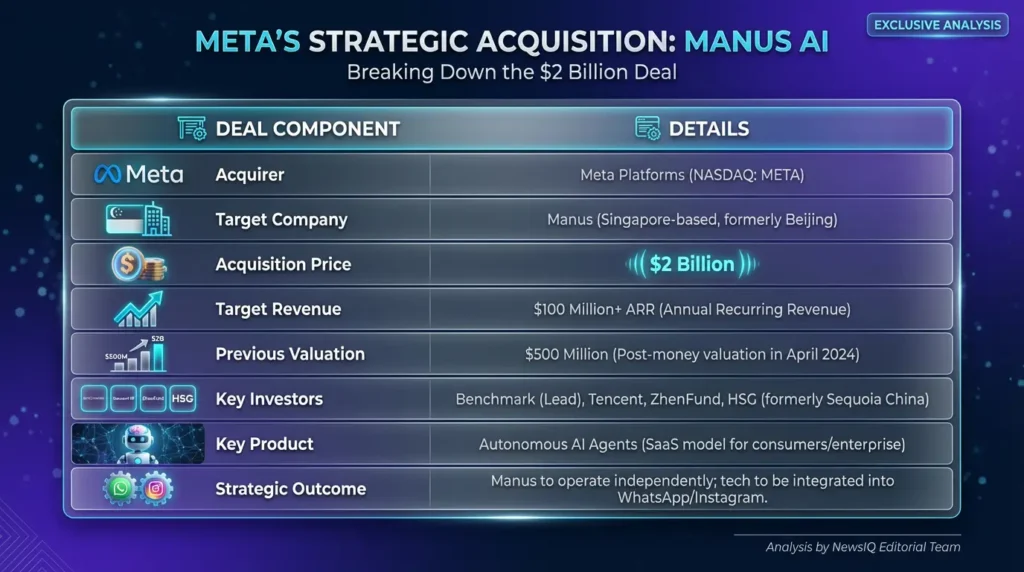
Meta Platforms is in the final stages of acquiring Manus, a high-profile Singapore-based AI startup, in a deal valued at approximately $2 billion. The acquisition marks a pivotal shift in Meta’s strategy, moving beyond experimental chatbots toward autonomous “agents” capable of executing complex tasks.
The deal, which reportedly matches the valuation Manus was seeking in its next private funding round, brings a rare asset into the Meta fold: a generative AI product that is already profitable. With investors increasingly scrutinizing Silicon Valley’s massive infrastructure spending, the purchase of Manus signals that Meta is ready to turn its AI ambitions into immediate revenue.
From Viral Demo to Billion-Dollar Exit
Manus exploded onto the scene last spring, capturing the attention of Silicon Valley with a capabilities demo that quickly went viral. Unlike standard Large Language Models (LLMs) that simply predict text, the Manus “agent” demonstrated the ability to act autonomously.
In its debut showcase, the software successfully screened job candidates, planned complex vacation itineraries, and analyzed stock portfolios with a level of precision that shocked industry observers. At the time, the company claimed its performance metrics outperformed OpenAI’s “Deep Research” initiatives, positioning Manus as a leader in the emerging field of “agentic AI.”
The startup’s rise was meteoric. By April, merely weeks after its public launch, the venture capital firm Benchmark led a $75 million funding round. That investment, which saw Benchmark general partner Chetan Puttagunta join the board, valued the young company at $500 million post-money.
However, it was the company’s December announcement that likely sealed the deal for Zuckerberg. Manus revealed it had signed up millions of users and, more importantly, hit an Annual Recurring Revenue (ARR) of over $100 million. For a startup less than two years old, achieving nine-figure revenue through monthly and yearly memberships is a statistical anomaly, validating the immense consumer demand for AI agents that can perform actual work.
Meta Platforms 2025 Revenue Overview
As of December 31, 2025, Meta has reported results for the first three quarters of 2025. Q4 and full-year results are typically released in late January 2026. The company provided Q4 revenue guidance of $56–59 billion in its Q3 earnings release.
2025 Quarterly and Full-Year Revenue (in billions of USD)
| Quarter | Revenue ($B) | YoY Growth | Notes |
|---|---|---|---|
| Q1 2025 | 42.31 | 16% | Reported April 2025 |
| Q2 2025 | 47.52 | 22% | Reported July 2025 |
| Q3 2025 | 51.24 | 26% | Reported October 2025 |
| Q4 2025 | 56.00 – 59.00 | 16% – 22% | Company guidance (midpoint ~57.5) |
| Full Year 2025 | 197.07 – 200.07 | ~20% – 21% | Estimated (vs. 2024: $164.50B) |
Key Insights:
- Revenue primarily comes from advertising across the Family of Apps (Facebook, Instagram, WhatsApp, Messenger), with Reality Labs contributing a small portion.
- Strong growth driven by AI enhancements, increased ad impressions, and pricing improvements.
- Full-year estimate assumes Q4 lands near the midpoint of guidance, implying total revenue around $198.6 billion.
For the most up-to-date official figures, check Meta’s Investor Relations site once Q4 results are released.
Solving the Monetization Game
For Meta, the acquisition addresses a critical pressure point. Mark Zuckerberg has staked the company’s future on AI, directing a staggering $60 billion toward infrastructure spending and data center construction.
While Wall Street generally supports the pivot, investors have grown increasingly “twitchy” regarding the timeline for a return on investment. The broader tech industry is currently leveraged heavily on debt-backed expenditures for NVIDIA chips and energy contracts, with few consumer-facing applications generating significant cash flow to offset the costs.
Manus represents a solution to this disparity. By acquiring a product with a proven subscription model and $100 million in existing ARR, Meta gains an immediate revenue stream.
The plan, according to reports, is two-pronged. Meta intends to keep Manus running as an independent service to preserve its current momentum. Simultaneously, the company plans to weave Manus’ underlying agent technology into its massive ecosystem of apps Facebook, Instagram, and WhatsApp.
This integration could fundamentally change how users interact with Meta’s platforms. While Meta AI is currently available as a conversational assistant, the addition of Manus technology could allow the assistant to take action booking tickets directly through WhatsApp or managing business inquiries on Instagram turning these social platforms into functional utility apps.
Navigating the Geopolitical Minefield
Despite the strategic fit, the acquisition brings significant geopolitical baggage that Meta will need to navigate carefully.
Manus was originally born from a parent company called “Butterfly Effect,” founded in Beijing in 2022 by Chinese entrepreneurs. The team only relocated to Singapore in the middle of this year. Before Benchmark’s involvement, the company had reportedly taken capital from major Chinese backers, including internet giant Tencent, ZhenFund, and HSG (formerly Sequoia China), through an early $10 million round.
This lineage has already attracted scrutiny in Washington. In May, Senator John Cornyn (R-Texas), a senior member of the Senate Intelligence Committee, publicly criticized Benchmark for investing American capital into a company with deep ties to China.
“Raising concerns about American capital going to a Chinese concern,” Cornyn noted on social media, reflecting a broader, bipartisan hawkishness in Congress regarding technology competition.
Meta appears acutely aware of these optics. In a statement provided to Nikkei Asia, the tech giant moved quickly to preempt regulatory blowback. A Meta spokesperson confirmed that following the transaction, Manus will sever all remaining ties to its former home base.
“There will be no continuing Chinese ownership interests in Manus AI following the transaction, and Manus AI will discontinue its services and operations in China,” the spokesperson said.
This hardline approach forcing a total divestiture of Chinese interests and shutting down operations in the mainland is likely a prerequisite for the deal to pass muster with U.S. regulators, who have become increasingly aggressive in blocking technology transfers that could benefit Beijing.
The Era of Agentic AI
Meta’s $2 billion acquisition of Manus marks a defining pivot in artificial intelligence: from systems that talk to systems that act.
For much of 2023 and 2024, the industry raced to perfect large language models capable of writing poems, debugging code, and drafting emails. As we enter 2026, the new battleground is agentic AI autonomous systems that can chain together tools, reason through multi-step problems, and complete real-world workflows with minimal human oversight.
By acquiring Manus, Meta has instantly vaulted to the forefront of this category. While Google, OpenAI, and Anthropic continue to build agent capabilities in-house (often still in research previews), Meta has purchased a shipping product that has already proven demand, crossing $100 million in annual recurring revenue in record time.
The real test now is integration and execution. Meta’s track record with big acquisitions is famously uneven: Instagram became a cornerstone of the company, while Giphy was ultimately blocked by regulators and other initiatives like the rocky rollout of verified subscriptions took years to find traction. Embedding sophisticated agentic workflows into the everyday, casual environments of WhatsApp, Instagram, and Facebook will demand exceptional product discipline and restraint.
If Meta gets it right, this $2 billion all-cash deal could prove transformative shifting AI from a massive R&D expense to a direct driver of new revenue streams.
Key Deal Points
- Transaction: Meta is acquiring Singapore-based AI startup Manus for approximately $2 billion in an all-cash deal, expected to close in Q1 2026 subject to customary regulatory approvals.
- Core Asset: Manus builds AI agents that autonomously handle complex tasks such as in-depth research, trip planning, financial analysis, and project coordination. The company recently surpassed $100 million in ARR and serves both enterprise clients and individual power users.
- Integration Strategy: Meta intends to embed Manus-powered agents across WhatsApp, Instagram, and Facebook enabling features like automated travel booking, smart shopping assistance, and personalized content scheduling while maintaining the standalone Manus product for existing customers.
- Geopolitical Context: Originally founded in Beijing in 2022 before relocating headquarters to Singapore, Manus had early backing from Chinese investors including Tencent and Hillhouse Capital Group (HSG).
- National Security Concerns: U.S. lawmakers, including Senator John Cornyn, raised questions about potential data risks tied to the company’s Chinese investors and historical operations.
- Resolution Measures: Meta has confirmed that, upon closing, Manus will fully divest all Chinese investments, terminate operations in China, relocate all sensitive infrastructure to U.S. and allied data centers, and implement enhanced governance oversight.
What are your thoughts on AI agents handling deeply personal tasks? Would you trust an AI to plan your next vacation, manage your investment portfolio, or negotiate on your behalf?
Join the discussion in the comments below or follow NewsIQ for ongoing coverage of the fast-moving AI economy.