Assam Is Pushing Out Indian Muslims, Not Just Migrants, Critics Charge
 Skasif
03/05/2026
Skasif
03/05/2026 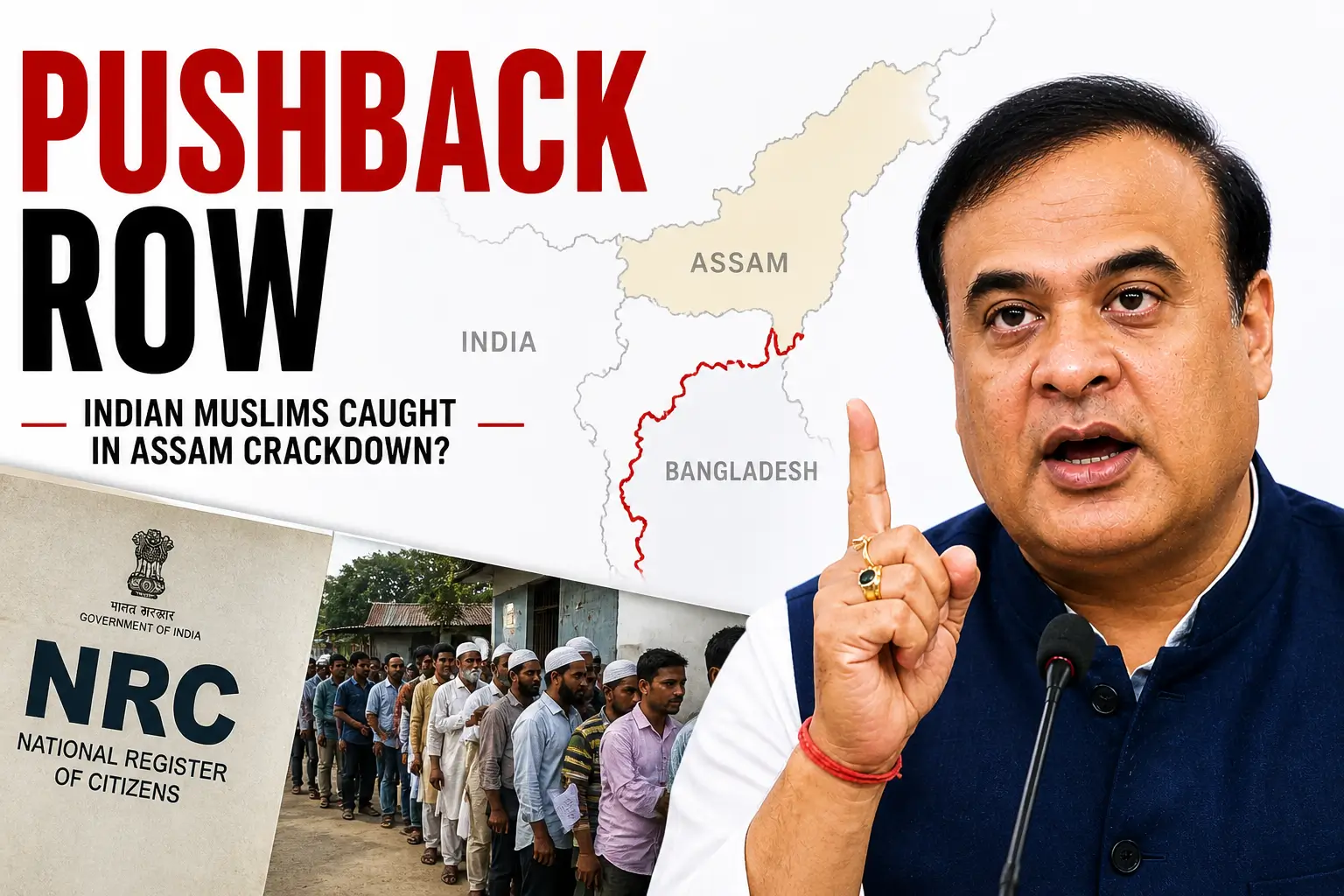
Assam Chief Minister Himanta Biswa Sarma, NRC imagery, and the Assam-Bangladesh border amid allegations that Indian Muslims were caught in Assam’s pushback operations.
Explosive: Indian Citizens Among the Pushed
The headline from Assam’s chief minister was simple: push back Bangladeshi migrants. No paperwork. No embassy. Just darkness and a shove across the border.
But the truth turning up at the border is more disturbing.
Reports, human rights groups, and even Bangladesh itself now say many of the people being pushed are not Bangladeshi at all. They are Indian Muslims. Bengali-speaking. Poor. And legally entitled to be in India.
The operation, critics charge, is not about migration. It is about votes.
Indian Citizens Being Pushed Into Bangladesh
Bangladesh has repeatedly protested that verified Indian nationals are ending up on their side of the fence. Families with Indian documents. People who have lived in Assam for generations. Rounded up, loaded onto vehicles, and forced across at night.
Human rights reports describe the same pattern. Authorities rely on appearance, language, and suspicion. In a region where millions speak Bengali and share cultural roots across both sides of the border, mistakes are easy. But some believe the mistakes are not accidents.
Several pushed individuals have returned or were later confirmed as Indian citizens. That has fueled allegations that the policy is less about illegal immigration and more about demographic targeting of Muslims.
The Real Goal: Changing the Vote Bank
Here is what the interview and the ground reports do not say directly but the math makes clear.
Assam has a Muslim population of roughly 40 percent. That is not a small minority. That is a voting bloc large enough to decide elections.
If 10 percent of non-Muslim voters turn against Himanta Biswa Sarma and his BJP government, they lose. Permanently. But if you can remove Muslim voters from the rolls and from the state the math changes.
The National Register of Citizens (NRC) process identified about 1.9 million people who could not prove their ancestry. The majority of those excluded were Muslims. Many are poor. Many struggle with paperwork their families never kept.
Now those same people are being pushed across the border at night. Not through courts. Not through appeals. Through darkness and physical force.
The Chronology of Targeting
Since the BJP came to power nationally in 2014, India has seen a steady pattern of targeting religious minorities. Muslims and Christians have faced new citizenship laws, police actions, and demolition drives. The government calls it law enforcement. Critics call it a systematic squeeze.
Assam fits the pattern perfectly.
Step one: Identify “foreigners” through a flawed NRC process that demands documents many poor Muslims do not have.
Step two: Wait for a Supreme Court ruling that gives district magistrates eviction power without specifying a destination.
Step three: Use nighttime pushbacks to physically remove people without formal deportation.
Step four: Watch the voter rolls shrink in Muslim-heavy constituencies.
Step five: Stay in power forever.
Sarma himself celebrated 12,000 names disappearing from voter rolls in one constituency alone. His explanation was that they left voluntarily or were pushed. He did not seem troubled by either option.

What the Interview Actually Revealed
In the ABP Live interview, Sarma laid out the mechanics plainly. Formal deportation through the Ministry of External Affairs is slow. Bangladesh demands proof. The extradition treaty does not cover routine migration.
So instead, officials hold suspected people for 10 to 40 days. Then find a spot with no Bangladeshi border guards. Wait for dark. Push.
“Dhakka marna padega,” he said. You have to shove them.
What he did not say is how many of those shoved are actually Indian citizens. Bangladesh says many are. Rights groups say the same. And the Indian government has not produced verifiable numbers proving otherwise.
Himanta Biswa Sarma: Pushing Bangladeshis back is not an easy thing.
Interviewer: Why would you say that?
Himanta Biswa Sarma: Because there is Bangladeshi police at the border as well. It is not like you can just go and hand them over. They do not accept them. There is no extradition treaty between India and Bangladesh.
Interviewer: So how do you send them back?
Himanta Biswa Sarma: What I do is, taking advantage of the darkness, where the BDR [Bangladesh border guards] aren’t present, we push them back there.
Interviewer: Really? You send them back like that?
Himanta Biswa Sarma: We send them like that. You don’t know the reality. What the BSF [Border Security Force] does is… the BSF holds the person in their custody.
Interviewer: Yes.
Himanta Biswa Sarma: They hold them for 30 days, 40 days, sometimes 20 days, or even up to 10 days.
Interviewer: Yes.
Himanta Biswa Sarma: When there is a spot where the BDR isn’t present…
Interviewer: Yes.
Himanta Biswa Sarma: …in that spot, you shove them and send them across.
Interviewer: But they will just come back.
Himanta Biswa Sarma: They do come back through Bengal. Between India and Bangladesh, there is no extradition treaty that allows you to just send Bangladeshis back. Bangladesh asks for proof.
Interviewer: Right.
Himanta Biswa Sarma: Whenever you…
Interviewer: If you want to send them officially.
Himanta Biswa Sarma: Now what happens is, through the NRC created in Assam, we have identified 1.7 million infiltrators.
Interviewer: Right.
Himanta Biswa Sarma: Prima facie.
Interviewer: Right.
Himanta Biswa Sarma: If I want to send them back according to the law, what do I have to do? I have to send all these cases to the MEA [Ministry of External Affairs].
Interviewer: Right.
Himanta Biswa Sarma: The MEA will send everything to Bangladesh.
Interviewer: Right, yes.
Himanta Biswa Sarma: Then it is up to Bangladesh to decide who they accept and who they don’t.
Interviewer: That is also true.
Himanta Biswa Sarma: Yes, that is why you cannot send people from India to Bangladesh, because Bangladesh does not accept anyone as a Bangladeshi. Now what is the option open for us? I will speak from your own data. Last year we pushed 50 people back.
Interviewer: Fifty.
Himanta Biswa Sarma: Fifty.
Interviewer: In the whole year?
Himanta Biswa Sarma: The whole year, I am stating your own figures…
Interviewer: Yes, I said it was 50 in one month and 1,400 in one year.
Himanta Biswa Sarma: This year we pushed back 1,400. Because in between, the Supreme Court gave a judgment a year ago that if a District Magistrate believes a person is not Indian, he can pass an eviction order.
Interviewer: I see, okay.
Himanta Biswa Sarma: Now, what does eviction mean? It means evicting them from India. To where? That is not mentioned in the act, and that is not mentioned in the Supreme Court order.
Interviewer: Okay.
Himanta Biswa Sarma: It just says you can evict them from the country. Right?
Interviewer: Right.
Himanta Biswa Sarma: So now we have started evicting, started pushing back.
Interviewer: At the Bangladesh border?
Himanta Biswa Sarma: At the Bangladesh border, the word is “push back.” Right. You take them to a convenient place, and practically, you have to physically shove them. It is called a pushback. And I think we pushed back a significant number from across the entire country last year, but you won’t find these figures officially anywhere.
Interviewer: So tell us, how many did you push back?
Himanta Biswa Sarma: I will tell you about my own area. There is a constituency in Assam called Sarupathar.
Interviewer: Yes.
Himanta Biswa Sarma: The names of 12,000 people are not on the voter list. Because when the enumerator went there, they couldn’t find those 12,000 people.
Interviewer: They were missing?
Himanta Biswa Sarma: They were not there.
Interviewer: So you sent them back?
Himanta Biswa Sarma: This is what I am saying, you should push back. You have to push back. And create an environment in Assam so people just leave on their own. When I talk about the 5-rupee, 4-rupee thing, the meaning is essentially: do not accept these Bangladeshis.
Diplomatic Fallout and What Comes Next
Bangladesh has summoned India’s envoy. Protests have been filed. Border management agreements have been violated. But diplomatic protests do not stop nighttime operations.
For the US and Europe watching this unfold, the questions are familiar. How does a democracy handle migration without sliding into communal targeting? When does border enforcement become demographic engineering? And what happens when the people being pushed have legal rights to stay?
The answers so far are not reassuring.
Assam plans more operations. Faster evictions. Fewer appeals. And each pushback risks sending another Indian citizen into a country they have never called home.
This is not a story about Bangladeshi migrants anymore. It is a story about Indian Muslims being removed from Indian soil. It is a story about a 40 percent voting bloc being reduced one nighttime shove at a time. And it is a story about political power being locked in by pushing people out.
The border remains dark. The operations continue. And the real targets are not foreigners. They are voters.