Turkey Just Showed the World Its Most Dangerous Kamikaze Drone
 Skasif
03/05/2026
Skasif
03/05/2026 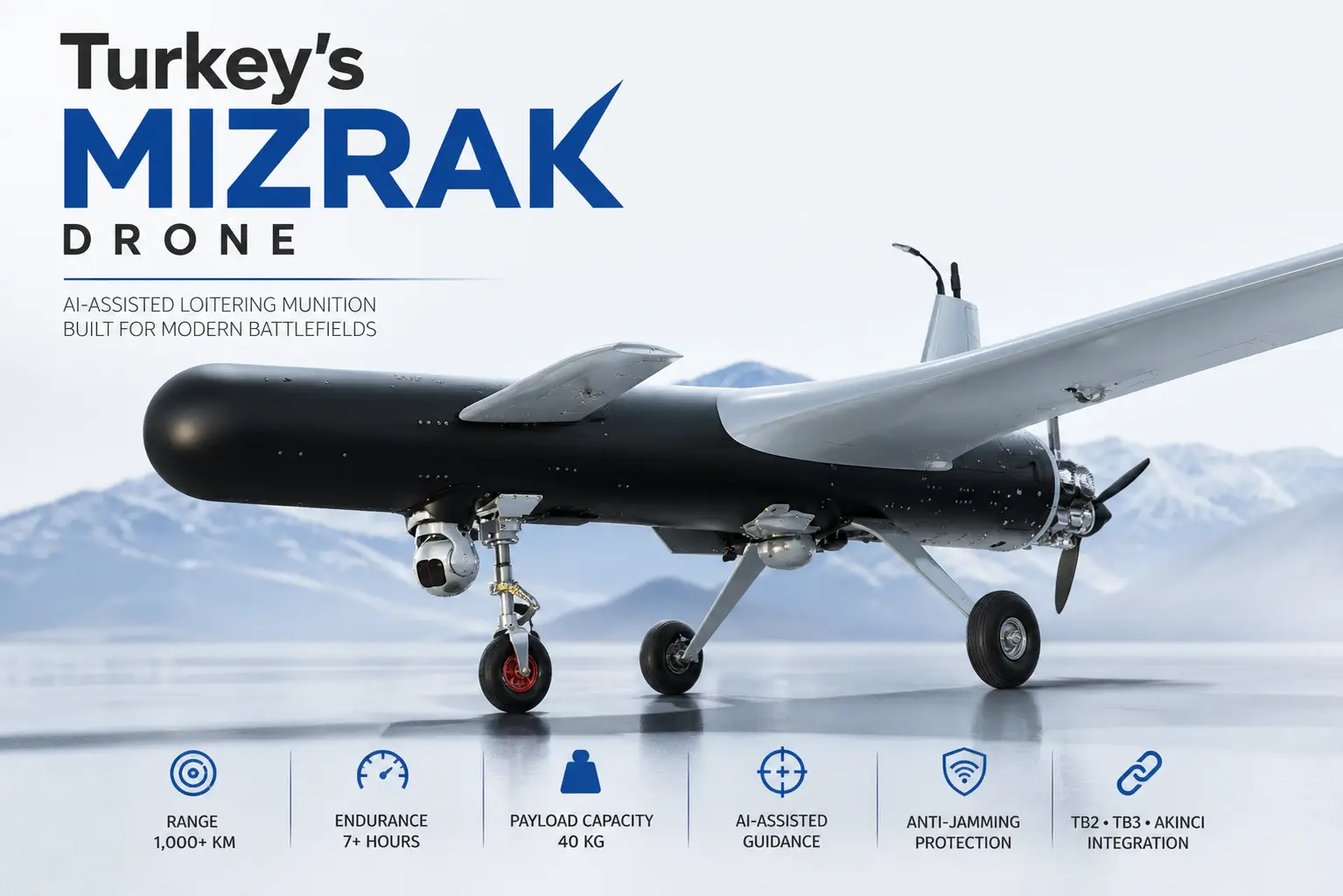
Baykar’s Mızrak drone shown in a premium product-style render featuring long-range strike capability, autonomous guidance systems, anti-jamming protection, and integration with Turkey’s drone fleet.
ISTANBUL — Baykar just turned its growing loitering munition portfolio into a full family. The company confirmed it has completed live-warhead tests on Mizrak, a new AI-powered loitering munition that flies more than 1,000 kilometers, packs a 40-kilogram payload, and navigates without GPS. The public debut comes at the SAHA 2026 defense fair in Istanbul on May 5.
Mizrak is the third expendable strike platform Baykar has introduced in under two months. It joins the longer-range K2 and the cheaper, swarm-oriented Sivrisinek. Together the three give Turkey a layered attack architecture that can saturate air defenses, hunt radars, and strike high-value targets deep in contested territory. All three share a common datalink backbone and can be commanded from a TB2 or Akinci unmanned aircraft orbiting at safe distance.
The name Mizrak translates to “spear.” Baykar says the designation reflects both the airframe’s aerodynamic profile and its precision strike role. The system has already passed live-fire validation, a milestone Baykar normally likes to reach before any public rollout.
Mizrak Drone Specifications and Capabilities
Baykar released a condensed specification sheet alongside the announcement. The numbers matter because they define which targets fall inside Mizrak’s threat radius and how commanders can employ it.
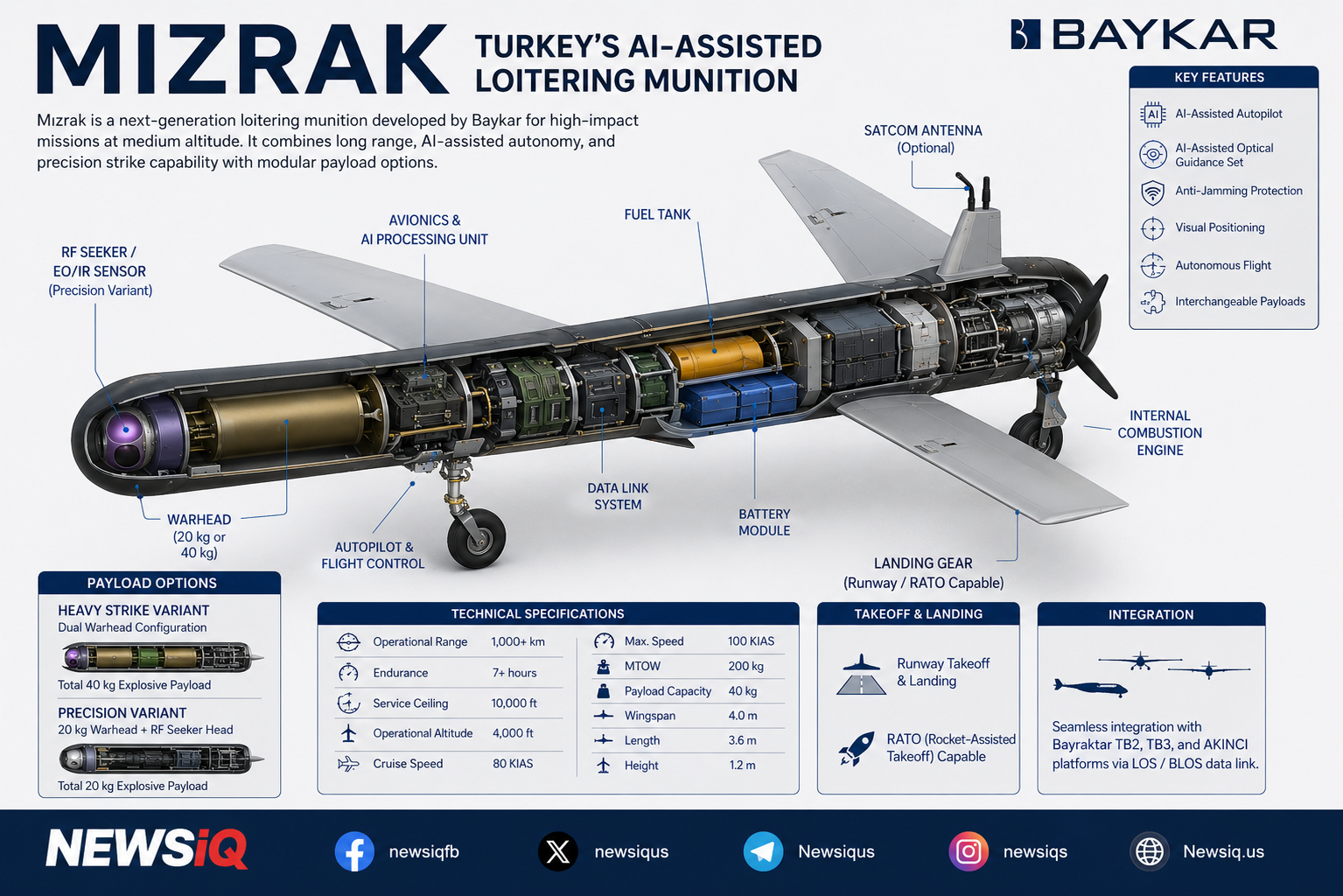
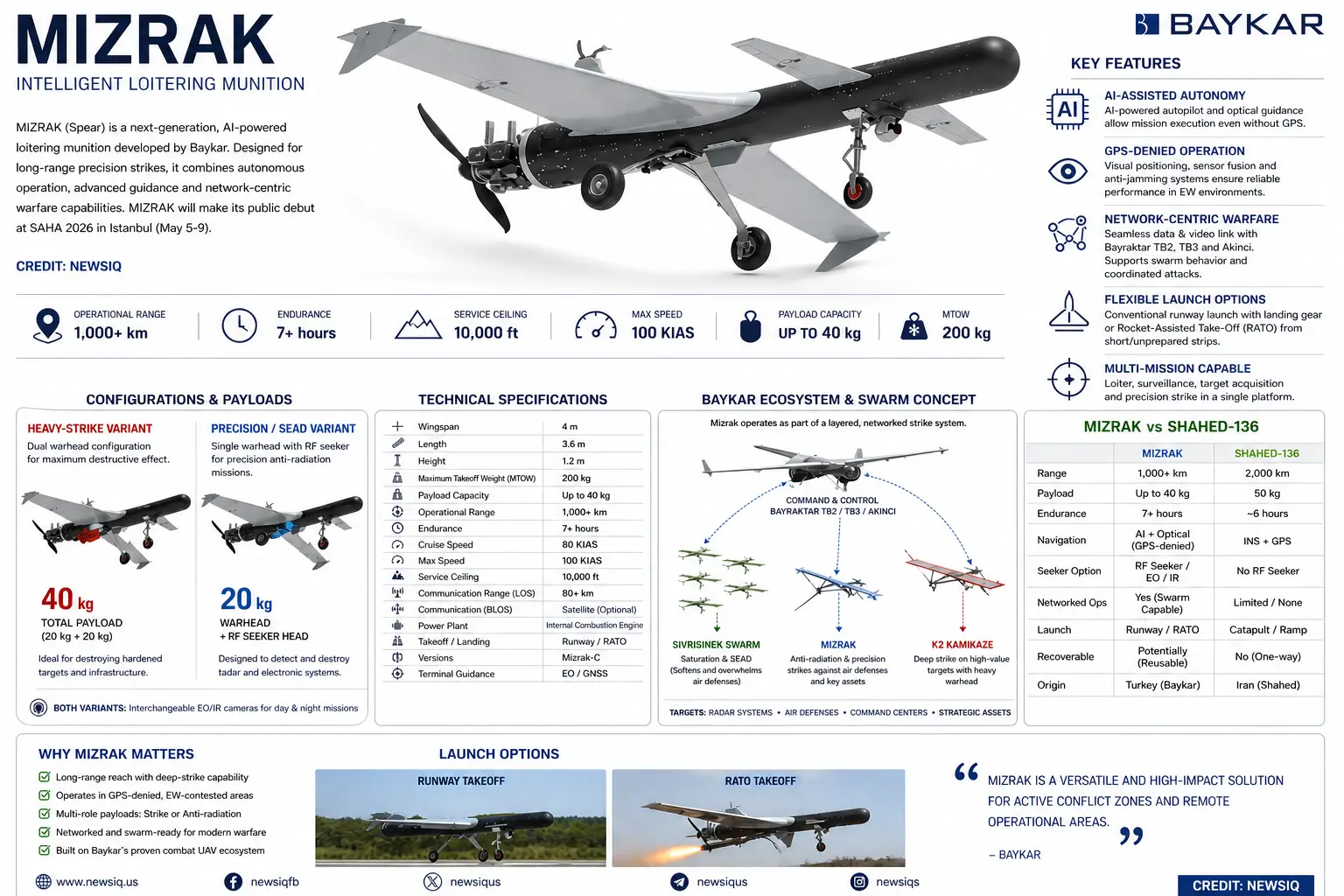
Maximum takeoff weight sits at 200 kilograms. Wingspan is 4 meters, length 3.6 meters, height 1.2 meters. The airframe is larger than small backpack-deployed munitions and fits squarely in the medium tactical class.
Cruise speed is roughly 80 knots indicated airspeed. Maximum speed reaches 100 knots. Service ceiling is 10,000 feet. Those figures place Mizrak in the same performance band as many manned light aircraft, not just small drones.
Range exceeds 1,000 kilometers. Endurance stretches past seven hours. That combination means Mizrak can fly a direct long-range attack profile or loiter over a distant search box waiting for mobile targets to appear. Cross-border surveillance and immediate strike reside in a single airframe.
Payload capacity is 40 kilograms, divided into two configuration options. The dual-warhead variant carries the full 40 kilos of explosive for maximum blast effect. The precision variant mounts a 20-kilogram warhead paired with a radio-frequency seeker that homes in on radar emissions and electronic signatures. Both variants accept interchangeable electro-optical or infrared camera payloads depending on mission type.
Launch flexibility rounds out the mobility picture. Mizrak can roll from a standard runway on its own landing gear or boost into the air with a rocket-assisted takeoff unit from rough or confined terrain. That matters for dispersed operations where fixed runways invite preemptive strikes.
How Mizrak Fits the Three-Drone Family
Baykar did not release Mizrak in isolation. In rapid succession it has shown:
- K2: 2,000 km range, 200 kg munition capacity, 13-hour endurance, and the ability to return to base or self-destruct. Designed for deep strikes on high-value targets.
- Sivrisinek (Mosquito): Roughly 1,000 km range, 20+ kg warhead, estimated unit cost $25,000-$30,000. Built for mass employment and saturation.
- Mizrak: The 1,000 km bridge weapon with heavier payload options and specialized seekers.
AI Autonomous Features and GPS-Denied Operation
The feature that separates Mizrak from earlier generations of one-way attack munitions is independence from satellite navigation.
Baykar integrated an AI-assisted autopilot and optical guidance set that fuses sensor data with visual positioning. The drone can navigate, find targets, and execute terminal guidance even inside heavily jammed environments where GPS signals are blocked or spoofed. Anti-jamming protection adds a second hardening layer.
That capability is not a checkbox item. Extended-range loitering munitions spend most of their flight inside contested airspace where electronic warfare is concentrated around high-value targets. A weapon that loses its way when jamming starts never reaches the aimpoint. Mizrak is built to fly the entire profile without external navigation fixes.
The AI component also supports autonomous target detection. In the RF-seeker configuration, Mizrak autonomously finds and prioritizes radiating targets. In electro-optical or infrared mode, the visual positioning system locks onto targets validated by the onboard processing suite. The operator retains human-in-the-loop authority through the datalink, but the drone does not require constant manual guidance.
Mizrak Loitering Munition Integration with Baykar Fleet
Data and video links connect Mizrak natively to Baykar’s TB2, TB3, and Akinci platforms. Line-of-sight communication reaches more than 80 kilometers. An optional satellite communications channel extends that network over the horizon.
One TB2 flying a standoff orbit can act as a command node for multiple Mizraks. The architecture supports swarm behavior: munitions share targeting data, divide attack roles, and sequence their strikes to saturate defensive systems. Baykar designed the entire ecosystem around network-centric operations where larger platforms provide sensing and command, and smaller expendable munitions deliver the effects.
This integration is the operational logic behind Baykar’s sudden three-drone reveal. The company did not release separate products. It released a layered system.
Baykar’s Three-Drone Layered Attack Family
In rapid succession Baykar has now shown three loitering munitions with distinct roles.
K2 sits at the top. Range reaches 2,000 kilometers. It can carry 200 kilograms of munitions, fly for 13 hours, and either self-destruct on target or return to base for reuse. The return option makes it more a reusable strike platform than a pure kamikaze drone. K2 is for deep strikes against high-value fixed targets.
Sivrisinek sits at the bottom of the cost curve. Range is roughly 1,000 kilometers. Warhead exceeds 20 kilograms. Estimated unit cost runs between twenty-five and thirty thousand dollars. That pricing invites mass employment. Sivrisinek is the saturation weapon designed to flood defensive arcs and force air-defense systems to reveal themselves.
Mizrak is the bridge. It carries heavier payloads than Sivrisinek, flies as far, and adds the RF-seeker option for hunting emitters. After Sivrisinek swarms expose and deplete air defenses, Mizraks target the surviving surface-to-air systems and electronic-warfare assets. K2s then strike the now-undefended high-value targets.
Defense analysts describe the concept as a modernized version of the layered strike tactics refined in Ukraine and the Middle East. The difference is that every element shares the same Turkish datalink backbone and can be orchestrated by platforms already in widespread service.
Baykar Mizrak vs Iran’s Shahed: Key Differences
The Shahed-136 naturally draws comparison because it set the benchmark for low-cost, long-range one-way attack drones. After years of iteration the Shahed-136 delivers roughly 2,000 kilometers of range and a 50-kilogram warhead. Mizrak covers half the distance with 10 fewer kilos of payload.
But Turkish analysts point to qualitative gaps that change the operational calculus. Hursit Dingil, a researcher at the Ankara-based Centre for Area Studies, said Iranian platforms lag in AI-based autonomous targeting, network-centric swarm coordination, communication range, and satellite-link reliability. Mizrak’s sensor-fusion and visual-positioning suite allows it to function inside electronic-warfare environments where many Shahed derivatives degrade.
The RF-seeker configuration also gives Mizrak a dedicated anti-radiation role that the baseline Shahed-136 does not carry. That makes Mizrak a dual-threat platform: it can hunt emitters or deliver general-purpose blast effects depending on the warhead configuration selected before launch.
Yusuf Akbaba, an independent Turkish defense expert, noted that all three Baykar platforms communicate with each other and with larger command nodes. That level of integration remains uncommon among low-cost strike munition families.
Geopolitical Ripple and Range Implications
A 1,000-kilometer range from Turkish territory places a wide arc of the eastern Mediterranean, portions of the Black Sea, and much of the Levant inside Mizrak’s reach. The system adds concrete new variables to an already tense regional picture.
Turkey and Israel have sharpened their rivalry since 2024. A weapon that can threaten targets across the broader theater from dispersed launch points introduces new deterrence and escalation dynamics. Baykar frames Mizrak as a commercial product, but the capability speaks for itself.
Saudi Arabia has already signed drone deals with Baykar. Other Gulf states, North African governments, and Central Asian buyers are logical follow-on customers. Baykar’s model of combat-proven systems at accessible price points has attracted a widening customer base that now sees Mizrak as the expendable strike option inside a larger unmanned ecosystem.
From a NATO perspective, the picture is mixed. Turkey remains an alliance member. Its defense industry is increasingly independent and willing to sell widely. European and American planners will study Mizrak’s performance data closely.

Production Momentum and What Happens Next
Baykar is moving fast on several fronts. In February, Leonardo CEO Roberto Cingolani said the first medium-class UAVs from the Italian-Turkish joint venture would finish assembly by April at the Ronchi dei Legionari plant in northeast Italy. That program covers fixed-wing and rotary-wing platforms and is running slightly ahead of schedule. While those aircraft are larger intelligence and strike platforms rather than expendable munitions, they share the same corporate standards and datalink protocols.
Mizrak’s SAHA 2026 appearance will be its first public showing alongside K2 and Sivrisinek. Baykar is expected to display coordinated flight demonstrations that visualize the layered-attack concept. Live-fire videos released ahead of the show confirm the warhead tests are already complete.
Open questions remain. Unit cost has not been published. Production rate and reliability data are not yet available. One Turkish expert cautioned that fusing advanced AI with relatively simple missile-based airframes must still prove itself in sustained combat conditions. Sensor fusion that works in tests faces harder scrutiny against determined countermeasures.
Still, Baykar’s track record tends to undercut skepticism. TB2 went from a curiosity to a category-defining platform in multiple active theaters. Mizrak arrives with live-fire milestones already behind it, not just brochure claims. The public debut at SAHA 2026 will show whether the full system works as advertised when the entire family operates together.
Briefy
Baykar’s newly unveiled Mizrak is an AI-powered loitering munition with a range exceeding 1,000 km and over seven hours of endurance. It carries a 40 kg payload in two configurations: a dual-warhead variant for maximum blast effect, and a single-warhead version with an RF seeker for hunting radar emissions. Mizrak can navigate and strike autonomously in GPS-denied environments using AI-assisted optical guidance and anti-jamming systems.
It integrates natively with Baykar’s TB2, TB3, and AKINCI drones, supports swarm operations, and can launch from runways or rough terrain via rocket-assisted takeoff.
Live-fire tested ahead of its SAHA 2026 debut, Mizrak forms the middle tier of Baykar’s new three-drone loitering munition family alongside the long-range K2 and the low-cost Sivrisinek.