Artemis II Just Sent Back Its First Images of Earth. The Moon Is Next
 Skasif
04/04/2026
Skasif
04/04/2026 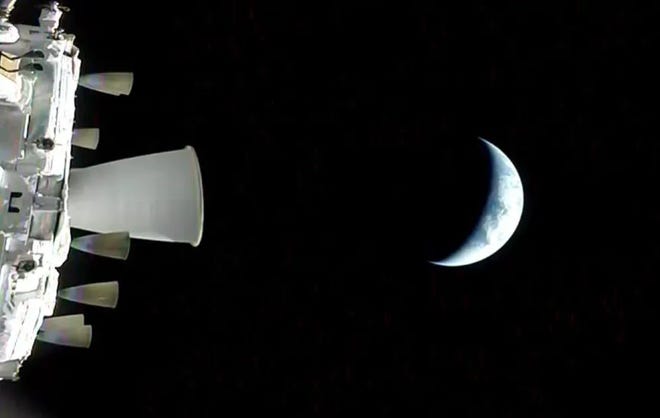
A view of the Earth from NASA’s Orion spacecraft as it orbits above the planet during the Artemis II test flight. Provided By NASA
The first Earth photos from Artemis II are out, and NASA’s four-person crew is now deep into a 10-day lunar mission that will take them around the Moon and back. The images, released after the April 1 launch, show Earth from the Orion capsule as the crew heads toward a close lunar flyby and a Pacific splashdown about 10 days after liftoff.
First look from deep space
NASA says the first downlinked images from the mission were taken by commander Reid Wiseman after the translunar injection burn pushed Orion out of Earth orbit and toward the Moon. The photos show Earth framed by Orion’s window, with auroras and zodiacal light visible in the scene.
For readers following the mission closely, this is the moment Artemis II starts to feel real. The crew is not just circling Earth for checks and tests anymore; it is on the long road to the Moon.
Why the images matter
The pictures are more than a pretty space shot. They mark the first downlinked images from the crew and show that Orion’s deep-space systems are working well enough to send clear visual data home.
They also give NASA a public proof point for a mission that is meant to test the hardware and the crewed flight path before future landings. Artemis II is the first crewed flight test of the Space Launch System and Orion, and NASA has framed it as a key step toward later lunar missions.
Where the crew is now
NASA said on Friday the spacecraft had already passed roughly 99,900 statute miles from Earth and was moving toward the Moon at about 161,750 statute miles away from it, with another correction burn planned to fine-tune the route. Other coverage put the crew farther from Earth as the day went on, reflecting the mission’s fast-moving trajectory and the timing of live updates.
That distance matters because Artemis II is not a quick lap. It is a planned 10-day mission, and the crew’s job is to help NASA learn how Orion behaves, how the team works in deep space, and how the spacecraft handles the trip home.
What happens at the Moon
The big moment comes on flight day 6, when the crew is expected to pass close to the Moon’s far side and come within about 4,000 miles of the surface. NASA says the lunar science team has selected features for the astronauts to photograph and document during a six-hour observation period.
That part of the mission is about more than sightseeing. The crew will be using handheld cameras and mission procedures to capture terrain on the far side that has not been seen directly by human eyes before, including named features such as the Orientale basin, Pierazzo crater, and Ohm crater. For space watchers, this is the point where the mission shifts from travel news to exploration news.
The return plan
After the flyby, the Moon’s gravity will bend Orion back toward Earth on a free-return path, with the mission ending in a Pacific Ocean splashdown near San Diego. NASA’s recovery team has already laid out contingency planning and rehearsals for that landing sequence.
The return matters for two reasons. First, it will close the loop on one of NASA’s biggest crewed flight tests in decades. Second, it will show whether the systems that keep astronauts alive in deep space can bring them home safely after days beyond Earth orbit.
Why this mission is getting attention now
People are watching Artemis II because it is the first crewed lunar mission in more than 50 years and the first time since Apollo 17 in 1972 that humans have left Earth orbit. It is also the first time this crew mix has flown together on a lunar mission, with Victor Glover, Christina Koch, and Jeremy Hansen joining Wiseman on the flight.
There is also a simple visual reason the story is spreading fast: Earth shots from deep space are hard to ignore. The first images give the mission a human face, and they offer a reminder of how small Earth looks once you are headed toward the Moon.
What to watch next
The next update most readers will care about is the Moon flyby, because that is when the crew will get their closest look at the far side and NASA will likely release more images. After that, the focus shifts to the long trip home and the splashdown sequence in the Pacific.
If you are following the mission for work, school, or simple curiosity, the useful questions are straightforward: how close will they get, what will they photograph, and does Orion keep performing the way NASA needs it to ? Those answers will shape the public view of Artemis II just as much as the photos do.