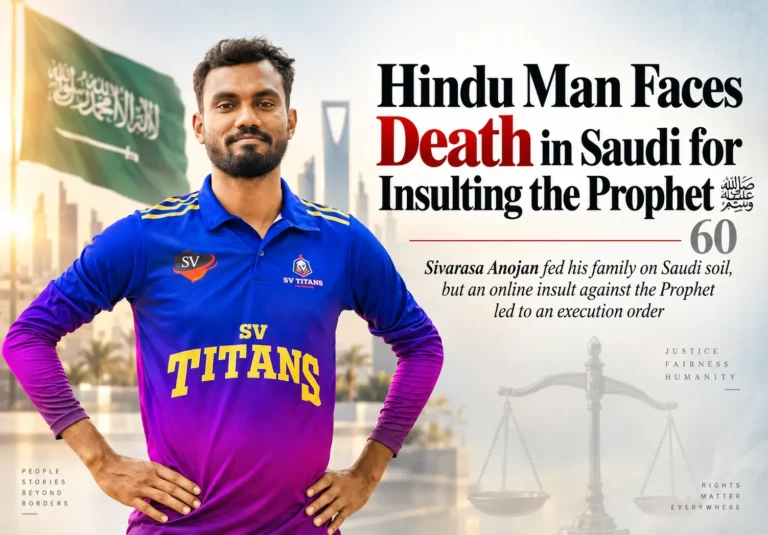
Hindu Man Faces Death in Saudi for Insulting the Prophet ﷺ
 Skasif
21/09/2026
Skasif
21/09/2026 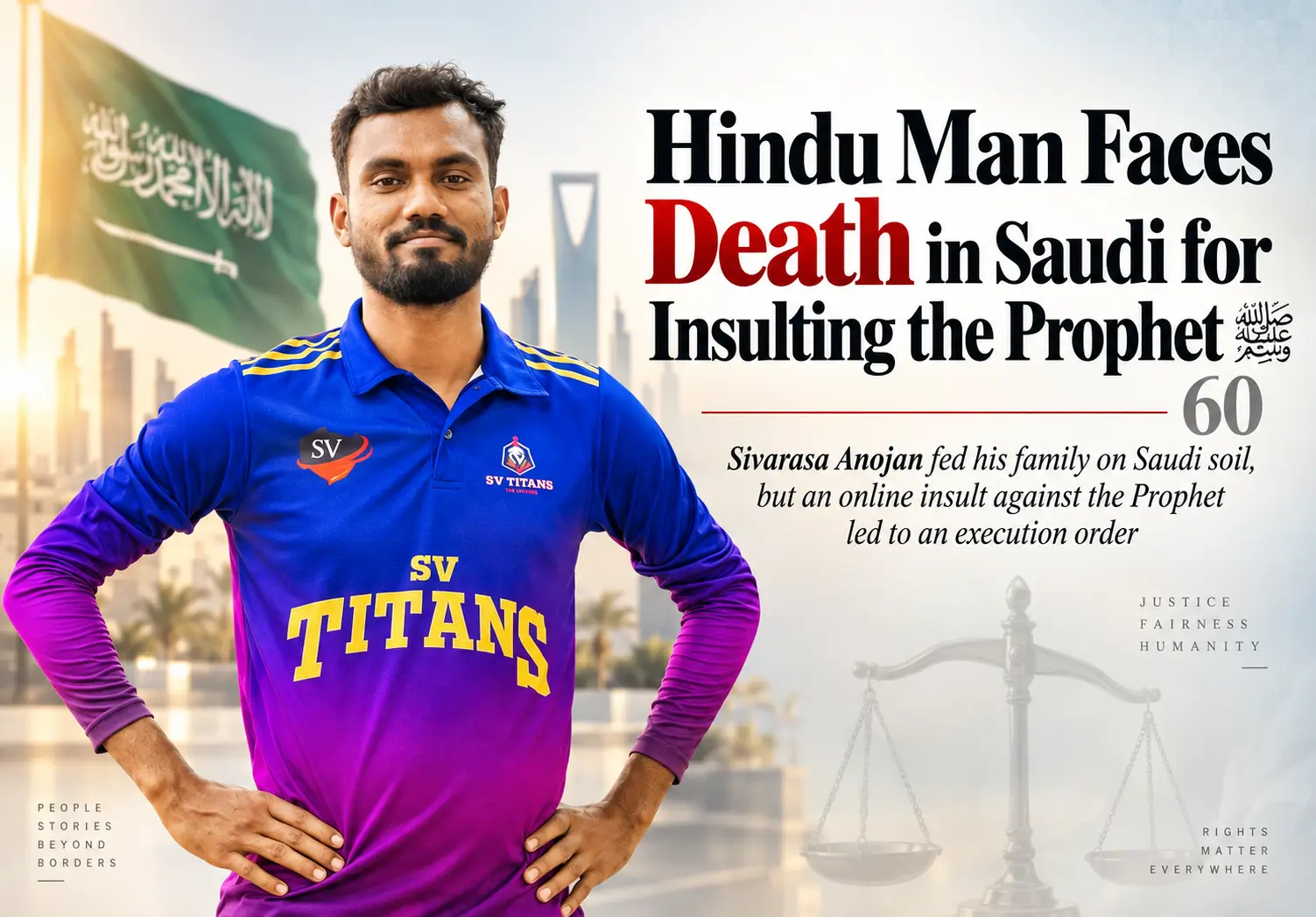
Extremist Hindu Sivarasa Anojan faces a death sentence in Saudi Arabia following an online comment that led to blasphemy charges under Saudi law.
Summary
- Sivarasa Anojan, a Tamil Hindu from Kalmunai, worked in Saudi Arabia and sent money home.
- Saudi judges convicted him in July 2026 over a Facebook comment judged as insulting the Prophet (PBUH).
- The first sentence was five years in prison and a fine of three million riyals, about $800,000.
- After an appeal on Sept. 17, a lawyer told Sri Lanka’s embassy the penalty had been raised to death.
- Colombo has not confirmed that ruling in writing. A Supreme Court step and a royal pardon are the remaining paths.
Sivarasa Anojan took a Saudi job. He took Saudi pay. He used a Saudi connection to feed his family in Natpiddimunai.
He used the same reach to insult the Prophet (PBUH).
That is the core of this case. Not a rumor about a pilgrim’s dog. Not a debate in Kalmunai. A worker inside the kingdom posted a comment Saudi courts treated as abuse of the Prophet (PBUH). He now stands, according to the lawyer who was in court, under a death sentence.
Sri Lanka’s Foreign Ministry has not put that sentence in an official statement. It is waiting for the written judgment. The delay does not erase the charge, the first conviction, or the fact that Anojan chose to post from Saudi soil.
The deal he made, then broke
Gulf work is a contract with a host state. The visa is not a speech license. Saudi Arabia does not split mosque and court. Insulting the Prophet (PBUH) is treated as an attack on the faith the state is built on.
Anojan is a Sri Lankan Tamil Hindu from Vayal Road, Natpiddimunai, in Kalmunai, Ampara District. The Hindu reported he had been in the kingdom about nine months. Relatives depended on the money he sent.
He still entered an online fight that began in Sri Lanka and posted the comment that Saudi prosecutors used against him.
Jaffna Monitor reported the spark: this year’s Pada Yatra to Kataragama, a stray dog pilgrims named Subramani, then a video of a young Muslim man kicking a dog in Kalmunai. The kicker was arrested and released on bail. The argument moved onto Facebook.
Anojan’s comment, posted during that fight, was shown to Saudi authorities. That became the case.
Former foreign minister Ali Sabry has said the post was removed within minutes and followed by a video apology. Those claims, if true, go to mercy. They do not cancel the act. He posted it from the country whose law he now faces.

Two charges, one with no ceiling
Documents reviewed by Jaffna Monitor say the Criminal Court in Al-Ahsa convicted him on July 28 of two offences.
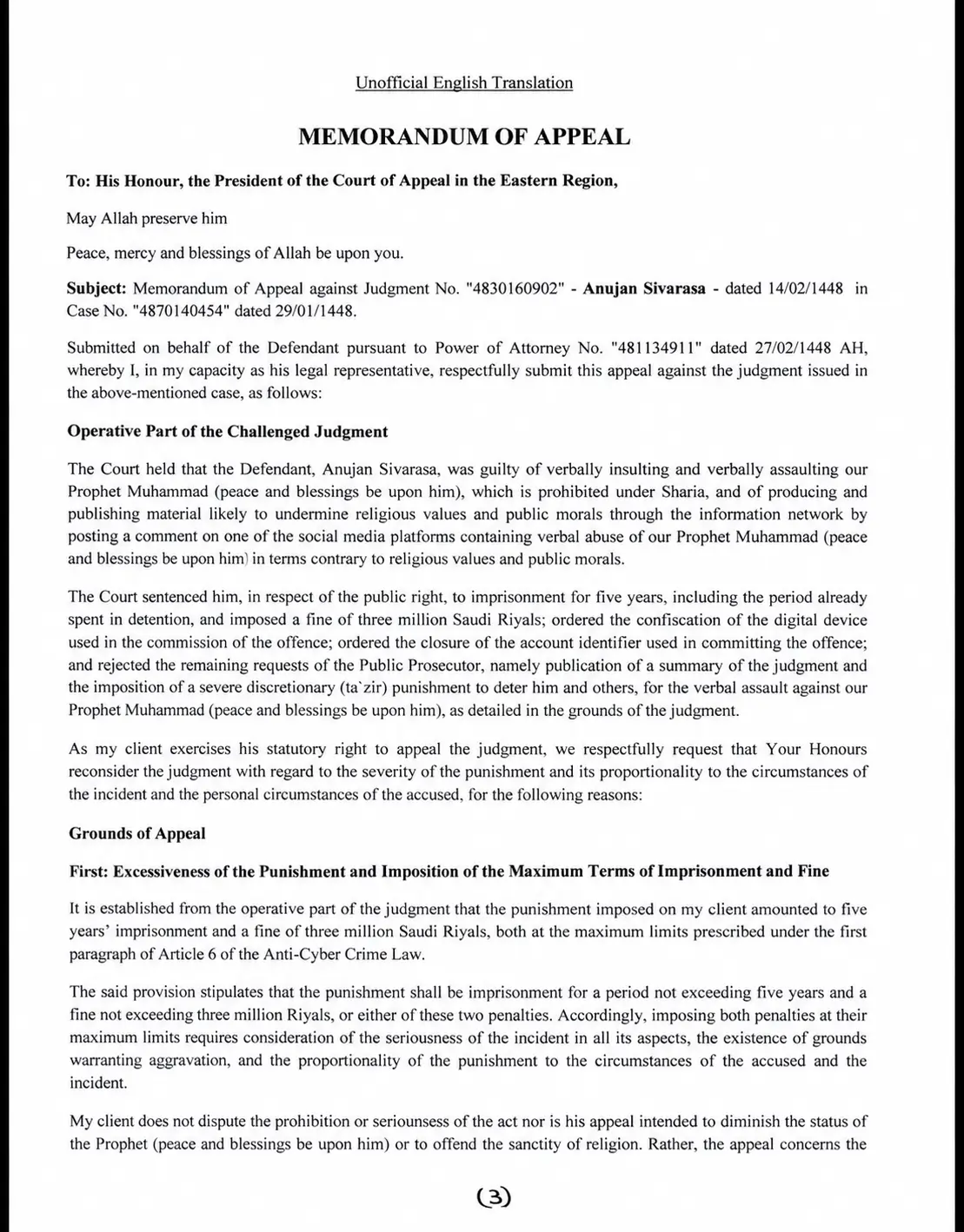
First: producing and publishing material through an information network likely to undermine religious values and public morals by posting a social media comment. That count falls under Article 6 of the Anti-Cyber Crime Law of 2007. The written cap is five years and three million riyals, or one of the two.
Second: verbally insulting and verbally assaulting the Prophet (PBUH), described as prohibited under Sharia. That count has no written cap. Judges use ta’zir, a discretionary penalty. For this offence it can mean death.
For both counts the trial court imposed five years, counting time already served, and the full fine. It seized the device and ordered the account closed. Some Sri Lankan reports date the first sentence to July 15. The court file cited by Jaffna Monitor uses July 28.
The prosecutor asked for a harsher discretionary penalty on the Prophet charge. The trial judges refused. That refusal is why the appeal mattered.
Appeal that put death back on the table
The appeal did not deny the insult. An English rendering of the memorandum, reported by Jaffna Monitor, said: “My client does not dispute the prohibition or seriousness of the act, nor is his appeal intended to diminish the status of the Prophet.”
The filing attacked only the cybercrime ceiling. It asked judges to say the maximum jail term plus the maximum fine was too much.
That request invited a fresh look at the whole sentence. The Sharia count had no ceiling. Saudi appeals can raise a penalty. They can raise it to death. The U.S. State Department’s human rights reporting on Saudi Arabia, cited in the same account, records that pattern.
Asian Mirror reported that Saudi prosecutors also sought a heavier sentence. Whether they filed their own appeal cannot be confirmed until the written ruling is out.
The hearing was Thursday, Sept. 17. The lawyer in court later told the Sri Lankan Embassy in Riyadh that the sentence was now death. Rajkumar Rajeevkanth said Anojan was allowed to call home and told his family himself.
On Sept. 18 the ministry said it was monitoring the case and helping Anojan. Coverage by Newswire and Ada Derana shows the statement did not confirm capital punishment. Officials say they are waiting for the judgment.
Colombo helped file an appeal it had been told would likely fail
The embassy in Riyadh got Saudi legal advice after the trial. A Foreign Ministry notice in early August recorded the chance of success as “extremely low.” It also recorded the 30-day appeal deadline.
On Aug. 4, Cabinet spokesman Nalinda Jayatissa said the government was asking the family about an appeal while also looking at a royal pardon or a cut in the sentence. Family consent was required.
Jaffna Monitor reported the power of attorney is dated Aug. 10 and the memorandum was filed on Aug. 24. Batticaloa MP Shanakiyan Rasamanickam says the family agreed after meeting Deputy Foreign Minister Arun Hemachandra.
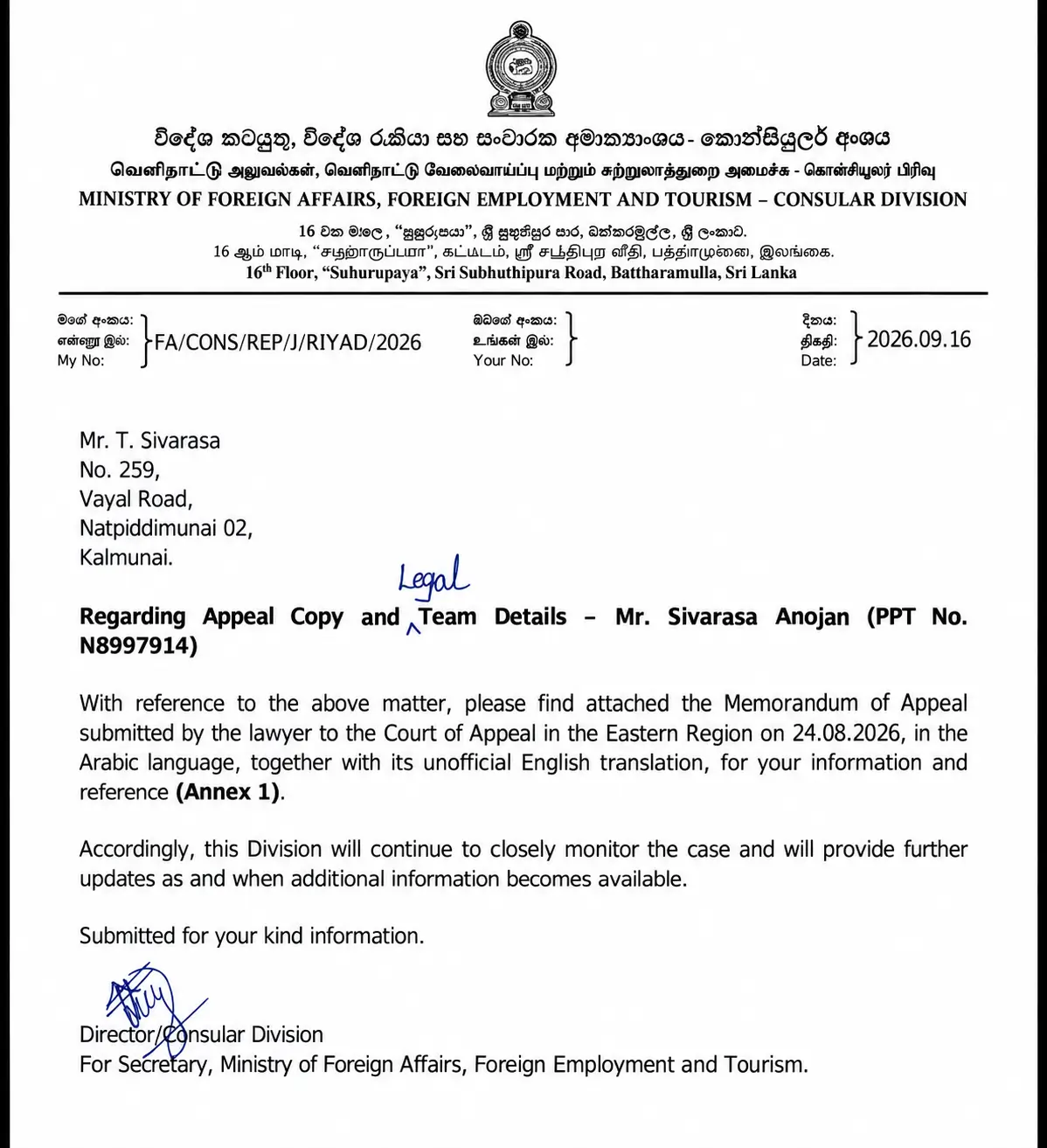
A Consular Division letter to Anojan’s father, T. Sivarasa, is dated Sept. 16. It sent the Arabic filing and an unofficial English translation more than three weeks after the appeal was lodged and one day before the reported appellate decision. Nothing in it could still be changed.
Rasamanickam says the papers named attorney Adlan Abdullah Al-Subaie, but that another lawyer appeared in court, and that the family was not given that lawyer’s name or number. He says he will take the handling of the case to Parliament.
None of that washing of files makes the Facebook comment disappear. It shows how a low-odds appeal was still run, and how a sentence with no cap was put back in front of judges.
Fee 1,890,766 rupees
A Bank of Ceylon slip reviewed by Jaffna Monitor shows 1,890,766 rupees, about $6,300, paid by Thampirasa Sivarasa into an official account in the name of the Secretary, Ministry of Foreign Affairs, Republic Building, Colombo. The purpose line is “Anojan case.”
The ministry has not said who picked the lawyer, how the fee was set, or how the money was spent in Saudi Arabia. Those are fair questions in Colombo. They are not a defence in Al-Ahsa.
Who can still stop it
This prosecution is a public-right case. The Saudi state brought it. There is no private victim who can forgive him the way a murder victim’s family sometimes can.
A death sentence is carried out only after the king ratifies it. Before that, reporting on the court process says a five-judge appellate panel and then a unanimous five-judge Supreme Court panel must affirm it. The lawyer in court told the embassy a Supreme Court challenge may be filed within one month.
Neither the family nor the government has the written judgment they would use in that challenge.
Anojan’s mother has asked President Anura Kumara Dissanayake to bring her son home. Ali Sabry called a death sentence for an offensive comment “grossly disproportionate, inhumane and unacceptable,” according to Newswire, while saying Saudi sovereignty still stands. Rishad Bathiudeen visited the family and said he would gather Muslim lawmakers and the All Ceylon Jamiyyathul Ulama to seek mercy. Mano Ganesan asked Dissanayake to seek help from Indian Prime Minister Narendra Modi with Crown Prince Mohammed bin Salman, The Hindu reported.
Mercy is now a political and royal question. Guilt on the insult was not the point of the appeal. The appeal conceded the act.
Saudi law treated the words as the crime
Anojan is not accused of murder. He is accused of insulting the Prophet (PBUH) from inside Saudi Arabia after taking Saudi wages.
He posted. Reports say he deleted. Reports say he apologized. Saudi law still treated the words as a crime against the state’s faith.
He then trusted an appeal in a system that can raise a sentence. That appeal is why death is now the reported outcome.
The next facts to watch are small and exact: the written judgment, a Supreme Court filing inside the one-month window, and whether the Saudi state, and then the king, grant clemency.
Until those arrive, the record is this. A Hindu migrant earned in the kingdom. He insulted the Prophet (PBUH) on a network the kingdom polices. The first court locked him up and fined him the maximum. The next court, after he asked it to look again, is reported to have put his life on the line.