“You Can’t Have It Both Ways”: Message Washington Is Preparing
 Skasif
17/08/2026
Skasif
17/08/2026 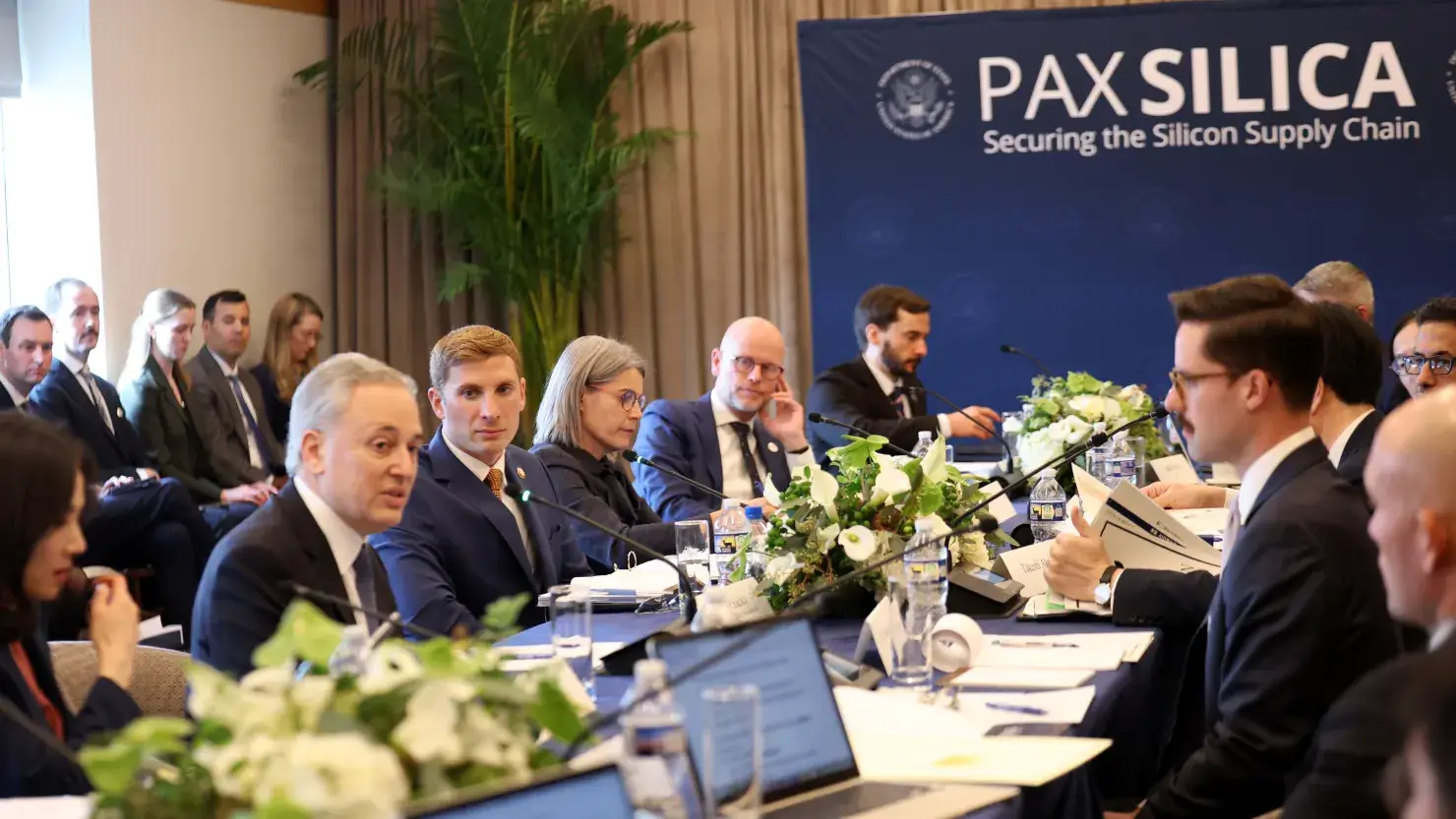
Summary
- A State Department draft, reviewed by Reuters, warns the 35 countries that signed the US “AI Opportunity Statement” in June 2026 that they may lose access to Washington’s AI coalition if they also join a rival Chinese framework.
- The letter does not name China directly, but it says signing the Pax Silica Declaration “cannot be held alongside membership in duplicative initiatives whose expectations conflict with our own.”
- Kazakhstan is the only country confirmed so far to have joined both Pax Silica and China’s World Artificial Intelligence Cooperation Organization.
- The draft is undated. Reuters could not confirm whether or when it will be sent, and the State Department declined to comment on it.
- China’s embassy in Washington says the pressure campaign will “stifle global AI advances and serve no one’s interests.”
What is actually happening
Washington is preparing to force a choice on dozens of countries caught between two competing AI alliances. According to a US official and an internal draft letter reviewed by Reuters, the State Department is getting ready to warn signatories of its AI Opportunity Statement that joining a rival China-backed group could get them cut out of the American-led coalition on chips, minerals, and advanced AI systems.
warning has not gone out yet. The document is undated, and Reuters could not determine whether the US intends to send it as written or revise it first. But the message inside is direct: allies cannot sit in both camps.
What does the draft letter actually say?
The draft urges the 35 signatories of the AI Opportunity Statement to “choose deliberately” on AI. It frames signing the Pax Silica Declaration as a real commitment, not a symbolic gesture. One line makes the stakes plain: “to be part of everything is to be part of nothing.”
The letter avoids naming China outright. Instead, it states that Pax Silica membership “cannot be held alongside membership in duplicative initiatives whose expectations conflict with our own,” according to the document Reuters reviewed.
A US official, speaking to Reuters on condition of anonymity because internal discussions are ongoing, said the goal is to close the door on countries trying to have it both ways. The official argued it is hard for any country to present itself as a trusted US tech partner while also backing a rival Chinese framework built to compete with that same partnership.
What is Pax Silica, and what is the AI Opportunity Statement?
Pax Silica is the State Department’s central push on AI and supply-chain security. The initiative was launched in December 2025, when Undersecretary of State Jacob Helberg convened its first high-level summit at the Donald J. Trump Institute of Peace in Washington, according to a report from Firstpost. The goal was to build a trusted circle of partners on critical minerals, energy, semiconductors, AI models, and advanced manufacturing, cutting reliance on rivals for the resources modern AI systems depend on.
By June 2026, around two dozen countries had signed the Pax Silica Declaration, and a separate, broader “AI Opportunity Statement” had picked up 35 signatories, including close US allies such as Japan, Australia, and South Korea. Countries in that statement have symbolically committed to a shared, pro-growth approach to AI policy alongside Washington. Pax Silica members go a step further, gaining access to shared investment opportunities in AI-related projects.
Strategy behind all of this is straightforward: lock in partners on the minerals, chips, and models that make advanced AI possible, and starve China’s AI ambitions of outside resources it could use for military or economic advantage.
Why is Kazakhstan the flashpoint?
Kazakhstan sits at the center of this dispute because it is the only country identified so far as a member of both camps. Washington welcomed Kazakhstan into Pax Silica in June 2026, calling it the first Central Asian country to join and pointing to its large reserves of critical minerals used in advanced technology and chip manufacturing.
That same country is also a founding member of China’s rival AI group. The overlap has raised real concern inside Washington. As the US official put it to Reuters, it is difficult to see how a country can credibly call itself a trusted partner in one technology ecosystem while backing an initiative China built to advance a competing vision for AI. The Kazakh embassy in Washington did not respond to a request for comment on the matter.
What is China’s World Artificial Intelligence Cooperation Organization?
In July 2026, Chinese President Xi Jinping launched the “World Artificial Intelligence Cooperation Organization” at the World Artificial Intelligence Conference in Shanghai. An official Chinese report said 29 countries signed on as founding members. The organization is headquartered in Shanghai and is pitched by Beijing as an open platform for global AI cooperation, with a particular focus on giving developing nations a bigger seat at the table on AI governance.
Reuters described the move as part of a broader Chinese push to promote its open-weight AI technology as a real alternative to American systems. That push comes as Chinese open-weight models have closed ground fast against proprietary systems built by US firms such as OpenAI and Anthropic, adding urgency to the wider contest for AI leadership.
What has China said about the US pressure?
China’s embassy in Washington pushed back hard when asked about the draft letter. An embassy spokesperson said Beijing opposes turning trade and technology into political weapons, adding that “such actions will only stifle global AI advances and serve no one’s interests.”
The State Department, for its part, told Reuters it would not comment on what it called “purportedly leaked internal documents.”
What remains unconfirmed?
| Confirmed | Unconfirmed |
|---|---|
| The State Department published the AI Opportunity Statement, with 35 listed signatories | Whether the draft letter will actually be sent |
| The Pax Silica Declaration had 24 signatories after the June 2026 summit | The final wording of any letter that does go out |
| China announced the World Artificial Intelligence Cooperation Organization, with 29 founding members | How any exclusion from US-led cooperation would actually be enforced |
| Kazakhstan has joined both initiatives | Whether other countries also hold dual membership |
What’s on the public record right now is a draft document and comments from one anonymous official, not a finalized policy or a letter that has actually gone out. That distinction matters for any country trying to figure out how seriously to take the warning.
What this means going forward
The US-China contest over AI supply chains has moved into a sharper phase. Washington is trying to lock down partners on minerals, chips, and models before China’s rival platform gains more members. Beijing, meanwhile, is positioning its own framework as more open and more attentive to the needs of developing countries.
If the letter goes out as drafted, it would turn a straightforward technical partnership into something closer to a loyalty test. For countries hoping to keep a foot in both camps, the practical question becomes whether that is even possible, or whether access to one bloc now requires formal distance from the other.