China Completes Earth-Moon Laser Communication Test at 100 Mbps
 Skasif
30/08/2026
Skasif
30/08/2026 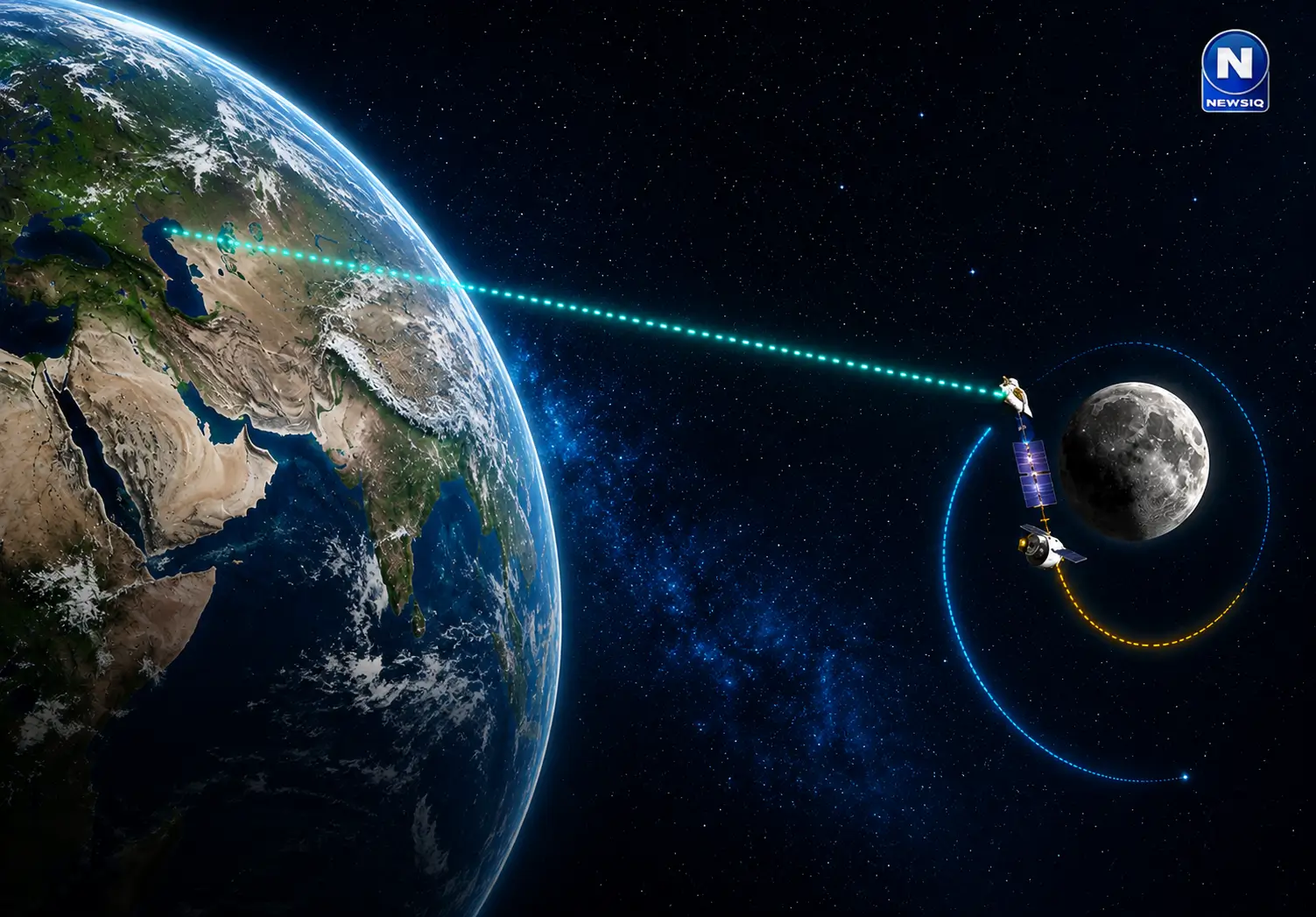
China’s DRO-A satellite testing a two-way laser communication link between Earth and lunar space across more than 400,000 km.
Chinese researchers completed a verified Earth-Moon laser communication test over 400,000 km using the DRO-A satellite. The Technology and Engineering Center for Space Utilization reported a 100 Mbps downlink and 1.25 Mbps uplink on August 29, 2026. This milestone expands China’s optical space network into cislunar space to support future lunar missions with high-bandwidth data transmission that traditional radio links cannot sustain.
Chinese researchers have successfully tested a two-way Earth-Moon laser communication link across more than 400,000 kilometres.
The Technology and Engineering Center for Space Utilization (CSU), part of the Chinese Academy of Sciences, announced the verified results on August 29, 2026. Using the DRO-A satellite in distant retrograde orbit, the team achieved a downlink speed of 100 Mbps and an uplink speed of 1.25 Mbps.
The test expands China’s space laser communication capabilities beyond near-Earth orbit and into cislunar space—the region between Earth and the Moon.
That matters because future crewed lunar missions, research stations, rovers and scientific instruments will generate far more data than conventional radio systems can efficiently handle. According to the research team, a 100 Mbps optical downlink could transmit a high-resolution 8K lunar image in about 12 seconds. A standard 5 Mbps microwave link could take four to five minutes.
The result provides an important engineering baseline for China’s planned lunar communication infrastructure. But it is still an experimental test, not a complete operational network.
Verified Speeds: 100 Mbps Downlink and 1.25 Mbps Uplink
The CSU published the results after more than a year of continuous in-orbit testing.
The verified transmission rates were:
Downlink from DRO-A to Earth: 100 Mbps
Uplink from Earth to DRO-A: 1.25 Mbps
Communication distance: More than 400,000 km
Yang Lei, a CSU researcher and head of the laser test team, confirmed these figures in reports published by Xinhua and the Chinese Academy of Sciences.
Some early media reports mixed up the uplink and downlink values. Later official corrections consistently confirmed the final configuration: 1.25 Mbps uplink and 100 Mbps downlink.
The speed is a major improvement over the radio link used in the same orbital environment. Yang said a traditional microwave system operating at around 5 Mbps would need four to five minutes to transmit one 8K image. The laser link could send it in roughly 12 seconds, which is why the team described the system as an “information highway.”
However, the 100 Mbps result should be viewed in context. NASA’s Lunar Laser Communication Demonstration (LLCD), carried by the LADEE spacecraft in 2013, achieved a 622 Mbps downlink.
China’s test is significant for a different reason: it is the country’s first published in-orbit verification of a two-way, high-speed laser link at this distance. The two missions used different hardware, designs and test conditions, so their headline speeds are not a direct measure of overall capability.
How the Earth-Moon Laser Link Works
Building a stable two-way laser link at lunar distance means solving several difficult problems at the same time. Yang compared the task to threading a needle from a thousand miles away.
A tiny pointing error on Earth could cause the narrow laser beam to miss the spacecraft by kilometres by the time it reaches lunar space.
1. Keeping the Laser Precisely Aligned
The satellite is constantly moving, while Earth’s atmosphere bends and distorts light. Small mechanical vibrations, telescope movement and atmospheric turbulence can all push the beam away from its target.
To maintain alignment, the team developed a custom acquisition and tracking system. It combines:
Real-time orbital data
Telescope flexure compensation
Atmospheric refraction models
Optical propagation delay calculations
Light takes about 1.3 seconds to travel one way between Earth and the Moon. That means the system cannot simply aim at the satellite’s current position. It must predict where the spacecraft will be when the laser arrives.
Yunnan Astronomical Observatory built the ground-based optical and tracking system. Zhejiang Lab developed the satellite’s optical-mechanical equipment, while the CSU built the onboard processor that helps coordinate both ends of the link in real time

2. Detecting an Extremely Weak Signal
After travelling more than 400,000 km, the returning laser beam spreads out and becomes extremely weak. Ground telescopes may receive only a few photons at a time.
Moonlight, starlight and city lights add background noise, making the signal even harder to detect. The CSU compared the challenge to hearing a pin drop in a busy market.
To recover the data, the Shanghai Institute of Microsystem and Information Technology supplied superconducting nanowire single-photon detector arrays. These highly sensitive detectors can register individual photons at high speed while producing very little internal noise.
Signal-processing algorithms then separate the communication data from the surrounding light. Together, these systems allowed the team to maintain a stable connection at the reported speeds.
3. Maintaining Speed Without Losing Data
Weak signals usually force engineers to lower transmission speeds to reduce errors. The team used high-bandwidth signal processing and specialised coding methods designed for low-photon conditions.
This allowed the system to maintain a 100 Mbps downlink without losing packet integrity during the reported test window.
DRO-A Satellite and Its Role
The laser terminal was installed on the DRO-A satellite, which operates in a distant retrograde orbit (DRO) within the Earth-Moon system.
This type of orbit is relatively stable and remains far from both Earth and the Moon. Its stability and visibility make it useful for future relay satellites, navigation networks and deep-space gateways.
DRO-A and its twin satellite, DRO-B, launched in March 2024. An upper-stage failure disrupted their planned journey, but the mission team used onboard propulsion and a long, low-energy transfer path to guide the spacecraft into their intended orbit months later.
A third spacecraft, DRO-L, operates in low Earth orbit. In April 2025, the three satellites formed a measurement and communication network.
DRO-A also carries conventional microwave radio equipment with a reported data rate of about 5 Mbps. The laser terminal works alongside that system as a higher-speed channel. This gives engineers a direct way to compare radio and optical communication in the same orbital environment.
The project is part of a Chinese Academy of Sciences A-class strategic pilot programme focused on distant retrograde orbit exploration. The broader programme is testing technologies that could support long-term operations in cislunar space.
Why Future Moon Missions Need Faster Communication
Today’s robotic orbiters already send large volumes of images and scientific data to Earth. Future crewed landings and permanent research stations could increase that demand dramatically.
Possible data sources include:
Live and recorded video feeds
Astronaut suit telemetry
High-resolution rover maps
Scientific instrument data
Navigation and safety information
Communication between surface crews, orbiters and Earth
Radio communication remains reliable, but its available spectrum and data capacity are limited. Larger radio antennas also add weight and power requirements to spacecraft.
Laser terminals can deliver higher data rates using smaller and lighter equipment. Those savings in mass and power are valuable for missions where every kilogram matters.
The CSU said the new optical link could eventually support crewed lunar landings, research stations and later deep-space missions.
China is not alone in developing this technology. NASA has tested laser communication from low Earth orbit, lunar orbit and deep space. European and Japanese researchers have also studied optical relay systems for lunar missions.
Rather than replacing radio completely, laser communication will probably work alongside it. Radio is still essential for commands, basic telemetry and backup communication. Optical links are better suited to transferring large volumes of data during suitable connection windows.
Current Limits of China’s Lunar Laser Communication Test
The published transmission rates are described as preliminary. The CSU said the test provides a foundation for faster communication in future trials.
Several important technical details have not yet been made public, including:
Bit-error rates at 100 Mbps
Total duration of the stable link
Performance across full orbital passes
Weather-related connection losses
Long-term system reliability
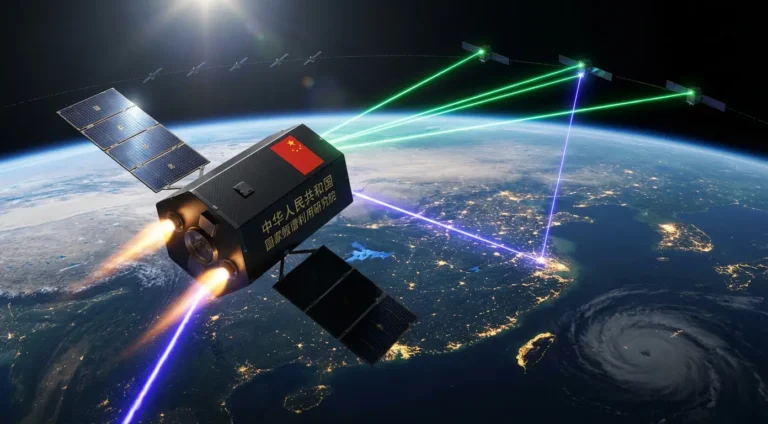
Laser communication also has one major practical weakness: thick clouds can block the beam.
Ground stations therefore need clear skies, or operators need a network of stations in different locations. The reports identify Yunnan Astronomical Observatory as the main optical ground site, but they do not describe a wider international network that could reduce weather-related outages.
It is also important to note that this was a link between Earth and a spacecraft in lunar space. It was not a direct laser connection to a lander or research station on the Moon’s surface.
A future lunar base would still require its own surface terminal, a relay satellite, or both. This experiment validates the Earth-to-orbit part of that future system.
Plans for crewed landings and lunar research stations also remain future goals, not fixed operational schedules. The expected increase in data demand is driving the technology, but engineers still need to prove that the link can handle sustained traffic under real mission conditions.
What Happens Next?
The next set of tests will show whether the system can move from experimental verification towards practical infrastructure.
Key developments to watch include:
Stable communication across full orbital passes
Published bit-error rates at 100 Mbps
Higher downlink speeds without losing the optical lock
More ground stations for better weather resilience
Integration with other DRO network satellites
Multi-node routing between Earth, orbiters and future lunar assets
For now, the verified result is clear: after more than a year of in-orbit testing, a Chinese research team established a two-way Earth-Moon laser link across more than 400,000 km.
Using the DRO-A satellite and superconducting single-photon detectors, the system achieved a 1.25 Mbps uplink and a 100 Mbps downlink. It is a real step towards faster lunar communication—but it is the first section of the highway, not the finished network.