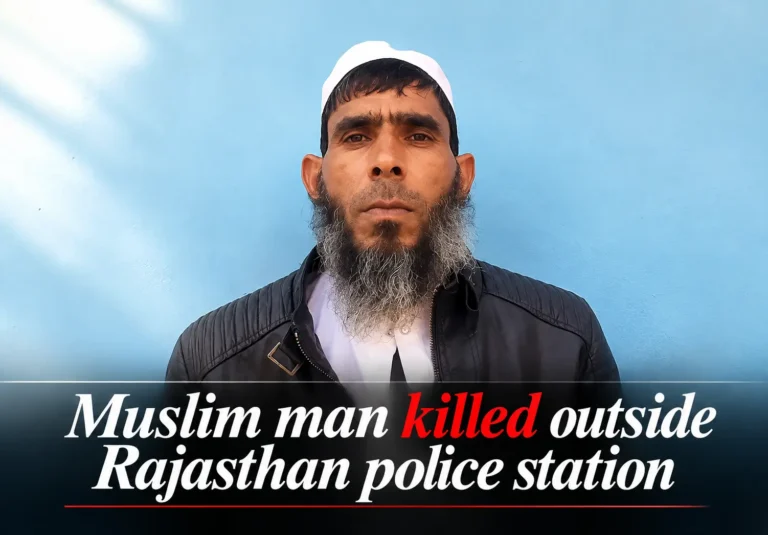
Muslim Man Saikun Khan Killed Outside Rajasthan Police Station
 Skasif
26/09/2026
Skasif
26/09/2026 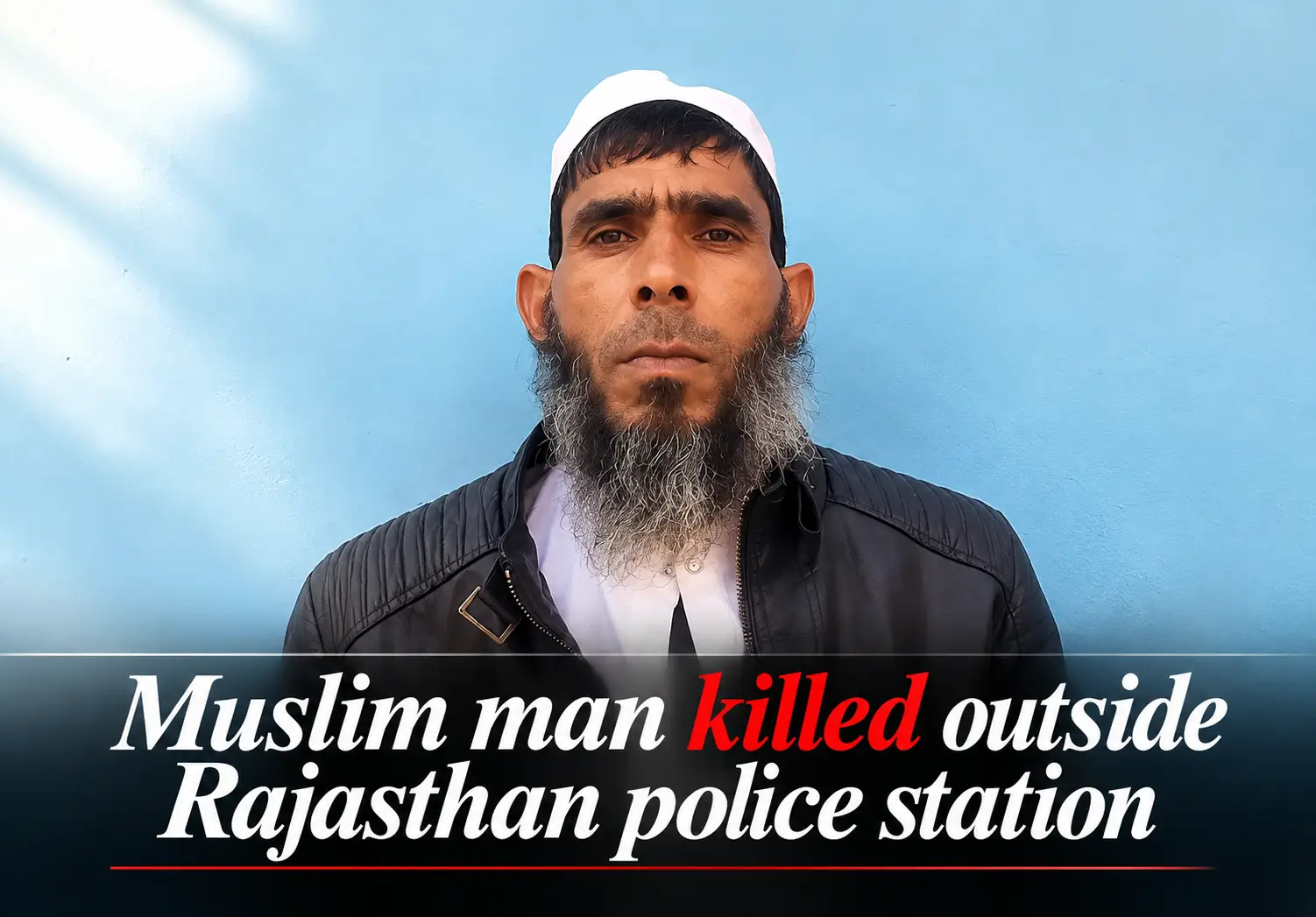
Saikun Khan, 40, was killed with a stone outside Baroda Meo police station in Alwar, Rajasthan, on Sept. 24, 2026. Credit: The wire
Summary
- Saikun Khan, 40, a Muslim farmer from Barawas village, was killed with a stone outside Baroda Meo police station in Alwar on September 24.
- Police arrested a local man, identified by The Times of India as Harsh Moortikar, and registered a murder case.
- Khan’s family says he was targeted for being Muslim pointing to his beard and skullcap as visible markers.
- A local Panchayat chief alleges the accused was inside the station earlier that day after a fight with his father, and police let him go without acting on a threat police deny this.
- Relatives and villagers protested at the hospital and station, demanding compensation and suspension of station staff; a road was blocked.
- Opposition leader Tika Ram Jully attacked the state government over law and order following the killing.
ALWAR, Rajasthan — Saikun Khan murder has triggered protests and questions about police protection after the 40-year-old Muslim farmer was fatally attacked with a stone outside Baroda Meo police station on September 24, 2026. His family believes he was targeted because of his religious identity. Police have arrested a local man, registered a murder case and rejected a communal motive.
Khan had left his home in Barawas village that morning to buy a motorcycle tire. He told his family he would return soon to tend the onion crop he had planted. Instead, his family received news that he had suffered a fatal attack outside a police station.
Reporting by The Wire and The Times of India documents the killing, the arrest and the protests that followed. Their accounts also reveal conflicting claims about the motive, the accused’s movements before the attack and the police response.
Saikun Khan’s Alwar Market Trip Ended in a Fatal Attack
Khan was a farmer from Barawas village in Rajasthan’s Alwar district and the father of two daughters and a son. According to his family’s account to The Wire, his son is a minor.
On the morning of the killing, Khan traveled to Baroda Meo, about 10 kilometers from his village, with another villager. The Wire reported that they were using the other villager’s motorcycle while Khan planned to purchase a tire for his own two-wheeler.
The Times of India identified his companion as Noor Mohammad and reported that Khan dropped him at a bank before continuing toward the market.
His father, Nasru Khan, told The Wire that a man suddenly struck Khan on the head with a heavy stone outside the police station’s gate. Khan fell, and his legs became trapped beneath the motorcycle. According to Nasru, the attacker then continued striking his son’s head.
The Times of India placed the attack at approximately 10 a.m.
Police told The Wire that Khan was initially taken to the community health center in Baroda Meo and subsequently referred to a larger hospital in Alwar. He died before reaching Alwar.
Alwar Police Station Stone Attack: What Police Say
Police identified the accused as a local man named Harsh. The Times of India named him as Harsh Moortikar and reported that he and Khan had no prior acquaintance.
The reports differ on his age: The Wire described him as 21, while The Times of India reported that he was 25. That discrepancy remains unresolved in the supplied reports.
Alwar Superintendent of Police Sudheer Choudhary told The Times of India that the accused had given no specific reason for targeting Khan.
“It appears to be a random act of violence,” Choudhary said.
Choudhary also said police had found no communal angle. According to the same report, officers said the accused had previously fought with his father and had cuts on his body when he was arrested.
Alwar Additional Superintendent of Police Priyanka Raghuvanshi separately confirmed to The Wire that a murder case had been registered.
Medical Examination Planned for the Accused
Police said they would constitute a medical board to examine the accused’s mental condition.
Raghuvanshi told The Wire that his behavior after arrest included shouting and threats against police and his father. She said officers would establish his mental condition through medical examinations rather than simply accepting his statements.
The supplied reports contain no completed medical assessment. Descriptions of his behavior are police observations, not a confirmed diagnosis or an established explanation for the attack.
Family Alleges Religious Targeting in Saikun Khan Murder
Khan’s relatives dispute the police account that there was no communal motive.
His younger brother, Irshad Khan, told The Wire that Khan had no known enmity with anyone. The family suspects that his beard and skullcap made his Muslim identity apparent to the attacker.
“We suspect he was killed because it was evident from his attire that he was a Muslim,” Irshad told The Wire.
The allegation places the question of motive at the center of the family’s demand for answers. Relatives described a man whose daily life revolved around farming, worship and his children.
Police rejected the religious-targeting claim. Raghuvanshi told The Wire that the family’s initial complaint did not mention such a motive.
The accounts therefore remain in direct conflict: the family suspects an attack based on religious identity, while police describe the killing as having no communal angle. Neither the supplied reports nor the statements they contain provide a court determination of motive.
Baroda Meo Police Station Murder Raises Questions About Earlier Events
The killing has also prompted allegations about whether police encountered the accused before Khan was attacked.
Sher Mohammad Meo, chief of the Meo Panchayat, told The Wire that he had been informed the accused was brought to the station following a quarrel with his father.
According to his allegation, the accused threatened to kill someone after being allowed to leave, but police failed to act. Sher Mohammad said Khan was subsequently attacked outside the station’s gate.
This account raises a separate issue from motive: whether there had been an earlier warning of violence and whether officers had an opportunity to intervene.
Police Dispute Claims About the Station Visit and Response
Raghuvanshi said police were investigating the allegation that the accused had previously been brought inside Baroda Meo police station. She told The Wire that a preliminary inquiry had found nothing supporting that claim.
She also disputed suggestions that officers failed to respond. According to her account, the attack location was not visible from inside the station, and police rushed outside after hearing cries for help and separated the accused from Khan.
The family’s account and the police version differ over the response. The supplied reporting does not establish an independently verified timeline of when officers became aware of the attack or reached Khan.
Saikun Khan Family Protest Draws Villagers to Hospital and Station
The killing of the Muslim farmer in Rajasthan brought relatives and villagers onto the streets.
The Times of India reported that crowds gathered outside Alwar district hospital and Barodamev police station, another spelling used for Baroda Meo. Protesters demanded compensation for Khan’s family and the suspension of the station’s entire staff.
The report described alleged scuffles with police and a blockade of the Alwar-Bharatpur road that caused long lines of vehicles.
Additional police teams were deployed from Govindgarh, Bagad Tiraya, Ramgarh and Laxmangarh to manage the situation.
The Wire also reported a sit-in and demands for action against the accused. The supplied reports do not confirm that compensation had been awarded or that any police personnel had been suspended.
Tika Ram Jully Questions Rajasthan’s Law and Order
The incident drew criticism from the opposition Congress, with Rajasthan Assembly opposition leader Tika Ram Jully questioning public safety under the BJP-led state government.
Jully said the killing outside a police station showed that criminals no longer feared the law. He criticized the state government and Alwar police, arguing that people should be able to expect protection near a police station.
His remarks focused on the location of the attack and the authorities’ responsibility to protect the public.
Those criticisms form part of the political response to the killing. They do not independently establish the attacker’s motive or resolve the conflicting accounts of police conduct.
What Remains Unresolved in the Saikun Khan Murder Case
The available reports establish that Khan suffered a fatal stone attack outside Baroda Meo police station, that police arrested an accused man and that a murder case was registered.
Several questions remain unanswered: what evidence supports the police conclusion about motive, whether the accused visited the station before the attack, whether any threats were made and what the medical examination will establish.
The police response also remains disputed. Further reporting would need to establish whether station records, available footage or witness statements support either account.
For Khan’s family in Barawas, those questions follow the loss of a father who left home for an ordinary market trip. His children and relatives are seeking accountability for a killing that happened just outside the place where residents would ordinarily expect police protection.