GLM-Image Launches: Z.ai’s Open-Source Model Sets a New Text Rendering Standard
 Skasif
14/01/2026
Skasif
14/01/2026 
GLM Image unveiled as a new open source AI model focused on accurate text rendering and image generation
A Major Step Forward for Text Inside AI Images
Z.ai has officially unveiled GLM Image, and the model is already making a strong impression across the AI community. While many image generation tools still struggle with readable words, distorted letters, or broken layouts, GLM Image shows that accurate text inside images is no longer limited to closed or paid systems.
From posters and infographics to tutorials and social media visuals, text accuracy is one of the biggest remaining challenges in image generation. GLM Image directly targets this gap and does so as a fully open source release.
The research team behind Z.ai has long been associated with advanced language and multimodal systems. With GLM Image, they bring that experience into practical visual generation that works well in real world use.
Built for Real World Use, Not Just Demos
GLM Image uses a hybrid design with a total of 16 billion parameters. Instead of relying on a single approach, it splits the work into two clear stages, each designed for a specific purpose.
The first stage focuses on planning and understanding. A 9 billion parameter autoregressive module predicts compact visual tokens that describe layout, meaning, and relationships. This stage is derived from a strong language focused base model, which helps GLM Image understand prompts clearly, including instructions that involve text placement, ordering, or multilingual content.
The second stage focuses on visual quality. A 7 billion parameter diffusion decoder takes those tokens and turns them into detailed images. It adds sharp edges, clean typography, realistic lighting, and surface detail. This balance allows the model to avoid common problems such as invented letters or warped words.
Because text is handled early in the process, GLM Image avoids many of the issues seen in pure diffusion systems where letters are treated as decoration rather than information.
Training Choices That Pay Off
The training process emphasizes clarity and structure. The model learns with semantic tokens that strongly correlate meaning with appearance. Training begins at lower resolutions and gradually moves to higher detail, ending with outputs that can be upscaled cleanly to 2048 pixels.
A lightweight character encoder improves Chinese text rendering, which shows clearly in benchmark results. Special attention mechanisms also help with image to image tasks, allowing users to preserve text, layout, or identity when editing existing visuals.
CVTG 2k Benchmarks Show Clear Leadership
Official evaluations highlight GLM Image strength in multi region images where text appears in several areas at once. This is one of the hardest tasks for image models.
CVTG 2k Average Word Accuracy Across Multi Region Images
| Model | Open Source | Average Word Accuracy | Notes on Multi Region Performance |
|---|---|---|---|
| GLM Image | Yes | 0.9116 | Strongest across 2 to 5 regions |
| Seedream 4.5 | No | 0.899 | Solid but trails on complexity |
| Z Image | Yes | 0.8671 | Good open alternative |
| Qwen Image 2512 | Yes | 0.8604 | Competitive |
| GPT Image 1 High | No | 0.8569 | Closed leader |
| Nano Banana 2.0 | No | 0.7788 | Moderate drop on more regions |
| SD3.5 Large | Yes | 0.6548 | Weak text handling |
| FLUX.1 dev | Yes | 0.4965 | Poor in dense text |
GLM Image maintains strong accuracy even when five separate text blocks appear in one image. Competing models show clear performance drops as complexity increases.
LongText Bench Confirms Strong Bilingual Performance
Text accuracy becomes even more important when dealing with long passages or non English languages. On LongText Bench, GLM Image performs strongly across both English and Chinese.
LongText Bench Results
| Model | Open Source | LongText Bench English | LongText Bench Chinese |
|---|---|---|---|
| Seedream 4.5 | No | 0.989 | 0.9873 |
| GLM Image | Yes | 0.9524 | 0.9788 |
| Nano Banana 2.0 | No | 0.9808 | 0.9491 |
| GPT Image 1 High | No | 0.956 | 0.619 |
Chinese score stands out sharply. While some closed models perform well in English, they fall behind when handling complex Chinese text. GLM Image closes that gap and proves valuable for global users who need accurate multilingual output.
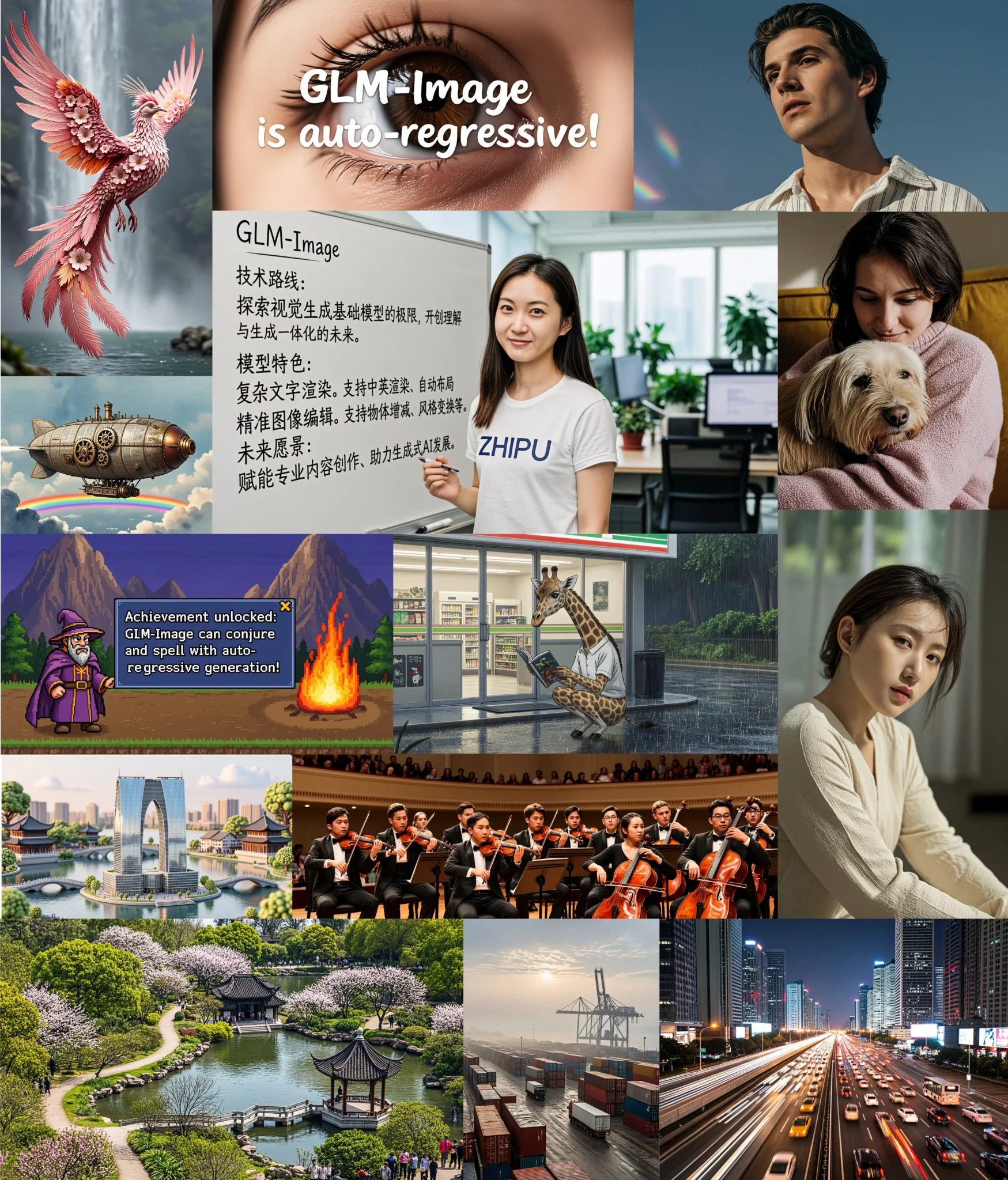
Visual Examples Show Everyday Strength
Examples shared by Z.ai highlight how this accuracy translates into real visuals. Modern architecture scenes include clean signage and readable labels. Step by step watercolor tutorials place captions exactly where expected. Fashion images combine sharp typography with detailed textures without visual conflict.
Community testing adds further confidence. Users report clean Japanese characters, stable multi subject scenes, and reliable edits when using reference images. Integration with popular interfaces appeared quickly, reflecting strong early adoption.
Fast Community Adoption and Open Access
The response on social platforms has been immediate. Developers shared local runs using quantized versions that fit comfortably on consumer hardware. While early builds are still being optimized for speed, many users note that prompt understanding and layout control already feel mature.
The MIT license allows commercial use, making GLM Image especially attractive for studios, designers, and educators who need reliable text without licensing restrictions.
All weights and tools are available through Hugging Face, with ready to use pipelines for text to image and image to image workflows.
A Signal of a Broader Industry Shift
GLM Image was trained entirely on domestic hardware using Chinese infrastructure. This demonstrates that cutting edge AI systems can now be built without reliance on foreign GPUs. Beyond technical achievement, this marks a strategic shift in how advanced models are developed and shared.
By releasing a strong model openly, Z.ai strengthens the global open source ecosystem and raises expectations for what free image generation tools can deliver.
Why This Release Matters
The demand for images that include readable words continues to grow across education, marketing, and social media. Until now, many creators relied on closed platforms to avoid broken text. GLM Image changes that balance.
It proves that open models can compete with and even outperform closed systems in one of the hardest areas of image generation. The hybrid approach offers a practical blueprint for future models that need both control and visual quality.
What Comes Next
Z.ai has hinted at further improvements through fine tuning and platform integration. With strong foundations already in place, future updates are likely to focus on speed, style diversity, and deeper editing control.
For the open source community, GLM Image raises the bar. It is not just a research release but a production ready tool that many creators can use today.
We will continue tracking updates to GLM Image and the wider movement toward open, high quality AI image generation.